You’d think Charles de Gaulle would have been a little bit more grateful to America.
As head of the Free French Forces during World War II, de Gaulle was essentially a leader in exile, and he had to base himself in England for the majority of the war after the Nazis took Paris.
It was only because of the sacrifices made by American troops– and exceptional generosity from US general Dwight Eisenhower– that de Gaulle was allowed to enter Paris on August 25, 1944.
America had already done all the fighting. But de Gaulle marched through the streets in triumph as if he had personally won the war.
The US government then went on to cement his power, so de Gaulle became head of France’s post-war provisional government, then later French president. France also received billions in aid from the Marshall Plan, courtesy of US taxpayers.
The guy pretty much owed his entire political career, not to mention the liberation and economic solvency of his country, to the United States.
But de Gaulle’s ego was far greater than his sense of gratitude; in fact in his own memoirs he compared himself to Joanne of Arc. He even whined that he didn’t receive enough US support.
The ultimate disrespect came on February 4, 1965. De Gaulle called a press conference to criticize America’s “exorbitant privilege” in global finance, concluding that the world needed to return to a classical gold standard.
Ever since July of 1944, the world had been on the “Bretton Woods” system. Every currency was pegged to the US dollar, and the US dollar was pegged to gold at a price of $35 per ounce.
Having the global reserve currency meant that America could finance its government deficits by simply printing more money. This is still the case today. De Gaulle was jealous of this benefit, so he tried wrecking the financial system.
In addition to demanding a return to the classical gold standard, de Gaulle also insisted that the US government redeem France’s dollar reserves for gold.
The idea caught on. Governments around the world, along with financial speculators and investors, started paying attention… and many began trading their dollars for gold as well.
This trend picked up steam over the next several years until, finally, in 1971, Richard Nixon shut it down… announcing that the United States would no longer redeem US dollars for gold.
The gold price naturally started to rise. Within a few months, gold was already above $40, up 13.5%. It reached $60 in 1972 (up 42%), nearly $100 in 1973 (up 66%), and $180 in 1974 (up 80%).
It’s not hard to understand why. Inflation was soaring. The world was a geopolitical hot mess. Then there was the Nixon political scandal at home. Uncertainty abounded, and gold was the remedy.
But then something interesting happened: Congress passed a law finally allowing private ownership of gold.
It seems crazy today, but ever since 1933, it had actually been illegal for Americans to own gold. Congress reversed this in 1974.
So just imagine you’re an average American in the 1970s watching gold rise more than 5x, from $35 to $180… but you can’t do anything about it because it’s illegal to buy. Then suddenly the law changes. Almost overnight, US investors started aggressively investing in gold.
Back then, of course, people didn’t have brokerage accounts, let alone access to futures exchanges. And there were no ETFs.
So instead people bought physical gold coins– Krugerrands, Eagles, etc. And there was booming demand for a while.
But right around this time, large investors, hedge funds, etc. started feeling like gold was overbought… and that the price had risen too far, too fast. So they started selling. In fact many funds were selling as small retail investors were buying.
And as you can imagine, the gold price soon started to fall; in fact the correction lasted roughly 18 months. Gold eventually hit a low of ~$100 in August 1976– a drop of more than 40% from its record high in 1975.
Yet even though speculators were selling, the fundamentals of gold had not changed.
Specifically, foreign governments and central banks were still seeking to diversify from their US dollar holdings. And more importantly, the US government financial condition was still atrocious.
So after an 18-month hiatus, the gold price started rising again in August 1976… from ~$100 to $800+ in December 1979.
So even though gold had reached a record high in 1974, people who understood the long-term fundamentals, i.e. why the gold price was going higher, saw an additional 4x return. People that were smart enough to buy more when the price fell did even better– 8x in less than four years.
And people who sold their gold in 1975 missed the rise from $185 to $850.
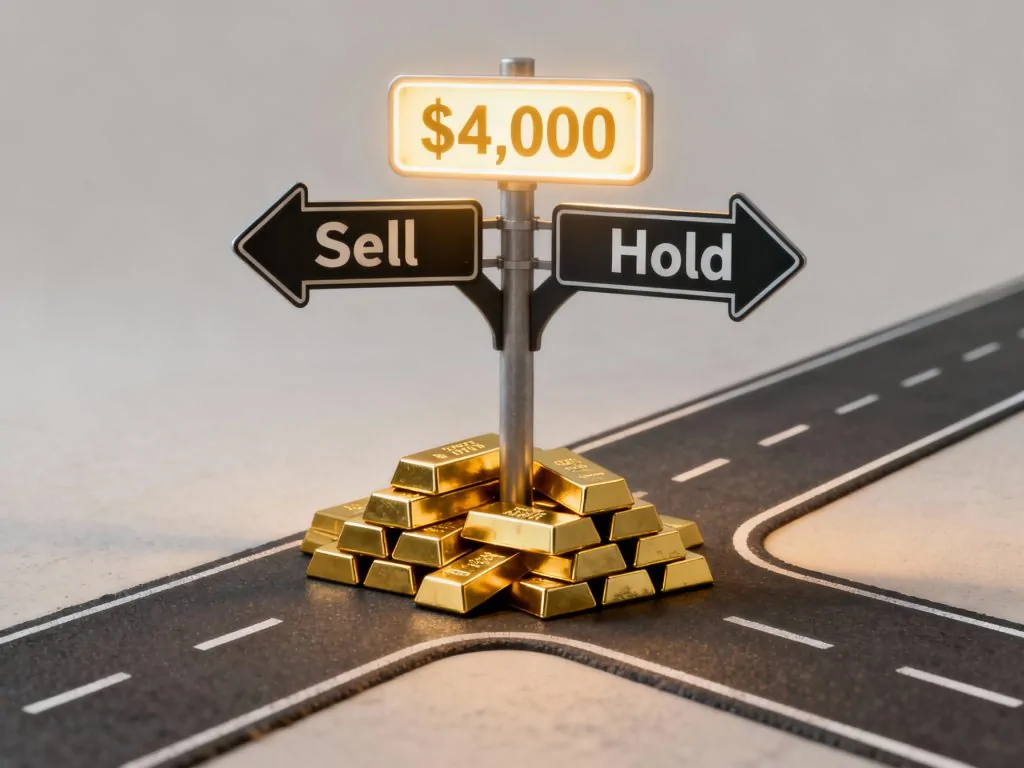
Gold just hit $4,000 today. It’s up more than 50% in a year, and up 100% in two years. So is it time to sell?
In our view, this is like 1975 again. Gold may be overbought now; after all, nothing is supposed to go up (or down) in a straight line.
We’re also seeing interesting data from ETFs. The “GLD”, for example, the world’s largest gold ETF, is seeing record inflows, including more than $2 billion in a single day last month.
This is a sign that, just like 1975, individual investors are piling in to gold after sitting on the sidelines for the past few years.
Strong, sudden retail demand is often a top signal, at least temporarily. And it’s possible that there could be a short-term correction.
But even if that happens, it doesn’t change the fundamental story of gold. Just like the 1970s, foreign governments and central banks today are aggressively diversifying their US dollar holdings, and gold is the most convenient asset for them to buy.
We don’t believe this has changed at all. Foreign governments and central banks might pull back on their purchases temporarily to see what happens in the market. But long-term they are still strong buyers of gold thanks to the US government’s terrible fiscal trajectory.
And despite any short-term corrections, this is what will ultimately drive gold prices higher over the next several years.