
It was only ten weeks ago that the US national debt crossed $37 trillion for the first time. Now, less than three months later, the national debt is set to surpass $38 trillion this week.
That’s a simply insane rate of increase— another $1 trillion added to the debt in just ten weeks.
This should be front-page news everywhere in America. The fact that it barely registers a mention, even in the most prominent financial media, suggests a dangerous level of complacency about the US national debt.
The complacency is so high, in fact, that the venerable Wall Street Journal published an article back in July essentially poking fun of people who are concerned about the debt.
The article quoted conservative deficit hawks in the 1980s and 1990s who warned that America’s excess debt (even decades ago) would lead to a major financial crisis.
The newspaper’s implication seemed to be that, because the big debt crisis never occurred 30-40 years ago, any fears about today’s debt burden must also be wrong.
One of the most common lies that the complacent class likes to recite about America’s gargantuan national debt is that “it doesn’t matter because we owe it to ourselves.”
This assertion is, quite simply, an outrageous falsehood. Let’s start with the facts:
Approximately $7.4 trillion out of the $38 trillion US national debt (19.4%) is what’s known as “intragovernmental holdings”.
This is the money that people claim “we owe to ourselves”, and it is primarily comprised of money that is owed to the likes of Social Security, Medicare, and various other trust funds ranging from veterans care to military retirement to the highway trust fund.
Let’s consider Social Security— which just itself is owed trillions of dollars. For decades, Social Security brought in more income (via payroll tax revenue) than it spent on retiree benefits. And that extra surplus was invested in US government bonds.
So in other words, the Treasury Department owes Social Security (i.e. every current and future retiree in America) trillions of dollars.
By saying “the debt doesn’t matter because we owe it to ourselves” almost suggests that it’s somehow OK to default on Social Security, i.e. to rob current and future retirees of their promised benefit.
That doesn’t seem OK to me. But if that’s what the complacent class truly believes, I wish they’d have the guts to just come right out and say so.
Ditto for military retirement, Medicare, etc. Defaulting on the debt that the government “owes to itself” means defaulting on US citizens, veterans, etc.
Yet still, even if one still concludes that defaulting on intragovernmental debt is harmless, there’s still the tiny issue that upwards of 80% of the US national debt is owed to others.
Nearly $10 trillion is owed to a handful of foreign governments and central banks including Japan, China, Norway, etc. Defaulting on foreign creditors would trigger a severe global financial crisis, not to mention the US dollar would cease being the world’s reserve currency practically overnight.
Trillions more are owed to US commercial banks, money market funds, pension funds, and insurance companies. Defaulting on them would cause a US financial crisis that would make the Great Depression seem mild by comparison.
The bottom line is that debt is debt. It doesn’t matter to whom it is owed— Social Security, the FDIC, Wells Fargo, the European Central Bank, or my own mother— it must still be paid. Failure to pay would result in catastrophic consequences.
Unfortunately given the government’s current spending trajectory, the debt will become much worse.
By the way, this isn’t some doom-and-gloom analysis or wild conspiracy theory. The Congressional Budget Office’s own “Long-Term Budget Outlook” forecasts America’s debt-to-GDP ratio rising “every year” for the next thirty years.
Today, in 2025, America’s ratio of public debt (which disingenuously excludes intragovernmental holdings owed to Social Security, Medicare, etc.) to GDP stands at 100%.
By 2035, just a decade from now, they forecast the public debt to GDP at 118%. Then 136% by 2045. Then 156% by 2055.
So even after adjusting for US economic growth (and hence rising tax revenues), the national debt just keeps getting larger.
The reason this matters so much is because the debt has to be serviced. Interest must be paid each year.
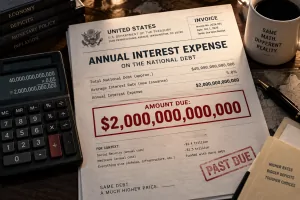
In the fiscal year that just ended on September 30ths (Fiscal Year 2025), the government spent more than $1.2 trillion… just to pay interest on the debt. That’s 23% of tax revenue.
And by the way, another 50% of tax revenue was spent on Social Security and Medicare… which doesn’t even include all the other “mandatory entitlement” spending like welfare.
These numbers all grow each year. Interest payments in particular are growing at an alarming rate. At current trajectory, in fact, the government’s annual interest bill will likely eclipse 40% of tax revenue within 8-10 years.
The implications are obvious— when the government has to spend the bulk of its tax revenue just to service the debt, it means there’s substantially less money for everything else, from military spending to border patrol.
Now, the White House hopes to be able to reduce its annual interest bill by slashing interest rates.
Think about it— even with a $38 trillion national debt, if the average interest rate is just 0.5%, the annual interest bill (at < $200 billion) is extremely manageable.
But realistically the only way to do this is for the Federal Reserve to ‘print money’ (i.e. expand the money supply through Quantitative Easing). This would essentially require the Fed to create tens of trillions of dollars to refinance the national debt.
Remember when the Fed created ~$5 trillion during the pandemic? We got 9% inflation. How high will inflation go if the Fed has to print $30 or $40 trillion? No one knows, but it’s probably not going to be 2%.
PS– This is exactly the reason why gold is rising. Foreign governments and central banks in particular are worried about the national debt, and what that means for their dollar holdings.
But I know for a lot of people it’s hard to buy gold at $4,000— which is why in our investment research we have focused on finding wildly profitable deeply undervalued gold companies.
One of our favorites will be making money hand over fist and trading at 5x earnings even if gold drops to $3,000 per ounce.
Click here to learn more and lock-in a limited time discount.