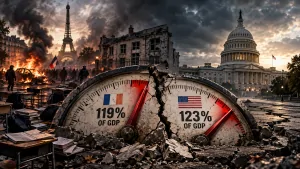

The Senate passed the “Big Beautiful Bill,” and it’s about to make America’s financial house of cards a whole lot shakier.
Already today interest on the national debt costs more than the entire— very large— defense budget. The runaway national debt is literally a matter of national security.
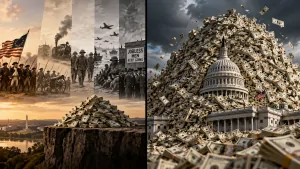
And the bill will add about $3 trillion to the national debt over the next decade, in addition to the $22 trillion the Congressional Budget Office already-projects for the same period.
Do the math, and by 2033, the US national debt will hit a jaw-dropping $56 trillion.
And that’s only if they decide not to pass another big beautiful budget buster next year. It assumes control of the government doesn’t swing in 2028 giving the Left another shot at free college, universal basic income, reparations, or a green new deal.
But why are we so focused on 2033 in particular?
Because that’s also the year when Social Security’s biggest trust fund runs out of money.
The Social Security Administration circles a date each year in its official report, signed by the Secretary of Treasury. That date tends to inch closer each year.
Based on the promises of various politicians NOT to touch Social Security, it’s very likely this problem will be ignored until it becomes a major funding crisis.
By 2033, we also forecast that interest payments on the national debt could devour more than half of all tax revenue.
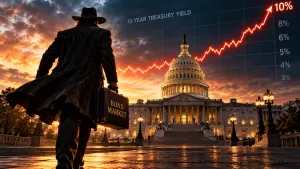
Foreign investors, already uneasy, will likely continue to sell their US government bonds, putting pressure on the Federal Reserve to “print” trillions of dollars to bail out the Treasury Department. This would almost certainly trigger massive inflation.
Then come the social consequences.
History shows that economic depressions like these lead to crime spikes—especially property crimes and theft. Riots erupt in cities across the country, sparked by shrinking benefits and deep economic anxiety. Local governments declare bankruptcy, unable to keep up with exploding costs and plunging tax revenues.
And into that vacuum steps an invigorated political movement: Socialism 2034.
Fueled by anger and desperation, it promises salvation through universal basic income, rent cancellation, and debt forgiveness. Capitalism is blamed for the crisis.
The calls grow louder for price controls, nationalizations, even capital restrictions.
I’m not saying it is going to play out exactly like this, but this is the trend that America is currently on. It’s hard to dispute the facts.
You and I don’t control Congress, the political parties, or Social Security. The only thing we can do is give ourselves the tools to respond to this— entirely predictable and avoidable— crisis from a position of strength.
That’s what a Plan B is all about.
And we talk about elements of this all the time.
Real assets—especially gold and other precious metals, but also economic necessities like industrial metals, energy, and productive technology—can help guard your wealth against inflation.
Second residency abroad can give you a place to go if your home country ever becomes too chaotic or dangerous.
And then there is financial diversification, so that all your savings isn’t under the control of one jurisdiction—especially when that jurisdiction is the US, the most indebted country in the history of the world.
Without serious reform, 2033 is when everything comes to a head—the debt bomb explodes, Social Security craters, and inflation goes nuclear. That means you have a hard deadline for having a portion of your wealth safely outside the United States.
Recent history is filled with examples, from Cyprus to Argentina, of countries in financial crisis implementing capital controls, withdrawal limits, and even wealth confiscation.
When confidence in government bonds evaporates and inflation spirals, it’s not hard to imagine Washington freezing capital outflows “temporarily” or simply forcing retirement accounts to buy “patriotic bonds” to fund Social Security.
By then, the window to move money abroad might be functionally closed.
It’s already becoming harder. Banks around the world have steadily tightened rules on Americans. Thanks to laws like FATCA and global information-sharing regimes, foreign banks now face enormous compliance burdens when dealing with US clients. Most don’t want the risk.
We detailed a few of the options still available in an international banking report we just released to our Total Access members (click here to learn more about our top tier membership).
The main takeaway: it’s far easier to open a foreign bank account when you don’t urgently need one.
If you wait until things get chaotic—whether that’s 2033 or earlier—it may be too late.
That’s why acting now, while the system still works, is crucial.
Foreign accounts aren’t about hiding money—in fact, US citizens generally must report foreign assets to the US government.
But they do let you store some of your savings in other countries, which gives you a legal barrier, and diversifies which jurisdictions can get their hands on your assets.
They give you flexibility if US banks freeze or restrict access. And they put you one step ahead of whatever “emergency measures” Washington dreams up next.