In 1909, a British journalist named Norman Angell published The Great Illusion, claiming that war between major global powers had become obsolete.
Nations were too interlinked, he argued. Capital was too entangled. Trade was too valuable. And no nation would put that prosperity at risk. War and conquest were things of the past.
But think about the world back then: Europe was in the middle of la Belle Époque, a stretch of unprecedented peace and prosperity. It had been nearly 40 years since the last major war (Franco-Prussian War) in 1871.
Gold-standard money moved across borders without friction. British capital financed German factories, German banks lent to Russian railways. And one of the largest trading relationships in the world was between supposed rivals Britain and Germany.
Mr. Angell’s book sold over two million copies; it was translated into 25 languages and became a fixture in educated households. Diplomats quoted it. CEOs planned around it. Angell’s conclusions seemed true, without question.
Then the Great War broke out five years later, and the world’s great powers went on to vaporize 16 million human beings and their collective economies. Global trade did not recover its 1913 level for roughly half a century.
Bizarrely, Angell later won the Nobel Peace Prize “for having exposed by his pen the illusion of war and presented a convincing plea for international cooperation and peace.” There would not be a less deserving recipient until Henry Kissinger and Barack Obama.
But this same mistake has been repeated again in our own time.
After the Soviet Union fell and American technology took the world by storm in the 1990s, it seemed that global peace and prosperity would last forever.
Even after 9/11 and the 2008 Global Financial Crisis, the world organized itself around America’s leadership.
The dollar was the world’s dominant reserve currency. The World Trade Organization tore down tariffs across the board. NATO and the United States Navy guaranteed no major power would risk war.
America supplied the security, the currency, and the rules; in exchange, the world traded and grew under an American-led system. Goods, capital, and supply chains ignored borders.
And for decades it worked reasonably well. But we’re now witnessing its breakdown in real time.
As I write this letter to you, gas stations in Asia are rationing fuel. Hospitals are running out of medical supplies. Major petrochemical producers in South Korea and Singapore (Yeochun and PCS) have declared force majeure, meaning they cannot fulfill their commitments to customers.
The cause is simple: the Strait of Hormuz has been closed for weeks.
The Middle East ships roughly 25% of the world’s polypropylene, 20% of its polyethylene, 25% of its sulphur, and 15% of its fertilizer. When that flow stops, factories stop. And remember that about half of what Americans buy comes from those same Asian factories.
Capital Economics, a global research firm, estimates that it could take three months for the resulting plastic shortages to spread globally, and four months until US automakers face aluminum shortages severe enough to cut production.
S&P Global’s April survey of manufacturers worldwide shows supplier delivery times lengthening at the fastest pace since August 2022.
Purchasing activity is near a four-year high as companies scramble to stockpile while they still can. Respondents are using “panic” and “emergency” buying language for the first time since the pandemic supply crunch— when Americans waited months for a new car, lumber prices tripled, and store shelves sat empty.
Yet rather than work together to ease the strain, governments are making it worse. With trust between major powers in collapse, every cross-border deal is now treated as a security threat… so they are blocking deals, capping technology transfer, and walling off entire industries.
China just blocked Meta’s $2 billion acquisition of an AI startup called Manus; Beijing argues that Manus was developed by Chinese founders with Chinese capital, and therefore an American giant cannot own it.
The United States has been doing the same thing for years— to its strongest allies, no less.
The Biden administration blocked Japanese company Nippon Steel’s $15 billion acquisition of US Steel on “national security” grounds, even though Nippon had offered to invest $2.7 billion of Japanese capital into Pennsylvania steel mills.
(Trump later reversed this, and the deal went through with additional government stipulations.)
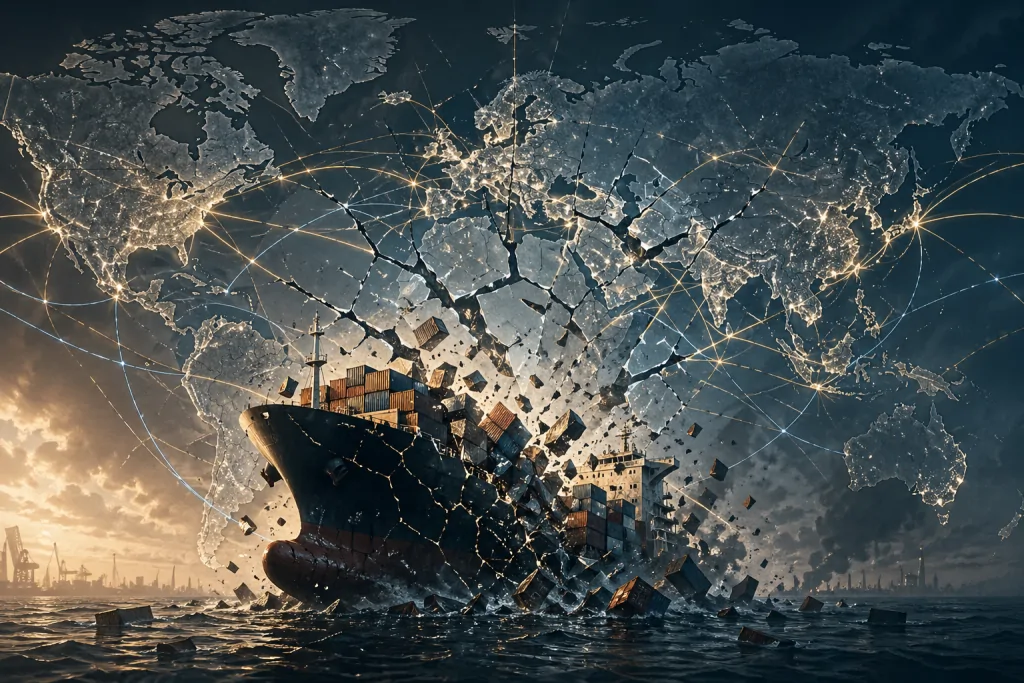
That is what de-globalization actually looks like in practice: not one dramatic rupture, but the slow accumulation of friction— a closed strait here, a blocked deal there, escalating tariffs, sanctions, “national security” reviews.
Stack enough of this friction together and the world looks entirely different.
Travel becomes harder and more expensive. Raw materials and finished goods become costlier. Specialization and trade become economic drags rather than efficiencies as nations are forced to make more things at home— including the goods that other countries can already manufacture more efficiently.
This is already happening, and it’s difficult to fix. It’s unlikely that anyone can wave a magic wand and bring back the geopolitical cooperation that fueled the world for decades.
The world is not coming to an end. Far from it. But it is changing rapidly.
Less cooperation, more conflict, and more tension has profound implications for future prosperity.
One of the obvious implications we see is that real assets— energy, food, gold, industrial metals— grow in value during times of conflict and global friction.
Tension and protectionism don’t reduce demand for any of them; they just make supply harder to get, so prices rise. When supply chains snap and borders tighten, these are the assets that benefit most.
So if you agree with our thesis, i.e. that the world is heading towards more conflict and less cooperation, real assets (and the companies which produce them) are an excellent hedge to offset that risk with financial gain.