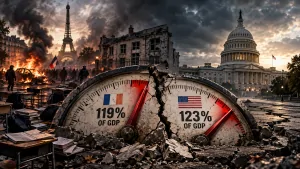
In early December 2001, ‘normal’ life very suddenly ceased to exist in Argentina— anything that remotely resembled a functional society came to an abrupt end. And that is by no means an exaggeration.
The banking system collapsed. Financial transactions ground to a halt. Desperate people looted supermarkets for food, and then grocery shelves emptied. Energy ran short. Riots broke out in the streets, and police were shooting citizens in the face.
The crisis raged so much that the President of Argentina fled the country by helicopter. Five presidents rotated through the office in two weeks. Then the country defaulted on $93 billion in sovereign debt— the largest default in history at the time.
Argentina was left in such a deep constitutional crisis that it didn’t even have the money or the legal framework to hold an immediate election.
This wasn’t exactly a surprise.
For years leading up to the crisis, Argentina had been struggling. The country was in the midst of a major economic depression. Unemployment was high. GDP was shrinking. Inflation was increasing. Crime was rising.
And yet, even with all of that negativity, life was at least in the ballpark of normal.
Basic services still functioned. Grocery stores had food. Banks were open and had money. And, even though unemployment was high, the vast majority of people still had jobs.
But it all collapsed in the span of three weeks. Poof. All because of too much debt.
To its credit, one of the groups that saw this coming was the IMF, which had warned the Argentine government multiple times about a looming crisis.
Even in early 2001, the same year as the crisis, IMF reports flagged Argentina’s soaring debt-to-GDP ratio, citing its “sharp deterioration in the public finances,” and deficits running well above the targets Buenos Aires had agreed to.
Well, the United States just received the same warning from the IMF last week. Even the language in the report is eerily similar.
In its 2026 Article IV consultation on the United States of America, the IMF warned that America’s “persistently high fiscal deficits [and] the continued rise in debt‑GDP ratio” creates a “growing financial stability tail risk” for both the US and the global economy.
They stressed “the pressing need to address the US’s longstanding fiscal imbalances through a frontloaded fiscal adjustment.”
That last part means that Congress must make critical spending cuts NOW. Not later. Time is running out.
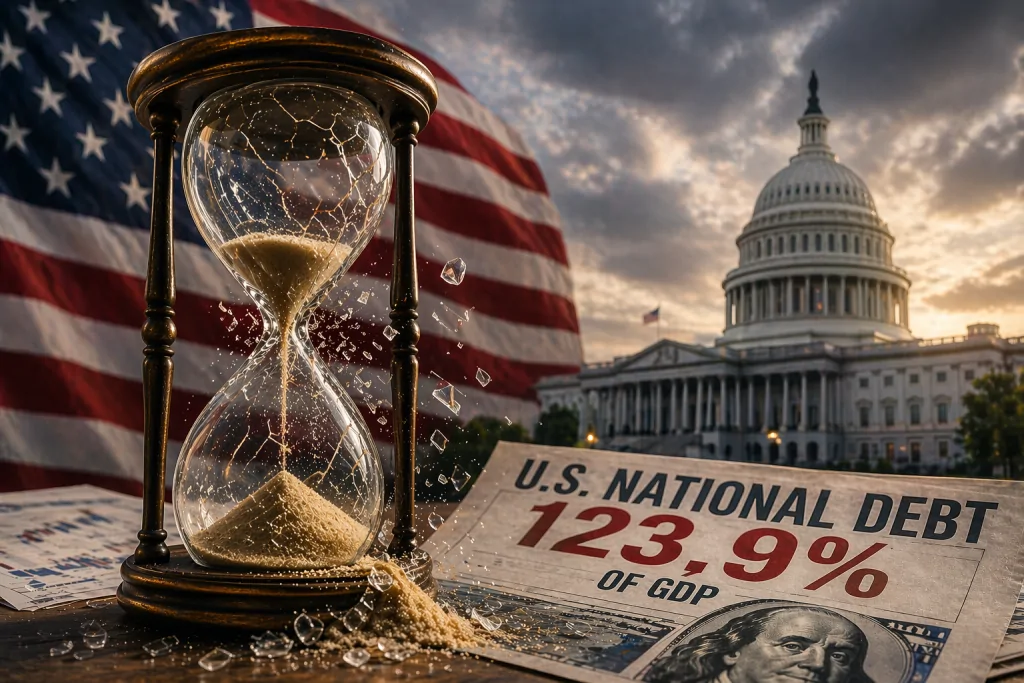
The IMF cites US government debt reaching 123.9% of GDP and deficits equal to 7.5% of GDP. More importantly, they point out that the US government has no credible plan to reduce them.
To be fair, America is not Argentina, and the US boasts major advantages— including one of the world’s most innovative economies and the deepest capital markets on earth.
But it’s nearly impossible to argue that the US isn’t heading towards a major debt crisis. The rest of the world has already figured this out— and the data prove it.
For example, in the first quarter of 2026, the share of global foreign exchange reserves denominated in US dollars fell by 2.3 percentage points, down to 56.1%.
That’s an unprecedented move in global reserves. To put that quarterly decline in perspective, the US dollar’s reserve share declined by roughly 10 percentage points over the previous decade…
… which means that roughly a quarter of that 10-year decline happened in the past 90 days! That’s evidence of a significant acceleration in the world’s loss of confidence in America.
The SWIFT international payments network tells the same story. The dollar’s share of international payments dropped substantially in Q1. In the Middle East, for instance, non-dollar transactions jumped from 18% to 31% in three months. In Asia, from 35% to 42%.
Another data point: the world’s central banks now hold more gold than US Treasury securities for the first time since 1996.
This comes as no surprise to our readers. We’ve been writing about this for the past 17 years.
Back in 2009, we were laughed at for suggesting that the United States could one day face a debt crisis. Today even the IMF is saying it.
We often cite that line from Hemingway’s The Sun Also Rises — “How did you go bankrupt?” “Two ways. Gradually, then suddenly.” The de-dollarization data suggests we’re entering the “suddenly” phase.