In the spring of 1946, hundreds of thousands of American soldiers were coming home from Europe and the Pacific, maimed, bruised, and shell-shocked. The economy they returned to was upside down.
Detroit was making tanks, not automobiles. Factories were making bullets, not baby carriages. Food was rationed. Fuel was scarce.
And, overall, life in America had been bleak for the better part of two decades. The Great Depression gave way to a stretch of war that led many Americans to fear that their kids would soon be speaking German and goose-stepping with the Hitler Youth.
Government finances were equally bleak. Between all of the massive public works programs of the Great Depression and eye-popping costs of World War II, the US national debt topped 100% of GDP by the mid-1940s.
And yet that moment was the beginning of a new Golden Age.
Think about the world at the time: Britain was bankrupt. Germany and Japan had been turned to rubble. And the Soviets had won their part of the war by feeding twenty million bodies into the meat grinder.
America came out the other side with full manufacturing capacity intact, the dollar enthroned as the world’s reserve currency, and virtually no economic competition anywhere.
What followed was two decades of suburb-building, highway-laying, automobile-making, and semiconductor-launching prosperity. There were bumps along the way, but on balance the economic trajectory of America was up and to the right.
Consequently, the US national debt started falling. And it’s easy to understand why. By 1946 there was no more war, no more depression.
The United States had just spent four years consuming every available resource to defeat the Nazis. But once the war ended, military spending (and hence the budget deficit) dropped like a rock. Congress started to run budget surpluses and used them to pay down the debt.
Over the next three decades, America’s debt-to-GDP ratio fell from 106% in 1946 to just 23% by the mid-1970s.
This week, fresh data from the Bureau of Economic Analysis confirmed that America’s debt-to-GDP ratio has officially crossed 100% once again.
One caveat: this number is based on what the government calls “debt held by the public”; it conveniently leaves out the trillions of dollars that Washington “owes itself”, including Social Security trust fund IOUs, federal pension obligations, and other intragovernmental holdings.
Well, that money has to be repaid too. Pretending otherwise might make the debt appear smaller. But a broader, most honest measure of the debt right now is actually 130% of GDP, well beyond the WWII record.
But fine, we’ll use the government’s official number of 100%, which is just announced this morning.
Yes, America has been here before. 100% is not unprecedented. But there is a major difference.
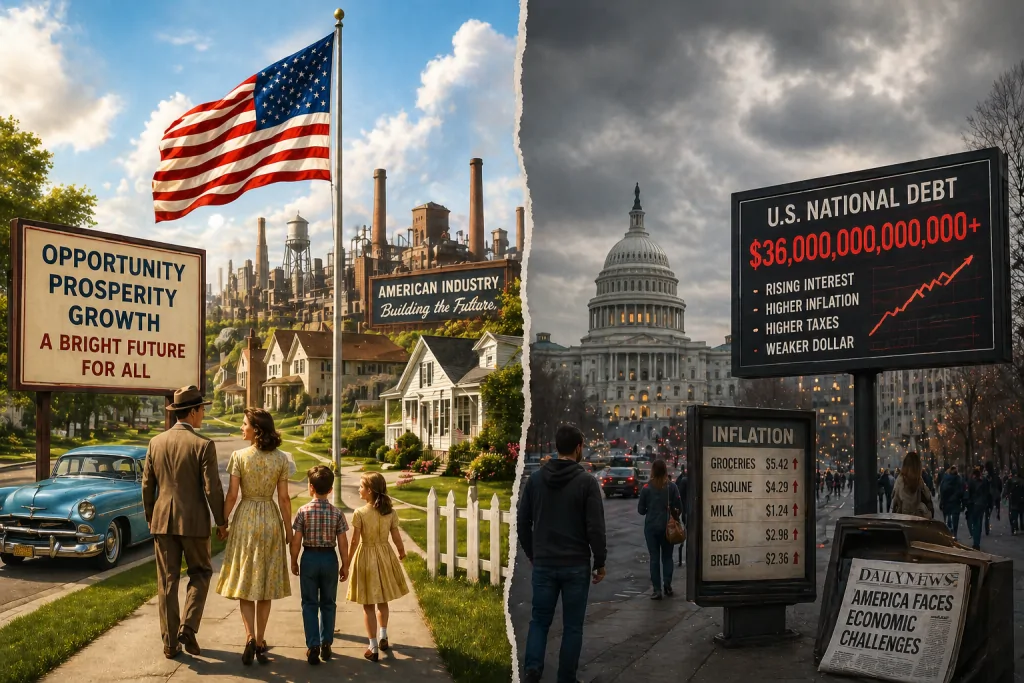
Back in 1946, the debt was at 100% of GDP because the US had just defeated the Nazis. The debt binge ended when the war ended.
In 2026, the United States is not fighting Hitler. There is no once-in-a-century pandemic. There is no specific crisis that, once over, will allow Congress to bring spending back into line.
Rather, the debt is so high because the debt is so high.
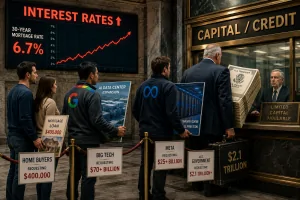
Interest on the federal debt is over $1 trillion per year. That’s a huge chunk of tax revenue. The rest of America’s tax revenue is consumed by mandatory entitlements like Social Security and Medicare.
Literally everything else, including the military, roads, and light bill at the White House, are funded with more debt.
So in other words, the deficit is structural and permanent. It will be there no matter how much Congress cuts… if they were even interested in fiscal reform.
And yet Congress shows no interest in spending cuts. Even when the most rampant and obvious fraud is presented with a bow on it, Congress does nothing.
Even worse— people who actually try to stop the fraud get publicly crucified, arrested, or sued.
In 1946, the political momentum of the United States focused on growth, productivity, and fiscal discipline. In 2026, all of it points the other way.
And the dollar’s status as the world’s reserve currency— a major advantage that helped pay down the postwar debt— is also slipping.
Foreign central banks have been quietly selling US Treasuries and buying physical gold at the fastest pace in modern history. Since the start of the year, they have unloaded tens of billions of dollars worth of US government bonds, and the interest rate on Treasurys have climbed in response.
That shows foreign confidence draining out of the dollar in real time.
Now, none of this means the world is ending.
We are not pessimistic people. Humanity’s best days are still ahead. The technological advances now arriving in robotics, artificial intelligence, nuclear power, and biotech are not incremental upgrades; they are giant leaps for mankind.
Civilization will improve, productivity will rise, and the economic problems will sort themselves out.
But getting there requires persevering through the next several years of challenges… during which time we expect the average American to see a lower standard of living driven by higher taxes, persistent inflation, and a regulatory burden that gets heavier by the day.
Of the three, inflation looks the most baked in. Foreign governments are abandoning the dollar at a rapid pace, so the Federal Reserve will almost certainly step in to ‘print money’ and bail out the Treasury.
The impact will be more inflation.
This is why we continue to write that real assets are the right place to be. In difficult and conflict-prone times, the basics like food, water, energy, critical industrial metals, and productive technology become the world’s most valuable resources. They hold their value regardless of which currency happens to be in fashion, or how high inflation goes.
And the key point is that, right now, many of the best real asset producers— which have huge upside ahead— are trading at absurd discounts. So it’s a great time to consider this strategy.