
$2,307,765,598,614.61.
That’s how much the national debt grew by in fiscal year 2026, which just ended last week on September 30.
$2.3 trillion in a single year is clearly and obviously runaway debt growth; think about it— the entire national debt didn’t reach $2.3 trillion until 1987.
By then the country was 211 years old, and it had been through a revolution, a civil war, two world wars, and the Great Depression. Now Congress adds that much in a single year.
Rising debt has many consequences, including inflation: when the government spends crazy amounts of money that it doesn’t have, that means more dollars chasing the same amount of goods and services. Prices go up.
In short, this mountain of debt is one of the big reasons for today’s sky-high cost of living.
What’s really bizarre is that Inflation affects EVERYONE. Yet hardly anyone understands that the root cause of the inflation is government spending.
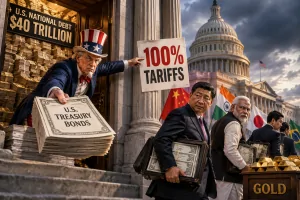
It might be even crazier how little attention this story receives. The media chimes in whenever the debt hits a milestone; when the national debt crossed $40 trillion in August, there were a bunch of stories from the New York Times to CNN.
But that lasted for about a day. Then they went right back to their usual themes about racism, sexism, etc.
It seems like every other issue is more important than the debt. Just watch any random episode of The View and you’ll see a window into the topics monopolizing Americans’ attention instead. People are whipped into a frenzy over gender-affirming care for prison inmates, the Lincoln Memorial’s reflecting pool, and a pilot who stabbed his captain on a flydubai flight.
Attention is a scarce resource. So Congress does nothing about excessive spending because voters aren’t paying attention to the debt.
The bond market, on the other hand, is absolutely paying attention.
The investors who lend money to the US government watch this complete lack of responsibility year after year. And they know there are obvious ways to cut the deficit.
The Government Accountability Office, Congress’s own auditor, estimates that between $233 billion and $521 billion is lost to fraud every year. Yet Congress won’t lift a finger to stop it.
At some point, lenders don’t feel like loaning more money to a government that won’t even stop obvious fraud. And it’s a major reason why bond yields have skyrocketed very quickly.
The 10-year Treasury yield went from about 4.6% in early August to above 5.3% on October 1, its highest level since 2002.
Now, I have a sneaking suspicion that part of this surge in yields is deliberate… that China and a few of America’s ‘frenemies’ are intentionally pushing yields higher as a form of financial warfare, maybe to manipulate next month’s midterm elections, among other reasons.
But the reality is that this crisis is entirely of the US government’s own making, and stopping it is completely under their control. All they have to do is make some hard decisions, do the work, and cut spending.
They just won’t do it.
So there are a few ways this can end.
The hopeful one is voluntary— the 535 members of Congress and the Senate get together, realize serious cuts are needed, and do what’s necessary for the good of America.
Unfortunately I don’t think that’s going to happen anytime soon.
That leads to option two, where they are forced to cut spending under duress because the bond market makes them.
If yields continue to surge, sooner or later Congress will be forced to act. There is SOME interest rate… maybe it’s 8%, maybe 10%, that will be too high for even Congress to ignore.
It’s basic arithmetic: five years from now the national debt will be at least $50 trillion. If bond yields at the time are 8%, that means the average interest rate on the debt could easily be 5% or more. That’s $2.5 TRILLION each year just to pay interest, about twice as much as military spending.
At that point Congress would have no choice but an austerity budget: cuts to military spending, cuts to Social Security and Medicare, and a significant increase in taxes, all at once.
Then there’s option three, their preferred option: do nothing. Make no hard decisions. And wait for the Federal Reserve to bail them out by creating new money to finance the deficit… trillions of dollars a year.
This is the tactic that worked in Japan for so long. Japan’s central bank conjured new money into existence and used it to buy government bonds. Eventually the central bank owned about half of Japan’s national debt.
That let the government keep borrowing at interest rates near zero.
But sooner or later, that creates serious inflation. Japan’s inflation hit a 41-year high in 2023, and its lenders now demand the highest interest rates in three decades.
Americans have seen it too. During the pandemic the Fed created roughly $5 trillion out of thin air, and the result was 9% inflation.
So ultimately when the Fed steps in to ‘print’ money and bail out the Treasury Department, the result of that will be continued and rampant inflation.
We’ve argued for years that real assets make so much sense in this environment; governments and central banks can produce debt and fiat currency. But they cannot create a barrel of oil, a BTU of natural gas, or an ounce of gold.
That’s why real assets tend to hold their value when the currency is losing its own… and why it makes sense to own them before the inflation cycle moves into its next phase.
P.S. Real assets are the whole premise of Schiff Sovereign’s investment research newsletter, Strategic Assets: profitable, low-debt companies that produce the things a government can’t print, researched while they’re still cheap.
We locked in gains of more than 10x on a small silver producer, and a precious metals company we still follow is up nearly 400%.