The US presidential election of 1912 almost sounds like the setup to a joke. Two Republicans, a Democrat, and a Socialist walk into a bar…
But it’s true: William Howard Taft and Teddy Roosevelt split the Republican vote (with Roosevelt starting his own “Bull Moose” ticket). Woodrow Wilson was on the Democratic side. And Eugene V. Debs ran as a Socialist, garnering 6% of the popular vote.
Realistically, the 1912 election was a contest over who could convince voters that he hated trusts and monopolies the most.
The early 1900s was a time Americans felt that big corporate monopolies (US Steel, Standard Oil, etc.) were fleecing them to drive up prices. And politicians felt the pressure to take action.
In the end, Wilson won the 1912 election, and his Democrats took a whopping 291 seats in the House.
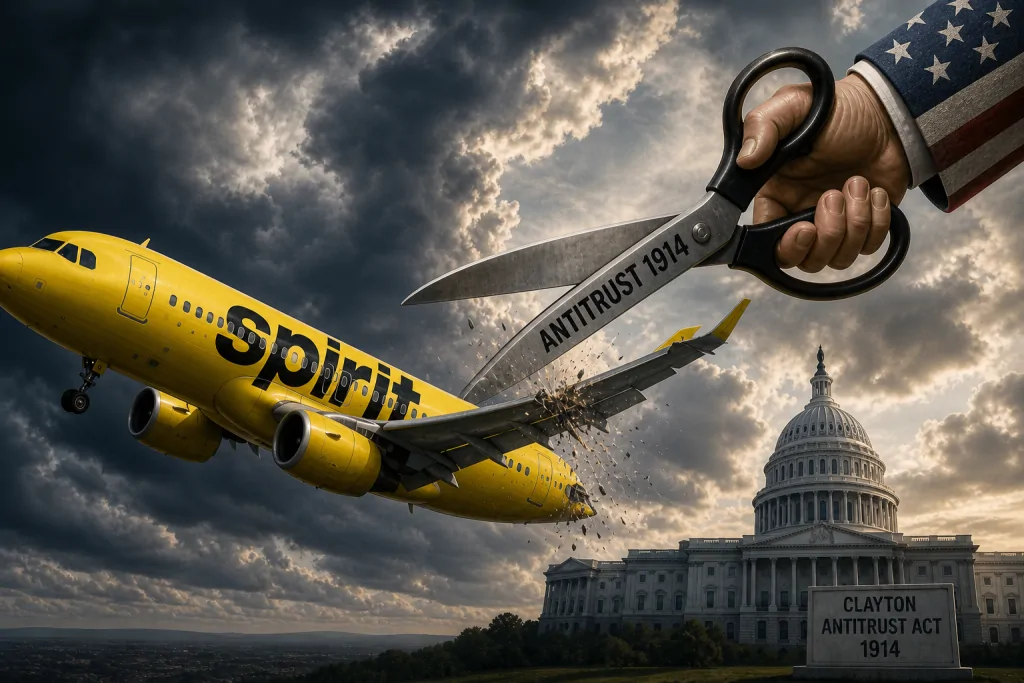
With their agenda assured, the Clayton Antitrust Act of 1914 swiftly followed, and it remains to this day one of the signature pieces of US legislation aimed at preventing monopolistic behavior.
This was precisely the law that was used to prevent the JetBlue–Spirit Airlines merger that both companies inked in 2022.
The big news over the weekend, of course, was that Spirit has now failed and ceased operations. The Internet is full of hot takes blaming Elizabeth Warren and the Biden administration for their role in destroying this airline.
And while that blame is accurate, it’s also far too simplistic. More fully, Spirit’s demise represents a complete failure of modern American “stakeholder capitalism.”
For starters, it’s important to point out that the officers, managers, boards of directors, and shareholders of both JetBlue and Spirit ALL agreed to the merger.
Business in general is tough. The airline industry is especially tough. And both companies agreed the best way forward was to merge.
But inspired idiots like Elizabeth Warren, who collectively have zero experience in business, finance, or aviation, decided that this merger (like all mergers in their opinion) was bad.
So they fought tooth and nail to dismantle it.
Ultimately the case was decided in federal court by a Reagan-appointed judge named William Young. I actually read his entire 113-page opinion over the weekend. And to be frank, my conclusion is that the judge made his best effort to do his duty and interpret the Clayton Act with respect to the JetBlue–Spirit merger.
In his written opinion, the judge himself acknowledges that his responsibility is to “predict the future of a dynamic market recovering from the COVID-19 pandemic, in markedly uncertain times.”
Sounds like a recipe for success!
But I found the analysis truly bizarre, because the judge, like Elizabeth Warren, Merrick Garland, Joe Biden, Lina Khan, and the rest, has no experience in aviation, finance, or accounting. He has never run a business.
Yet, throughout his analysis, he opined on whether it was appropriate, for example, for JetBlue to take on such a large amount of debt to consummate the merger.
This is ridiculous. The decision should be left to the board of directors of JetBlue, not to a federal judge.
The judge further acknowledged that he was completely out of his element and had to rely on the testimony of expert witnesses.
Ultimately the trial came down to which ‘expert’ the court found the most credible. And in his written opinion, Judge Young assigned “significant weight” to the government’s ‘expert’, a Columbia University economics professor.
It didn’t matter that the “Big Four”, i.e. United, Delta, AA, and Southwest all engaged in mergers and acquisitions over the past 20 years. The government felt compelled to deny what would have been the fifth largest airline— JetBlue/Spirit— from ever existing.
And so, based largely on the testimony of a single expert, the merger was denied.
Plenty of comments this weekend lamented the Spirit employees who are now out of work, or the impact to passengers who won’t be able to fly Spirit’s routes anymore. And they all blame Elizabeth Warren— who was instrumental in making sure the lawsuit happened.
But again, I think this is an overly simplistic view.
If those routes, say San Juan to Fort Lauderdale, are remotely profitable, they’ll be picked up by another airline. Probably JetBlue.
Spirit’s fleet of aircraft will not disintegrate. They’ll be bought by another airline. Probably JetBlue.
Even those employees who are now collecting federal unemployment benefits will probably be rehired as those routes are restarted. Probably by JetBlue.
In short, JetBlue is now in a position to buy— out of liquidation at bargain-basement prices— everything it was prepared to pay $3.8 billion for just two years ago.
So realistically, this is a major victory for JetBlue.
Who loses? Spirit’s former employees will eventually find work. The passengers will find new airlines.
But the stockholders of Spirit Airlines will be completely wiped out.
Keep in mind, Spirit wasn’t owned by some “evil billionaire.” It was owned by mutual funds and pension funds— places where the retirement savings of firefighters and schoolteachers were invested.
In fact Spirit was held by multiple mutual funds managed by Fidelity Investments… which happens to be domiciled in Elizabeth Warren’s home state of Massachusetts. Fidelity, and all the people invested in those funds, are worse off today.
Meanwhile, JetBlue stock is up about 8% since the government proposed rescue of Spirit crashed.
Capitalism is supposed to be an economic system built on freedom, in which all participants get to decide what’s in their best interest.
More often than not, a capitalist system produces win-win deals that are in everyone‘s best interest. And both JetBlue and Spirit decided four years ago that a merger was a win-win deal.
What happened instead is the ultimate demonstration of how America has changed: a country where inspired idiots like Elizabeth Warren have not only managed to seize power, but continue to be reelected by the very people they are harming.
Warren insisted that a lawsuit be brought to disrupt a win-win deal. And the government brought that case not because of its merits, but to virtue-signal their woke economic justice.
The judge in the case was completely unqualified to render an opinion on such business complexities, and was forced to apply a law that was created in 1914 before there was even a civil aviation industry.
This same law was not applied to the four largest companies in the industry. Only to Spirit and JetBlue.
And in the end, investors in Spirit paid the price.
Ultimately there were two paths. One path was a win-win. The other path was a total wipeout — $3.8 billion that could have gone to Spirit Airlines shareholders.
The government did everything in its power to ensure the wipeout. And absolutely zero people will be held accountable.