
On New Year’s Day in the year 1829, a 29-year-old young lady from Washington DC named Peggy Timberlake married John Eaton— a powerful senator from Tennessee.
Eaton was also close friends with the incoming president Andrew Jackson.
Peggy, on the other hand, was rumored to be somewhat of a harlot. She was openly flirtatious and allegedly promiscuous, and her wedding to Sen. Eaton came only a few months after the mysterious death of her first husband.
The elite “power wives” of Washington DC considered Peggy scandalous and immoral, and so they simply refused to engage with her. They would not attend any event where Peggy would be present. They would not invite her to their parties. They spoke ill of her behind her back.
So when Andrew Jackson made Sen. Eaton his Secretary of War in March of 1829, the snub against Peggy became a federal problem.
President Jackson, whose own late wife had been savaged by similar gossip during the brutal 1828 campaign, took the shunning of Peggy as a personal insult. And he actually demanded that his cabinet bring their wives into line and accept her.
Jackson’s cabinet could not (or would not) demand this of their wives. And for more than two years, the so-called “Petticoat Affair” consumed federal attention.
It finally ended in the spring of 1831 with something America had never seen: Jackson’s entire cabinet resigned except for the Postmaster General. The Secretaries of State, Treasury, etc. all left. Even Eaton as Secretary of War resigned.
In short, a dispute over whether the power wives of Washington were willing to invite another lady to dinner had resulted in the effective dissolution of the executive branch.
Nearly two centuries later, that remains almost unimaginable. High-level resignation is something the American government simply does not do.
In its entire history exactly one president has resigned— Richard Nixon, in 1974, and only to avoid impeachment.
Only two vice presidents have resigned, including Spiro Agnew in 1973 due to pending criminal charges.
American politicians only give up power under extreme duress— likely a family emergency… or the imminent arrival of a criminal indictment. It is a “from-my-cold-dead-hands” political culture. We even treat a President declining to seek reelection as a major event.
In Britain, by contrast, prime ministers resign all the time. When they lose the confidence of their party, they step down… and the machine produces another.
I used to think that was a genuine strength— that American politics might be healthier if resigning were less taboo.
I am no longer sure.
Keir Starmer is the perfect illustration. By this spring his net approval had collapsed to the lowest rating recorded for any prime minister since Ipsos began measuring in 1977.
Failure didn’t bother him. In fact Starmer’s government kept criminalizing criticism— Britain now jails its own citizens for anti-migrant posts while the actual migrant criminals walk free and receive taxpayer assistance.
Even last month, with dozens in his own party urging him to resign, Starmer remained defiant: “The country expects us to get on with governing. That is what I am doing and what we must do as a cabinet.”
What finally forced him out was not voters. Yes, his own party helped push him out after disastrous local elections cost Labour more than a thousand races last month.
But underneath that sat the bond market.
Investors had been dumping British government debt for weeks, and in early May the yield on the 30-year gilt spiked to the highest level in decades.
Bond investors want fiscal restraint. And they had concluded that Starmer would respond to his electoral beating by spending even more money.
So naturally, investors sold their UK government bonds… and the British government’s borrowing costs soared.
This is nothing new; less than four years ago, then Prime Minister Liz Truss resigned after just 44 days because the bond market didn’t like her economic plan. Bond yields surged and the British pound went into free fall.
Calm returned only after Truss resigned in disgrace.
The sad irony is that Starmer’s likely successor is worse. Andy Burnham— the longtime mayor of Greater Manchester— campaigns on what he calls “business friendly socialism“, which makes as much sense as “vegan wolf”.
He also wants more borrowing, higher taxes, and bringing utilities and “public essentials” back under state control.
Bizarrely, Burnham has complained that Britain is “in hock to the bond markets,” as though the people lending to the government should simply hand over their capital with no questions asked.
(Given Mr. Burnham’s penchant for nationalization, he may in fact get his way. I wouldn’t be surprised to see more wealth tax proposals in the UK.)
The actual solution is embarrassingly simple. You are only “in hock to the bond market” if you borrow. Balance the budget, live within your means, and the bond market gets no vote at all.
Yet basic fiscal responsibility is an impossible idea— and it tells you everything about the modern Western politician. This most certainly will not improve under a “business friendly” socialist.
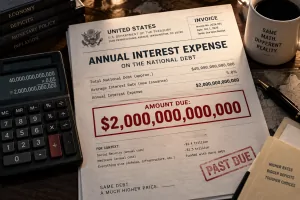
Ultimately, the last institution still imposing any discipline on government is not the voter— it’s the creditor. And the United States, with its own debt arithmetic getting worse every year, is approaching that the same line.
One day the bond market will start calling the shots in Washington too, voters’ wishes be damned, and it will do it through higher yields and a weaker dollar.