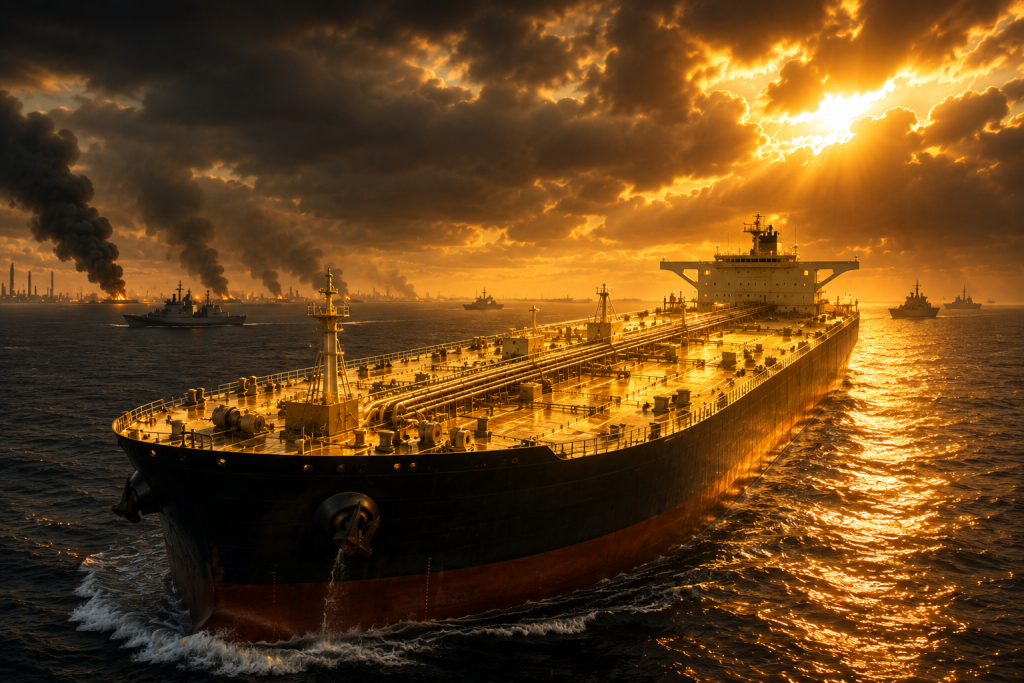
How much do you think it would cost to send a supertanker, one of the giant ships that move the world’s crude oil, through a narrow stretch of water that is full of mines, where missiles hit two tankers in early July, and where a crew member has already been killed?
Last month, one shipowner agreed to make that run— through the Strait of Hormuz— for nearly $470,000 per day.
For perspective, in the first few months of last year, before the war, the biggest crude tankers on earth were earning as little as $36,000 a day.
The ships collecting these fortunes don’t produce anything at all. They don’t pump oil, they don’t refine it, and they don’t sell it. They just carry it from one place to another.
And that is exactly why they have become the biggest winners of this war.
When Iran effectively closed the Strait of Hormuz in late February, oil spiked to $120 a barrel in March, then calmed as ceasefires came and went. But all the while, tanker rates just kept climbing.
That’s because of the arithmetic that drives the shipping business; it’s simple to understand— when the strait became too dangerous to navigate, everything had to be rerouted. So instead of a quick voyage through the strait, cargo had to be transported through far more complicated means… and ships had to sail much longer routes to avoid the danger.
The end result is that oil from the region now crosses far more ocean, and every voyage takes a LOT longer. This means ships are tied up for longer… driving demand higher for shipping.
And it’s not like this problem can be eliminated by simply adding more ships to the global fleet; supertankers take years to build, and shipyards spent the past decade producing very few.
That last part matters, because it is the reason this windfall was visible long before anyone had heard of this war.
One of the largest supertanker owners earned more than $100 million in the first quarter, excluding one-off gains from selling ships, as its fleet was making roughly two and a half times as much per day as a year earlier.
The company paid out every penny of it as a dividend, extending a streak of quarterly payouts stretching back more than fifteen years. And the second quarter will be even better: by early May, it had already booked most of its available days at nearly double its first-quarter rate.
Another major tanker owner reported nearly $200 million in profit for the quarter and declared the largest dividend in its history.
Tankers are not the only winners. One owner of bulk carriers— the ships that haul iron ore, grain, and coal— has become the target of a takeover battle in which a rival has raised its offer again and again, and the board keeps rejecting bids it says still undervalue the fleet.
All three companies are on the research list of Schiff Sovereign’s investment newsletter, Strategic Assets.
They were featured in 2023 and 2024, back when shipping was about as unloved as a business can be. That was the point. Shipping moves in long cycles, and the bottom is where the next shortage is easiest to see… because years of terrible rates had stopped owners from ordering ships, and a ship ordered today does not carry cargo for three years.
Counting the ships that would exist in 2026 took no view on Iran— only a public order book.
They met a strict set of criteria: profitable, little or no debt, trading cheap against current cash flow, and operating in an industry with an aging fleet and hardly any new construction on order.
The war revealed that setup; it did not create it. As of early July, one tanker owner had more than doubled since being featured, the other was up more than 90%, and the bulk carrier owner was up more than 50% on a takeover bid rather than a rate spike.
The tankers keep paying quarterly dividends, and one payout alone equals almost 10% of the share price when that company was first featured.
We expect this pattern to repeat across real assets.
The world spent a decade underinvesting in the physical things civilization runs on: ships, mines, oil fields, refineries, smelters. Now geopolitics has turned violent. When there is no spare capacity, every disruption has to be resolved by price, and the companies that own the scarce assets collect the difference.
To be clear, we are not permabulls, and rates like these will not last forever. A durable peace would bring tanker earnings down hard, and shipping has punished euphoric buyers many times before.
Our edge is not predicting wars or commodity prices. It is applying strict criteria to well-run companies, making the case to buy when they meet the bar, and to sell when they no longer do.
That discipline is working. Of the more than twenty companies currently on the research list, six are showing a loss. The companies that we closed out returned an average of 172%.
A silver producer gained more than 950% in under a year, and others returned 540%, 240%, and 150%.
If you would like to see the full research, including the companies we believe are positioned for the next disruption, you can try Strategic Assets with a 30-day, no-questions-asked money-back guarantee.