[Editor’s note: This letter was written by Schiff Sovereign’s CEO, Viktorija, who was born and raised in Lithuania and is now based between Mexico City and Panama.]
It’s been about 15 years since I moved away from the tiny village in rural Lithuania where I grew up… and back then it still felt run down, backward, post-Soviet.
My whole childhood was basically subsistence farming with my family. Everyone I knew was the same way. Even by the late 1990s we considered touch-tone telephones to be “high tech”, and no one had ever heard of the Internet.
But last week I led a group of our Total Access members on an intimate tour of Lithuania– from the capital city of Vilnius, to the quiet countryside where my family still lives. And I was blown away by how much had changed.
Sure, the smoke off the charcoal smelled exactly the way I remembered it. Same woods, same white birch pressing in from every side. My niece and her husband ran the whole thing– plates moving, drinks appearing, everyone was handed something before they’d even asked.
But the atmosphere was totally different.
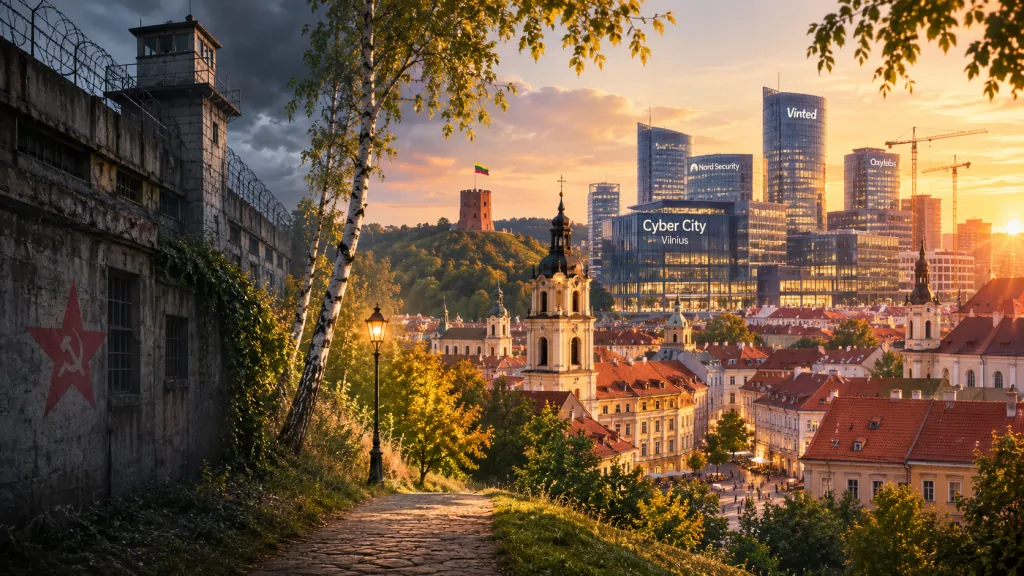
Here’s what it is now. A country of 2.8 million people– smaller than São Paulo– that’s produced six unicorns since 2020. Vinted. Nord Security. Oxylabs. Cast AI. The former employees of the first wave are now founding the next.
A former textile factory in Vilnius is now Cyber City, housing more than 3,000 tech workers. Robinhood opened a crypto centre there in 2025. Checkout.com followed in 2026.
They aren’t coming for the birch trees. The Bank of Lithuania approves fintech licenses in about three months, the fastest process in Europe, and a Lithuanian license lets a company operate across the entire EU.
Around 280 fintech firms now operate from the country, and no other EU member has licensed more of them.
There’s also an extremely high level of education tech workers; Vilnius has become a major hub for talent in Europe, hence why so many AI companies are starting here.
The taxes help too. The corporate rate is 17% against an EU average above 21%, and small companies pay nothing at all for their first two years.
None of this is an accident. Lithuania spent decades under Soviet occupation, with Moscow deciding what people could build, buy, and say. When that ended in 1990, the country swung hard in the opposite direction.
The business friendliness isn’t a marketing strategy but a reaction, built by people who remember exactly what the alternative looked like and don’t want to go back.
You can see it on the streets: nice cars, new construction, restaurants that would hold their own in any European capital, and rising over all of it is a well-preserved “old town”, the original medieval city center from 1,000 years ago.
Apartments in Vilnius average around 3,000 euros per square meter. That puts a 100-square-meter apartment, around 1,100 square feet, in an EU capital at roughly $340,000; in Boston, where condos average about $710 per square foot, the same space runs more than double.
But just twenty minutes outside the center, extremely well-built houses still go for under 2,000 euros per square meter, with the land practically thrown in for free.
(Our Plan B Confidential research service published a full report on Lithuanian property in November, covering neighborhoods, taxes, and mortgages for foreigners.)
Lithuania grants temporary residency to foreigners who start a business there, and its startup visa fast-tracks founders, family included.
And anyone with a parent, grandparent, or great-grandparent who held Lithuanian citizenship before the Soviets invaded in 1940, and who left the country before 1990, may qualify to have that citizenship reinstated without giving up their current passport. That’s an EU passport hiding in the family tree.
My family isn’t in tech. They’re not investors. But the tech-driven economic boom has reached them too… everyone is benefitting. And we took an intimate tour of all of it, so our group could see the transformation from the inside.
Our Total Access group had just spent four days walking through a former Cold War KGB prison, touring a Nazi execution fort, crawling through crypts beneath a medieval cathedral, and eating at Michelin-starred restaurants.
Now they were standing in my family’s backyard outside Kaunas, looking more relaxed than I’d seen them the entire trip.
I watched one of them– a guy who splits his time between Florida and Medellín, not easily impressed– take a bite of šašlykai and go completely quiet. Šašlykai is what you eat when someone in Lithuania wants to show you they care: meat on skewers, marinated overnight, cooked slowly over charcoal until the whole yard smells like something your body recognizes even if your brain doesn’t.
The next day, we drove Soviet-era and older tanks through a field. It’s loud in a way that rearranges your organs, slower than you’d expect and more violent than you’d hope. Nobody in the group had done it before. And everyone loved it.
But underlying all of it is a quiet economic boom in a place that almost no one has heard about.
If you’ve never heard much about Lithuania, that’s the point. The window on places like this doesn’t stay open forever.
One honest warning: Lithuania in winter is genuinely awful. We went in the right season. Plan accordingly.
P.S. This trip was part of Total Access– our membership that takes a small group of people to places most travelers never see, with access they wouldn’t find on their own. If that sounds like something you want to be part of, you can learn more and apply here.