In the summer of 1972, a Soviet official named Nikolai Belousov stepped off a plane in New York City with a shopping list.
The Soviet Union had just finished its worst harvest in over a decade and was on the verge of starvation… and Belousov was tasked with the nearly impossible mission of buying enough wheat to feed an entire nation.
So he flew to America.
His first meeting was with Michel Fribourg, the head of Continental Grain. The two shook hands and closed a deal for Russia to buy millions of tons of American wheat.
Belousov’s next stops were the other biggest grain traders in America: Cargill, Cook, Bunge, Louis Dreyfus, and Garnac.
He worked through every major American grain firm in a matter of weeks— each deal negotiated in complete secrecy… and each firm assumed they were the only American grain house that the Soviets were talking to.
In reality, Belousov was closing deals with all of them.
By the time word got out that the Soviets had been buying from everyone, everywhere, all at once, Belousov had already locked up roughly 440 million bushels of wheat, about a quarter of the entire American crop, for ~$700 million.
And here’s the wild part: this was the peak of the Cold War… yet America’s staunchest adversary didn’t even pay full price for US wheat.
That’s because, for years prior, the US Department of Agriculture had been funding subsidies to make American grain cheaper abroad, covering the gap between the higher domestic price and the lower global price.
So the end result was that the Soviet Union drained American wheat inventory— and that’s when the Law of Supply and Demand kicked in. Wheat prices nearly doubled. Corn prices more than tripled by the following summer. Bread, beef, and eggs all followed.
Yet while Americans were suffering major food inflation at home, the US government was subsidizing the Soviet Union’s wheat purchases to the tune of $300 million in taxpayer funds.
The American taxpayer had financed the largest grain purchase the world had ever seen, for the benefit of its sworn enemy.
Then the second shoe dropped. The following autumn, in October 1973, the Arab oil-producing countries announced an embargo on the United States in response to America backing Israel in the Yom Kippur War.
Consequently, the price of crude oil roughly quadrupled… and it made the food inflation much worse.
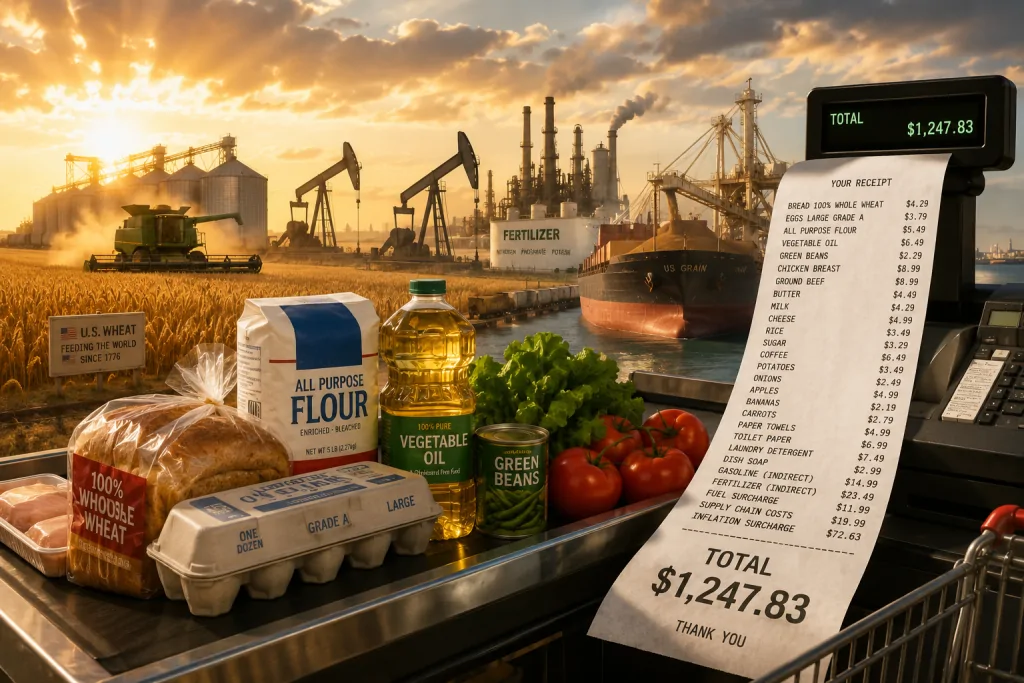
Many people don’t realize just how much modern agriculture runs on oil and gas. Nitrogen fertilizer is synthesized from natural gas. Phosphate (another critical fertilizer ingredient) is mined and hauled with diesel. And everything from tractors to grain dryers burns fuel.
Because of the embargo, fertilizer prices more than doubled in 1973 and 1974, and food prices quickly followed. Inflation was eating quite aggressively into consumers’ standards of living.
All of this had a major impact on the stock market; as inflation raged throughout the 1970s, even America’s largest companies suffered. Their earnings shrank (especially when adjusted for inflation) and stock prices went nowhere.
The Dow Jones Industrial Average stock index closed at 1,000 in November 1972… and literally ten years later in November 1982, it was still at 1,000. The market went nowhere over the course of an entire decade.
And adjusted for inflation, of course, most stocks were losers.
The only real winners were REAL ASSET producers— especially gold and energy companies. Gold went from $35 an ounce in the early 1970s to a peak of $850 within a decade— though there were downturns in between.
Gold miners (and silver miners as well) were the best performers of the decade, with the Barron’s Gold Mining Index returning a phenomenal 1,247% in ten years.
Similarly, oil went from about $3 a barrel to nearly $40, and companies like Exxon completely trounced the S&P 500.
More than fifty years later, similar conditions are building again.
The Strait of Hormuz has been effectively closed since late February, except for the tankers Iran waves through from China and its other friends while everyone else waits outside.
Some oil is moving, for sure. But given that about a quarter of the world’s sulfur and roughly 15% of its fertilizer exports normally move through that strait, there are significant implications for the agricultural sector.
Many consequences are already on the books.
Urea, the world’s most common nitrogen fertilizer, climbed above $850 a tonne this spring, up roughly 80% since February and the highest price since 2022. Sulfur, an essential input for phosphate fertilizer, has doubled since January to record levels.
And in a recent American Farm Bureau survey, 70% of farmers said they cannot afford all the fertilizer they need this season.
Here’s why that matters: spring planting is over. Farmers either paid those high fertilizer prices… or they skimped. And skimping means smaller harvests this fall.
Either way, higher food prices are already locked in. The shock has already happened. The impact just hasn’t been felt yet in the grocery stores because the harvest hasn’t taken place yet.
Meanwhile, agricultural markets are trading as if nothing has changed. Crop prices haven’t come close to keeping pace with energy and fertilizer costs, and governments are already hoarding: China has temporarily banned phosphate fertilizer exports to keep supplies at home.
The last time this happened, the people who owned fertilizer production made money. Everyone else just got the grocery bill.
The featured research in Schiff Sovereign’s investment newsletter, Strategic Assets, already includes a potash producer, a phosphate producer, and a palm oil grower, and we’re watching a fantastic fertilizer company for the right entry point.
Our palm oil grower has nearly doubled since we published the research. The potash producer is up more than 16%… with a lot more room to grow. Our phosphate producer, which we recently featured, is still trading inside our suggested buy range.
If you’d like to read that research, you can try Strategic Assets with a 30-day, no-questions-asked money-back guarantee. Click here to learn more.