On Friday afternoon the Treasury Department released its final numbers for fiscal year 2026, which just ended on September 30, and the results are pretty much what you’d expect: horrible, appalling, inexcusable.
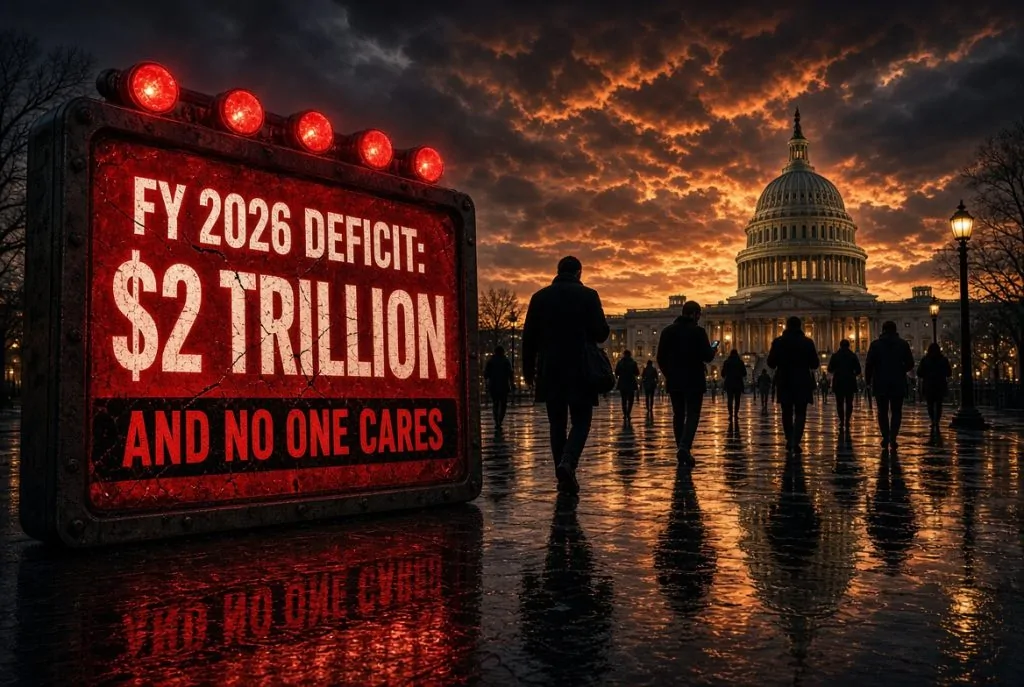
Treasury reported a total budget deficit of $2 trillion, $220 billion worse than the year before.
And once again, mandatory spending— things like Social Security and Medicare— plus interest on the debt, exceeded 100% of tax revenue.
In other words, they could have literally furloughed the entire US military, shut down the national parks, laid off the TSA, etc., and there still would have been a budget deficit. That’s just beyond pitiful.
The saddest part is how few people take this seriously.
Hardly anyone in Congress seems to care. No one on either side is jumping up and down and shouting from the rooftops that they have to cut this budget, and do it immediately.
Obviously there’s no interest in Congress because no one in the media is talking about it… and it rarely comes up as a key issue among voters.
And that’s the irony: voters absolutely care about this. They just don’t know that they do.
The number one issue for most voters right now is affordability. Life in the US has gotten absurdly expensive. I’ve been visiting Texas with my family for the past couple of weeks, and I’m astonished that every time we leave the house it costs $200 just to do anything.
Everyone has stories about just how mind-numbingly expensive life has become. People aren’t looking for less inflation; they’re looking for prices to fall back to the levels they remember from the good old days of 2019.
What many people don’t realize is that all this government spending, together with an insane level of regulation, is largely responsible for the high cost of living.
The media is focused on the war in Iran— and that certainly that has contributed to higher energy prices. But it’s an overly simplistic view to blame high prices on the war.
Simply put, everything the government touches and ‘invests’ in becomes more expensive. And there is perhaps no better example than the ridiculously-named Affordable Care Act.
Obamacare was a noble idea in theory: help Americans obtain health insurance, and bring down the cost of healthcare.
But in practice, insurance premiums have gone through the roof. The number of ‘uninsured’ only fell because tens of millions of people were put on Medicaid or taxpayer-subsidized plans, And overall healthcare spending is much greater (i.e. less affordable) than before.
The federal government now spends a trillion dollars a year on healthcare, and that doesn’t even include Medicare. That trillion dollars is just Medicaid and similar programs.
So basically the government passed a bill to make healthcare more affordable, and now they spend a trillion dollars a year because people can’t afford the supposedly affordable healthcare. It’s ridiculous.
Bottom line: everything the government touches becomes more expensive: healthcare, housing, education, food, energy. Everything.
So voters who care about the cost of living, which is almost everyone, absolutely should care about government spending (and about costly regulation too).
Unfortunately, most people are not aware of the clear and obvious link between irresponsible spending, excess regulation, and the cost of living. And the legacy media is far more interested in the clicks and eyeballs that come from pitting Americans against each other on social issues than they are in having a rational discussion about the budget.
None of this should not be controversial. Gross interest on the debt in fiscal year 2026 was $1.36 trillion, roughly 25% of tax revenue and significantly more than what was spent on the military.
That’s a blatant warning sign that spending is out of control.
Fortunately there is significant fat to trim. Hundreds of billions of dollars a year are lost to outright fraud. And that’s before you get into other forms of graft that are technically legal but absurdly wasteful. And that’s before an ounce of effort goes into making things more efficient.
In many ways it’s heartening that there’s so much room for improvement. But American voters tend to elect the most ignorant, incompetent, and morally bankrupt people on the planet to represent them.
The conduct of government has been so bad for so long that people’s expectations are minimal at best. Voters expect nothing and get even less in return.
Sadly, the most likely outcome is more of the same. No one in Congress will cut anything. The spending will continue and even increase.
Eventually, the Federal Reserve will have to resort to full-blown monetary expansion (‘printing money’) to help the government make ends meet. The cost of living will continue to rise, and no one will understand why.
There will be a lot of finger-pointing, but absolutely no accountability or genuine solutions… and that’s why it makes so much sense to have a Plan B.
P.S. A government can print dollars by the trillion, but it can’t print an ounce of gold or a barrel of oil. That’s why real assets like gold, oil, and the companies that produce them hold their value when the currency loses its own, and why it makes sense to own them now.
Real assets are the whole premise of Schiff Sovereign’s investment research newsletter, Strategic Assets: profitable, low-debt companies that produce the things a government can’t print, researched while they’re still cheap.
We locked in gains of more than 10x on a small silver producer, and a precious metals company we still follow is up nearly 400%. Right now we’re giving away a free sample issue so you can see what’s inside. Click here to download yours.