Imagine for a moment that it’s the year 2022… just four years ago. Try to put yourself in the shoes of a senior Chinese central banker at the time.
Your responsibility is to manage one of the largest stockpiles of foreign reserves on the planet—with a huge chunk already invested in US government bonds.
Now, for decades, investing in US Treasury bonds wasn’t just a smart idea for your central bank— it was the only idea.
The US had long been China’s largest trading partner, and the US dollar had been the dominant global reserve currency. Not to mention, US government bonds had been considered the world’s risk-free asset: extremely liquid, and backed by the most powerful country in the world.
It was hard to argue for investing China’s reserves in anything else.
But remember 2022. Russia had just invaded Ukraine. And, for better or worse, the US Treasury Department responded by freezing assets owned by Russia’s central bank.
It did so under a law that allows the US government to freeze assets and to cut off access to dollar, for any country that America doesn’t like, at the President’s sole discretion.
As a representative of the Chinese government, you have to wonder how long it will be until your country is next… and finds more than a trillion dollars of its own assets frozen.
You also recently witnessed an American president clearly exhibiting signs of dementia— shaking hands with thin air and wandering around with presumably no idea where he is or why he’s there.
Moreover, the US federal government had just spent the past two years (2020 and 2021) borrowing trillions of dollars to pay people to stay home and not work. And Congress demonstrates no intent to rein in their reckless spending.
Remember, your job as a central banker is to make sensible, rational, long-term decisions about your nation’s strategic reserves. And it’s starting to become clear that you should diverisfy some of that risk.
But your options are limited.
As a central bank, can’t speculate in tech stocks, or Costa Rican beach condos, or some memecoin. You have to stick to liquid, widely recognized strategic financial assets.
You look at European government bonds first. But from a financial perspective, those governments are in even worse shape. Ditto for Japan.
There are some financially responsible countries, like Singapore. But those bond markets are too small to absorb the hundreds of billions of dollars in capital that you need to invest.
You cross out the options, one-by-one, until there is a singular choice that remains: gold.
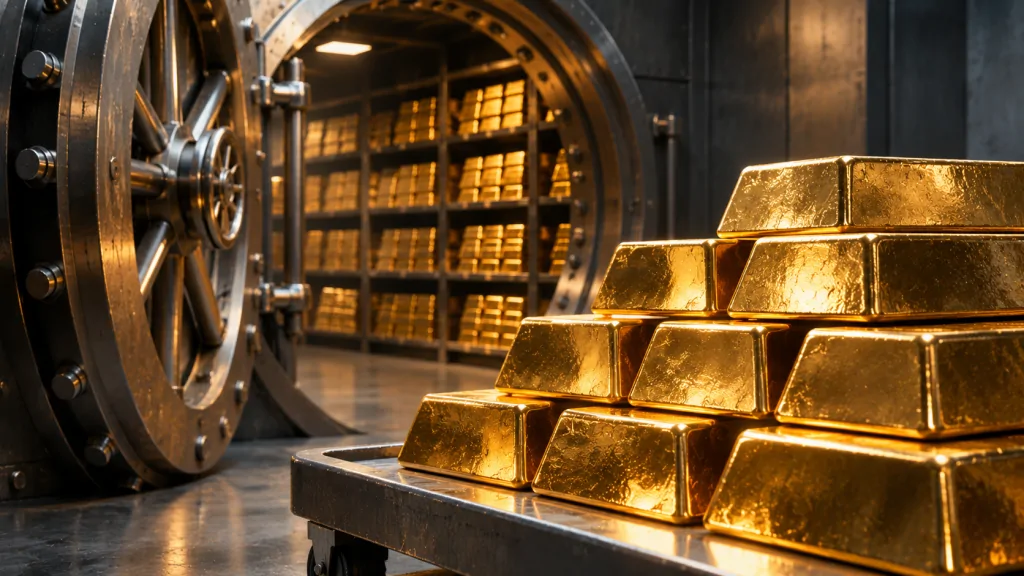
Gold is the only asset that isn’t controlled by any other government. You don’t have to worry about having some other country ‘freeze’ your gold reserves; you can hold it under lock and key on your own soil. Yet it’s also universally recognized as a strategic financial asset around the world.
With that choice in mind, your central bank starts buying gold. Lots of it. By the metric ton.
This calculus wasn’t unique to China; at some point over the past couple of years, most of the world’s sovereign governments and central banks went through a similar analysis.
They all have different circumstances, but ultimately they all realistically have only one option: gold.
Remember, no central banker ever bought US government bonds hoping to flip them for a profit. And no central banker is speculating in gold either.
Instead, they’re looking for a strategic asset to denominate their national savings and surplus.
But at the same time, they’re not stupid. So at times when gold looks fairly cheap, they tend to buy more. When it’s at an all-time record high, they tend to buy less.
And that’s the cycle we’ve been seeing over the past few years. Central bankers were happy to load up on gold when it was $1,600 or $2,000, and really all the way up to $4,000+.
At that point, central bank demand slowed down, and it was individual speculators and hedge funds that pushed gold into a manic speculative frenzy, up to its $5,600 record price in January.
Central banks sat back, and as gold fell into the low $4,000s, they resumed their purchases.
That seems to be a stable level where central bankers are buying; they are essentially signaling to the market that they will sell Treasury bonds and buy gold at ~$4,000.
Over time, we anticipate that floor will go higher; there are still trillions upon trillions of foreign-owned US government bonds. And unless/until Congress and the White House get serious about balancing the budget, this dollar diversification trend will continue.
Long-term, that will push gold prices much higher as every foreign government and central bank on the planet revisits this same analysis.
We’ve long written that among the big winners will be well-managed mining companies.
There are the major ones like Barrick, Newmont, and Agnico Eagle. But there are a whole lot of hidden gems out there in the gold market, and many of them have financial models based on $2,500 or $3,000 gold prices.
So literally every day that gold stays above $4,000, those companies are minting money hand over fist, far above their projections.
In the latest issue of Schiff Sovereign’s investment research newsletter, Strategic Assets, we analyzed one such company with ZERO DEBT and profit margins that exceed most tech companies.
Not only is the company debt-free, it has so much cash that its bank balance is roughly HALF of the company’s market capitalization.
So when you adjust for that outrageous cash balance, you’re only really paying about 1x annual profit. That’s crazy cheap.
Naturally the stock is down substantially from its high earlier this year as investors soured on gold miners.
This is bizarre rationale to us; central bankers have used the drop in gold as a chance to buy more of it. The drop in share prices for miners like this one is an even better deal.
If you want to know more about this company, and the dozens of other real asset companies we have researched in Strategic Assets, click here.