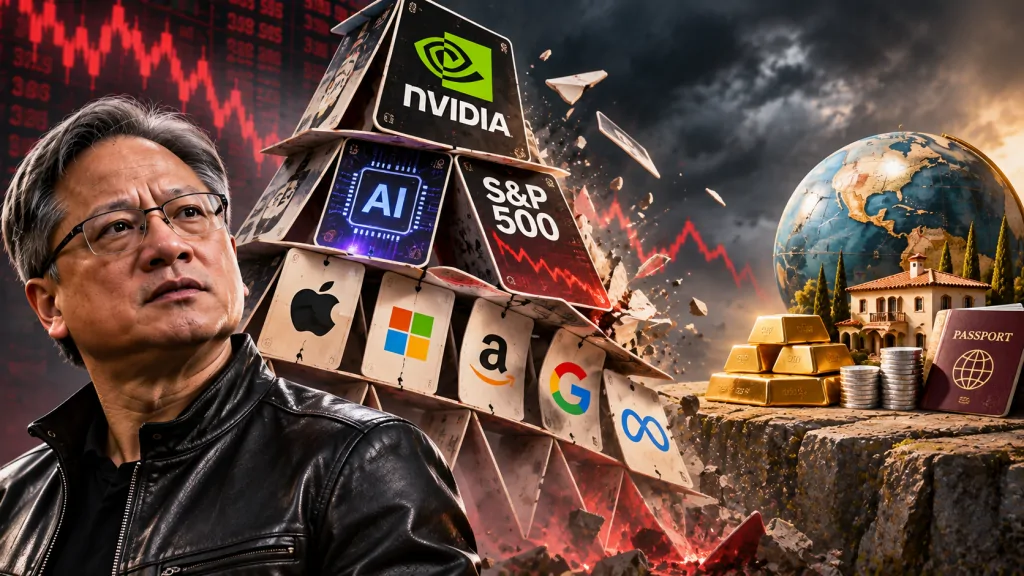
It’s a sign of our bizarre times that a single individual could trigger trillions upon trillions of dollars worth of gyrations in global capital markets.
It’s even more bizarre that this individual is not the President of the United States or Chairman of the Federal Reserve… or that the triggering event in question wasn’t the start of World War III.
To put the market swoon in context, Jensen and his wang caused more chaos in the stock market than any election result in US history. More than Putin’s invasion of Ukraine. And nearly as much as the early days of the pandemic in 2020.
That is an incredible amount of concentration risk.
Nvidia alone makes up roughly 5% of the S&P 500. Seven big tech companies make up about a third of the index— and they’re all heavily exposed to the ‘AI trade’.
So even if you own a generic S&P index fund, you have a massive bet on AI whether you meant to make one or not.
And it’s not even just tech. Even non-tech companies are heavily exposed to the AI trade. Caterpillar makes farm equipment and bulldozers… but they also sell the giant engines and turbines that power data centers.
Its stock sank 15% last week (worse than the overall market) after Jensen’s transgressions were exposed.
To be clear, I’m a huge proponent of AI and technology in general, and I’m heavily invested in the sector.
But in the fallout of this Nvidia scandal, a lot of people are probably starting to realize that most of their eggs are in one basket.
Savvy investors have tools at their disposal to mitigate various risks.
On one hand they can diversify. Risks from having too much AI exposure can be reduced by investing in other sectors. Gold miners are on sale. Many energy companies are inexpensive.
Investors can also diversify asset class, i.e. reducing their holdings of stocks and invest in things like real estate, silver, short-term bonds, and crypto.
They can also diversify geography; if all of their holdings are US companies, that itself is also concentration risk. Brazil’s market is cheap. China is cheap. There are several others.
The point is it makes sense to diversify, because chaos appears without warning. No one woke up two weeks ago expecting to see Jensen Huang under fire for sleeping with an alleged Chinese spy.
But at Schiff Sovereign, this way of thinking— hedging and diversification— is the way we think about the world in general. It’s not just about financial investments.
A lot of people’s lives look just like their portfolios. The house, the business, the bank account, the brokerage, the retirement… it’s all in the same place. Everything they own is a bet on one single country.
That’s a lot of concentration risk.
Most of our audience is in the US. And, yes, the US is a fantastic place. But just like concentrating your entire net worth in the AI trade, having all of your eggs in one basket (one country) creates risk.
Last week President Trump was in China, sitting at a round table with Xi Jinping and Vladimir Putin. Xi was in the middle looking every bit the global leader.
The scene seemed to be carefully orchestrated to drive home a very clear message: the US is no longer the sole superpower anymore. America looked like a country that is now sharing the stage with others.
That has a lot of implications if all your eggs are in that basket.
Similarly, it’s hard to know what’s going to happen. We could wake up one day soon to all sorts of crazy news… like, the FAA grounded flights across the entire country. Or the NSA’s classified network went down. Or hackers got into the Agriculture Department’s payment system. Or the opposition party has stormed to power.
This is why the idea of diversification makes so much sense.
You can diversify a lot in life.
You can have a foreign bank account (that’s not in your home country’s hacked-up financial system). You can also hold some cash in a home safe, along with physical gold and silver, water, and non-perishable food.
You could also own some cash-flowing real estate overseas— a property which generates rental income for the part of the year when you’re not using it. It’s an investment, but it’s also a place to go if you need it.
We’re not talking about liquidating everything and fleeing the country. We’re talking about sensible diversification; in the same way that you might diversify your portfolio against concentration risk, you can diversify many elements of your life.
From time to time, we all need a little reminder. Whether the Nvidia saga is over remains to be seen…
But this is ultimately what a Plan B is about: making sure no single surprise, at one company or in one country, can disrupt your life.
P.S. Hedging a stock takes one trade. Diversifying your life takes a little more planning.
Plan B Confidential, our flagship research service here at Schiff Sovereign, covers how to do it.
It shows you which countries make it easy to get legal residency, where to open a foreign bank account, how to hold gold and silver outside the banking system, and where overseas real estate is worth buying.
Members also get our Rolodex of vetted immigration attorneys, bankers and tax advisors for when they decide to act.