
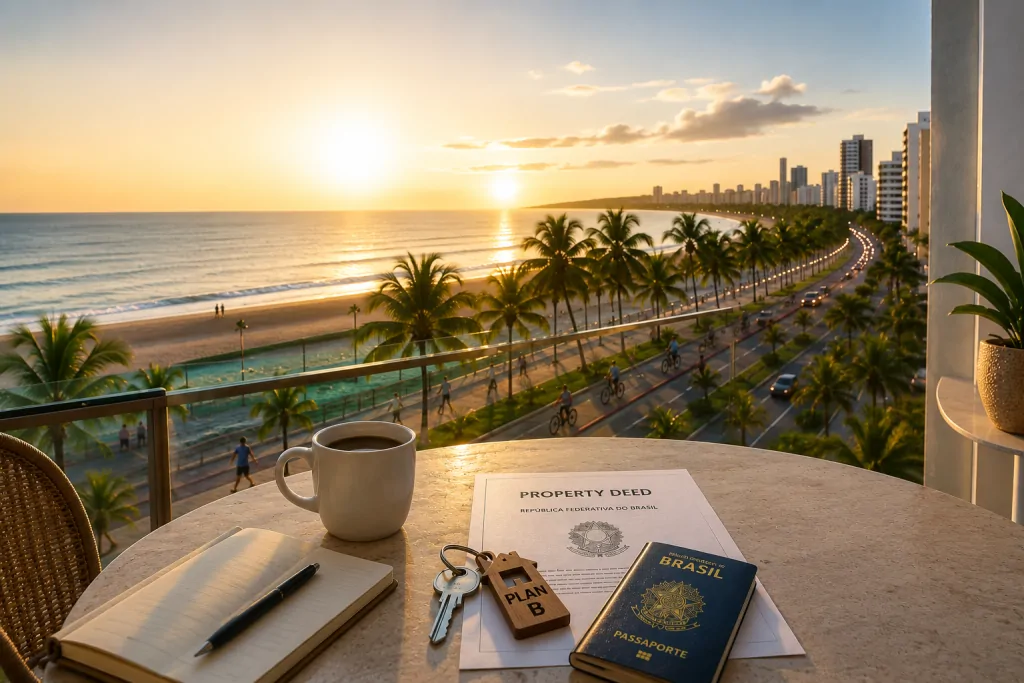
Every morning until eight, you can walk straight down the middle of this palm-lined beach avenue, and feel like the whole coast was built for people, because there isn’t a single car in sight.
That’s because this city clears its main beach road of traffic every morning from 5 to 8am, and it feels like half the population is already out walking, running, and cycling on it before the tropical heat arrives.
The water is warm, the way it stays all year round. A 25-minute Uber across town just cost about five dollars. A dinner in a simple but nice cafe on the beach is sub $10.
This is João Pessoa, a midsize beach capital on Brazil’s northeast coast, at the easternmost tip of the Americas, where locals like to say the sun rises first in the New World.
It’s safer and calmer than the Brazilian cities you’ve probably heard of, a good deal cheaper, and almost no foreign buyers have found it yet.
But the few who have bought here figured out something the rest haven’t.
A beach apartment here isn’t only a vacation home. Buy one and you become a legal resident of Brazil— a home and a Plan B in one.
This type of Plan B usually starts by accident. You travel somewhere, you like it, you go back. A few days becomes a few weeks. Eventually you find yourself scrolling the local property listings, and one day you buy the place you keep returning to.
At first it is just a home you use a few weeks a year. But the world keeps getting stranger, and slowly it dawns on you that if things ever got truly crazy back home, you already have somewhere else to be. That quiet knowledge is worth more than the view.
Brazil makes this an easy choice. Foreigners can buy property in their own name, with the same ownership rights as locals.
Here’s where it becomes a Plan B. Brazil offers a path to residency through real estate: buy a qualifying property and you can apply to live there legally.
Brazil wants investment flowing into its poorer, less-developed north, so it set the price threshold lower in certain regions. The north is already cheaper to buy in. So not only do you spend less to qualify, you get more for what you spend.
Plus, to keep the residency active, you only need to spend two weeks in Brazil every two years.
Most people get this part wrong. They picture uprooting their life, learning a new bureaucracy, becoming an expat.
You don’t have to move anywhere. You hold the option from a beach chair, two weeks at a time.
And it doesn’t have to sit empty the rest of the year. You can rent it out to cover your costs. Tourist demand on a warm-water beach runs year-round, and the costs are low— condo fees on a big coastal apartment often run a couple hundred dollars a month.
The real value shows up on the day you hope never comes… again.
When governments slammed their borders shut in 2020, a tourist visa meant nothing— non-residents were turned away at the gate. Legal residents were still let in.
That’s the whole point of residency, and it’s an invisible insurance policy right up until you need it. In a crisis, being a resident versus a tourist makes all the difference.
That’s the trick of a good Plan B: not a bunker you flee to, but a place you already love that happens to come with the right to stay.
It helps that Brazil is, right now, about the cheapest place in the Western Hemisphere to run this play.
It got here the hard way. When the commodity boom broke in 2014, Brazil fell into recession, impeached a president, churned through corruption scandals, and rode out COVID and brutal interest rates. In dollar terms, property got cheap: the average asking price is about $1,947 per square meter, roughly where it sat in 2010— and cheaper still after inflation.
Mexico, the obvious alternative, got the opposite. Remote-work money and North American buyers flooded in after COVID and ran prices up. Brazil never got that rush. It’s farther, it speaks Portuguese, it’s more of a hassle to reach— and that’s exactly why it’s still cheap.
Of course, Brazil still has its problems. And it is not for everyone.
The point is not that Brazil is the right Plan B destination, but that building a Plan B is not as radical as it sounds.
It can start as simply as taking a few good vacations somewhere you might actually want to live one day.
This week, our flagship service, Plan B Confidential, published the first part of a deep dive on Brazil’s coast— the best beach markets, the residency thresholds, and the mechanics of buying, renting, and the tax side.
But Brazil is only one option.
You can gain residency through property purchases in places like Greece, Panama, Latvia, and Cyprus as well. Others, such as Mexico, Spain, and Costa Rica only ask you to prove you have a certain amount of savings or income so you won’t become a burden to the state.
Our research walks through all of them— what each country asks for, what it costs, and what it actually takes to qualify. You can read through it from your couch and narrow the whole world down to the two or three places worth a real look.
That’s the cheapest way to start: exploring the world on paper, before you spend any real time or money on the ground.
If you’d like to see everything Plan B Confidential covers, you can learn more here.