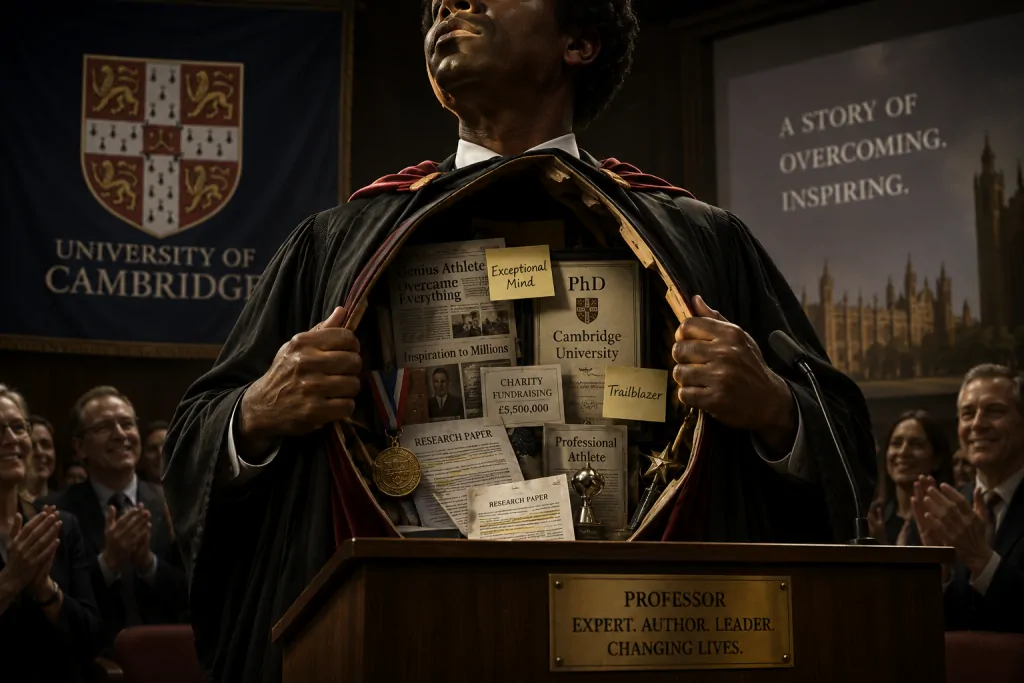
In 2023, Jason Arday became the youngest black professor in Cambridge University’s history.
His story, as told in a decade of glowing profiles, was the stuff of Hollywood. Arday was autistic and nonverbal until age 11, and could not read or write until 18. He was epileptic, yet ran 30 marathons in 35 days, and later 600 miles in six days.
He beat a brain tumor around the time he finished his PhD. He had played both soccer and snooker at a professional level, raised millions of pounds for charity, and even appeared as a child in “Seven Up,” the most famous documentary series in British history.
Everyone printed his story without question: the BBC, CBS News, the universities themselves. For years, nobody blinked.
There was just one problem. It was all made up.
And it should have been obvious. “Seven Up” began filming twenty-one years before Arday was born.
Arday made the claim he was on the original show in a 2022 interview, and no one bothered to do the math to realize that it was impossible for him to be on the show. It was the same as claiming that he had been part of the cast of Gone with the Wind.
Yet only this summer, when confronted with the arithmetic, did he start to change his story and insist that he had been talking about some other project, not “Seven Up”.
The rest of his resume crumbled the same way. On July 30, the University of Bath corrected a blog post that had him playing professional soccer and touring professional snooker, and apologized to Arday for allegedly misquoting him.
His fallback claim, semi-professional soccer for a club he never names, conveniently can’t be checked; snooker’s databases record one amateur match with zero prize money.
Reporters hunting for the money behind his claimed £5.5 million in charity found traceable donations in the thousands.
So how does a resume this fake survive for eleven years? Because at every step, the institutions whose job it was to check decided to just believe instead.
It started in 2015, when Liverpool John Moores University awarded Arday his PhD. His examiners missed more than 100 passages copied nearly verbatim from another academic’s 2009 thesis.
By September 2025, Times Higher Education, Britain’s leading academic publication, had built a 63-page dossier documenting the plagiarism. Arday’s defamation firm, Carter-Ruck, sent the magazine a letter calling its reporting a “targeted campaign” that “may be, whether consciously or unconsciously, racially motivated.” The magazine killed its own story.
Its reporter, Jack Grove, kept asking questions anyway. So the Metropolitan Police opened a harassment investigation into Grove, for emailing a professor questions about his resume, and warned him to stop because Arday’s mental health was suffering.
In March 2026, Liverpool John Moores University finally examined the plagiarism and ruled it “honest and reasonable error.” An analysis commissioned by the Telegraph would later put the odds of that “honest” overlap occurring at roughly one in 100 billion.
The PhD stood. Arday never disputed the copying itself; his defense was that he hadn’t received adequate supervision, given his autism and learning disabilities.
Cambridge knew about all of it and did nothing. So in June, one of its own faculty members gave up and handed the case to an outside academic, Nathan Cofnas. He published everything in late July, and within days the real story of Arday’s lies were being reported in the press.
Cambridge’s response was to declare Arday the “victim of a vile campaign to undermine his credibility.”
As the scandal grew, Arday sat for an interview with the Guardian, a paper with no history of hostility toward progressive academics, and piled on new details to the story of his victimhood.
Arday claimed that a masked man had confronted him at his faculty building on two occasions, producing a knife the second time. Someone had mailed a severed pig’s head to his parents.
Then the paper did something Arday clearly wasn’t expecting. It checked.
Cambridge’s security cameras had captured no masked man on either occasion. The Metropolitan Police said Arday’s account of the pig’s head was “categorically” incorrect, and the London butchers the reporters contacted said no police officer had ever investigated. As one put it, “That’s the kind of thing we’d remember.”
When the Guardian came back empty-handed, Arday explained the entire phenomenon in two sentences: “To be honest with you, I thought you’d just believe me. Why would I lie?”
Unquestioned belief was the only treatment he had ever known. That sounds like quite a privilege.
On August 1, the Guardian published its full fact-check of Arday’s persecution story. Cambridge held out for four more days, then announced on August 5 an investigation into Arday’s “academic qualifications and honorary appointments.” Bear in mind, those are the same qualifications it had spent three years celebrating. Arday resigned within hours.
It took eleven years, a whistleblower, a killed exposé, a police file, and national headlines to get one professor’s resume checked. Who knows how many others never make the papers.
Jussie Smollett faked a hate crime. Elizabeth Warren faked being a Native American to be labeled a minority professor at Harvard.
Arday said hold my beer and watch this. And, shielded by his victim status in the world of academia, he got away with the most egregiously absurd lies for over a decade.
A fraud in an ivory tower would be harmless if the ivory tower stayed out of your life. It doesn’t.
Academia is where government shops for its experts: Lina Khan went from Columbia law professor to running the Federal Trade Commission at age 32, where she spent her tenure protecting Americans from cheaper groceries, discounted liquor, video game mergers, and a handbag monopoly.
The COVID lockdowns arrived stamped with academic credentials, and so did gender ideology, critical race theory, and every other policy with “the research shows” attached.
The scandal was never one fibbing professor; it’s that the entire “expert” class gets vetted this carefully.
Arday, at least, finally quit. The institutions that spent eleven years enabling him are still there, still certifying the next crop of experts, still expecting you to just believe them.