
It’s so simple, how could no one have thought of this before?
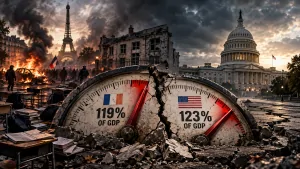
The man currently polling in second place to become the next President of France has put forward an ingenious solution to tackling France’s national debt, currently standing at around 117% of the country’s GDP.
Jean-Luc Mélenchon says, “All we have to do is take the 18% held by the Bank of France and chuck it in the fire.”
This is the guy who has a real shot at running the second-largest economy in the eurozone, and he’s telling voters that roughly €636 billion of what their government owes can simply be erased.
And the voters like the sound of it. Of course they do, who doesn’t love getting something for nothing?
Quick economics lesson for the brilliant man who wants to lead France: the Bank of France bought those bonds with euros it created for the purpose… the European Central Bank’s own explainer says buying bonds “creates money in the banking system.”
Normally those euros come back out of circulation as the debt gets repaid. Mélenchon’s plan skips that part: the government ‘throws the debt in the fire’ and doesn’t pay it back. So the central bank eats the loss… meaning that the €636 billion conjured out of nothing stays in the system.
This creates inflation, plain and simple.
Goods and services cannot be created out of nothing. Euros can. So when there’s suddenly more money in the system relative to the same amount of goods and services, the end result is inflation.
The other obvious implications is that France would still owe the rest of its debt… and those lenders will have seen that France is willing to default. I wonder what that would do to French bond yields?
Or maybe they’ll rest easy with Mélenchon’s assurance that “I’m not going after private creditors, not at this step in any case.”
Why do French voters even care about the national debt? Because they’ve been feeling the consequences of idiotic fiscal policy for years.
Interest alone costs the French government more than its entire defense budget. There’s no taxing their way out, either: the French are already the second-most-taxed people in the developed world, at about 44% of GDP.
So every fix takes some benefit away from taxpayers. Last year’s plan canceled two public holidays, froze pensions, and cut civil-service jobs… and the prime minister who proposed the solutions was thrown out.
The plan before that raised the retirement age from 62 to 64 brought the biggest protests France had seen in decades; that plan has now been suspended to keep the current government alive.
Meanwhile, growth was less than 1% last year, and unemployment is at its highest since 2020.
And here comes Mélenchon with a plan that costs nobody anything: delete a portion of the debt and go back to spending as if everything is OK.
However dumb the solution, at least the French are talking about the problem.
The US government crossed $40 trillion in debt last month. That’s roughly 123% of GDP, worse than France.
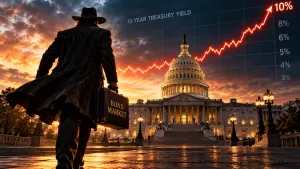
America gets away with it, for now, because the dollar is still the world’s reserve currency. Central banks hold a lot of their strategic financial reserves in US Treasury bonds, so Congress has always had a line of foreigners waiting to lend it money no matter how large the deficit.
But that line of foreigners is now getting shorter. Foreign holdings of Treasuries fell by $72 billion in June alone, China’s are at their lowest since 2008, and so far this year foreigners have bought just 7% of the new debt the US government issued.
The reasons aren’t a mystery: a dysfunctional government that can’t even pass a budget or eliminate fraud from its spending, while increasingly weaponizing access to the US dollar system.
When the foreign buyers stop showing up, America finds itself with France’s problem. Automatic cuts to Social Security are only six years away. Interest on the debt is already larger than the defense budget.
Extreme government spending is already pushing inflation higher… and socialists are everywhere now promising to spend even more.
These people genuinely believe that money is something you can conjure out of thin air with no consequence.
But whether they cancel the debt, or simply continue to ignore it, the consequence ultimately comes back to inflation.
That’s because conjuring money out of thin air, or borrowing from future generations to spend today, doesn’t produce one more barrel of oil, one more bushel of wheat, or one more pound of copper. It just produces more euros and dollars.
America has been here before.
Through the 1970s the US government ran deficits for Vietnam AND a historic expansion of welfare spending… then cut the dollar’s last link to gold in 1971. They created new money to cover the difference.
Consumer prices doubled over the decade, and the Dow finished 1979 where it started 1970, which after inflation was a loss of about half in real terms.
Meanwhile, gold went from $35 an ounce to $850. And oil went from about $3.40 a barrel to nearly $30. The world’s most important (and scarce) resources not only held their value, but they dominated. And the companies that produced them did far better.
Over roughly the same stretch, Barron’s index of gold mining stocks rose more than 1,200% while the S&P 500 managed 43%.
The new money has to go somewhere, and it flows into whatever the government cannot create more of.
Today, a lot of the companies that produce those real assets like metals, energy, food, and the ships that carry them, are still cheap.
We find them for subscribers of our investment research newsletter, Strategic Assets.
Gold and silver moved first, as central banks started diversifying out of the dollar. A small silver producer we featured in April 2025 rose more than 10x in ten months. A gold producer has gone up 5x, yet it’s earning money so fast that the stock is cheaper against its earnings today than the day we wrote it up. It pays a dividend, too.
Now the rest is showing life. A zinc producer we featured is up more than 150% in under a year. A tin miner is up more than 230% and trading at all-time highs. Two oil tanker owners we bought when nobody wanted them are up more than 150% and 110%, and one just reported the best quarter in its history.