
Hardly a week goes by without another data center announcement, and the projects have gotten so big that they’re now measured in gigawatts.
A gigawatt is a billion watts of electricity. Running around the clock, one gigawatt is enough to supply about 800,000 average American homes— and a single large data center is now built at that scale.
The data center that Meta is building near El Paso is designed for a full gigawatt and comes online in 2028.
Plus Meta just announced plans to grow its campus in Louisiana to 5GW. And OpenAI’s Stargate program, spread across sites in several states, is planned for 10GW.
These projects are also spectacularly expensive, and even the richest companies on earth have stopped paying for them out of pocket.
Earlier this month Google borrowed $25 billion from the bond market. It was the company’s third major bond sale this year, which brings its 2026 borrowing to more than $70 billion.
Google needs the money because its capital expenditures budget this year is about $200 billion, and in Q2 they spent more cash than they brought in for the first time in more than two decades.
Meta is doing the same thing. In late July, a BlackRock-led group raised $12.5 billion of debt for that El Paso site, where Meta will be the sole tenant for twenty years.
The group had to pay about 7.5% to get the deal done, one of the highest yields on any blue-chip data center bond to date. That comes on top of the $25 billion in bonds that Meta sold in May, and another $30 billion borrowed for the Louisiana campus.
And that’s just two borrowers. The total borrowings right now related to AI and data centers is truly staggering.
But it’s not just tech spending that’s driving the bond market. Let’s not forget about the US federal government, which is on track for a $2.1 trillion deficit this fiscal year.
That’s just the NEW amount of debt they have to borrow this year just to keep the lights on and pay all the Somalis.
The White House is asking Congress for a $1.5 trillion Pentagon budget next year, more than 40% above this year’s and the largest defense request (as a percentage of GDP) since World War II.
So between tech spending and the federal deficit, that’s already several trillion dollars in capital that needs to be borrowed from the bond market… THIS YEAR.
Here’s the problem: America’s “net private savings”, i.e. the sum of ALL undistributed corporate profits, plus total household net income, is only about $2.2 trillion.
In short, the federal government already requires nearly ALL of the net private savings from literally every household and every company across America… just to make ends meet.
Meanwhile the biggest foreign lenders are backing away.
Japan, the UK, and China— the three largest foreign lenders to the US government— all cut their Treasury holdings in June. China now has their lowest Treasury holdings since 2008, down more than 13% from last year.
In short, foreigners are not coming to the rescue. So there is very little capital left over to lend for data centers and AI expansion.
And that says nothing about the tens of millions of other borrowers— small businesses, home buyers, etc. who need to borrow money.
This is why interest rates are rising— it’s simple supply and demand: demand for capital is at an all-time high. Yet supply of capital (at the moment) is fixed. And when the supply/demand fundamentals of capital get out of whack, interest rates rise.
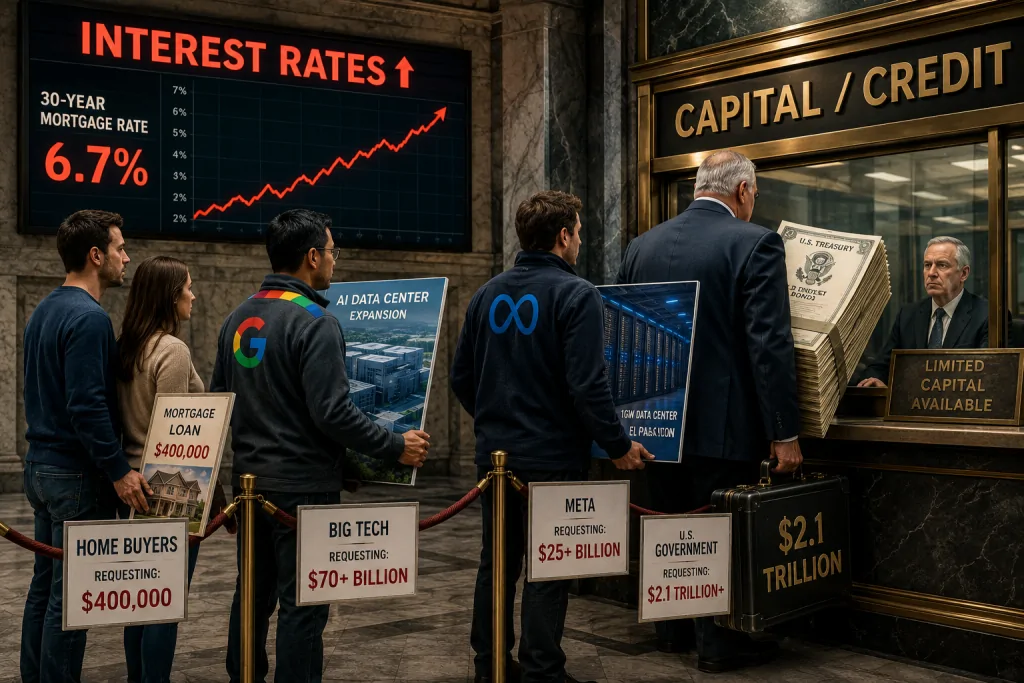
Families who need to buy a home now are standing in the same line as Google, Meta, and the Treasury Department, competing for the same money.
That’s why the average 30-year mortgage rate is 6.7%, and will likely go MUCH higher from here…
… unless the Fed starts printing money again.
Technically the Fed doesn’t physically ‘print’ anything, it’s all electronic. And they don’t call it ‘money printing’, because that would be too embarrassing. They refer to it as ‘quantitative easing’. But it has the same effect— increasing the supply of capital to meet the demand, thus causing interest rates to fall.
Mortgage rates fall. Treasury yields fall. Everyone is able to borrow for less.
Which sounds great… except that conjuring money out of thin air invariably triggers more inflation. So if you can borrow more cheaply but have to pay more for everything, are you really any better off?
It’s obvious the White House wants the Fed to cut rates… which means firing up a fresh round of Quantitative Easing. And Congress certainly won’t mind being able to borrow more.
Pretty much all politicians, regardless of party affiliation, want lower interest rates. Given the choice between high mortgage rates and higher inflation, politicians will pick higher inflation every time.
And that’s exactly why it makes sense to have a Plan B.