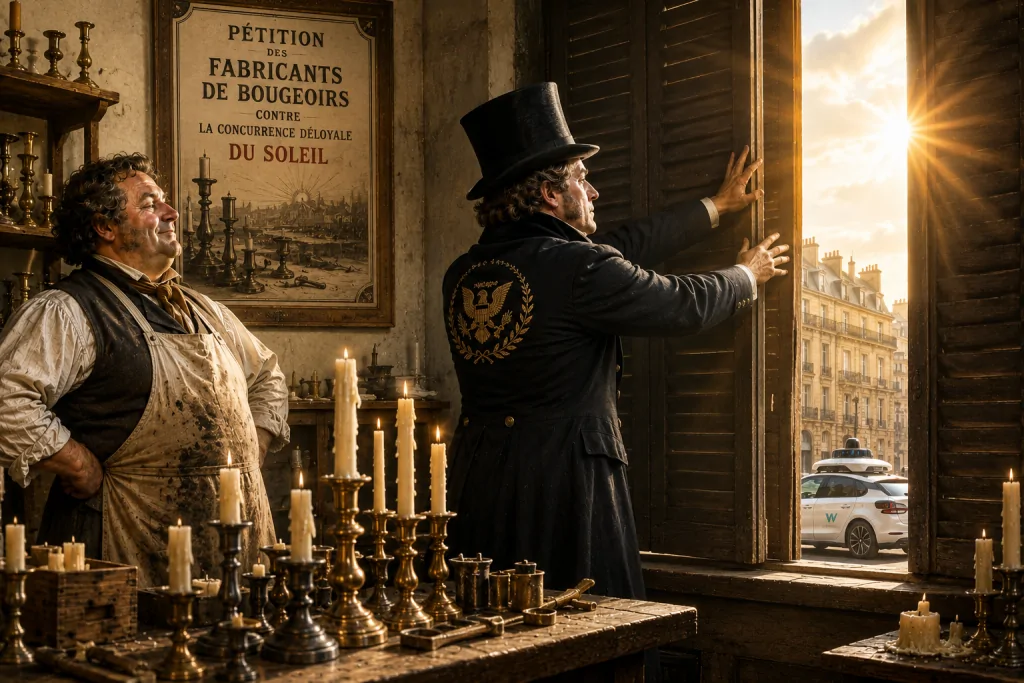
In 1845, the French economist Frédéric Bastiat petitioned parliament on behalf of the nation’s candlestick makers. They were being ruined, he wrote, by an unscrupulous rival that was flooding the market with light at a price no honest candlestick maker could match.
This light-producing rival, of course, was the sun.
And Bastiat satirically demanded “a law requiring the closing of all windows, dormers, skylights, inside and outside shutters, curtains… in short, all openings, holes, chinks and fissures” to ensure that no sunlight could enter French homes.
Think of the jobs this would create. “If more tallow [curtains] be consumed, there will arise a necessity for an increase of cattle and sheep,” the petition argued. “Thousands of vessels would soon be employed in the whale fisheries [for oil].”
Bastiat, one of history’s most famous proponents of free markets, was obviously joking. He wrote the petition to mock the tariff wall that sheltered France’s industries from cheap foreign goods— block the cheaper competitor, protect the domestic producer, count the jobs saved.
No one counted the cost of protectionism: everyone else paying more for everything, and the whole country became poorer.
Yet decade after decade since, every new innovation has been met with exactly this kind of uproar. And nobody is joking.
It wasn’t so long ago that taxi drivers were up in arms over Uber undercutting their prices. In June 2015, nearly 3,000 of them shut down parts of Paris, burning tires and blocking airport roads, because Uber’s cheap service didn’t require the professional taxi license that could cost $270,000.
The French government caved within a day, ordering police to seize the unlicensed Uber drivers’ cars.
Now the wheel has turned. Waymo’s robotaxis launched in Atlanta in June 2025, bookable through the Uber app of all places. And Uber drivers say the competition is cutting their pay.
Naturally the Atlanta Rideshare Drivers Union wants the city to slap a $0.50 to $1.00 fee on every robotaxi ride, paid into a “driver transition fund,” plus a ban on robo pickups at the Atlanta airport.
If only they could tax the sun for the candlestick makers.
The federal government runs the same play, just bigger.
In January 2025, the Commerce Department finalized its ‘Connected Vehicle Rule’, which bans cars with Chinese-linked software from the US market, starting with the 2027 model year.
The stated reason is national security: keeping foreign adversaries out of the cameras, microphones, and GPS units on American streets.
That’s a real concern, to be fair. But then came the carve-outs.
Volvo, majority-owned by China’s Geely, got authorization in May to keep selling. Ford, after talks with the department, decided its China-built Lincoln Nautilus doesn’t need an exemption at all.
But Polestar— owned by the same Chinese parent as Volvo— was shut out and is leaving the US market.
The Commerce Department doesn’t publish these decisions or its reasoning, so nobody outside the building knows why one Geely brand got a green light and the other got kicked out of America.
Let’s be honest: if these Chinese cars were really a security threat, there would be no carve-outs to negotiate. There would be a flat ban. No exceptions.
The real threat of cheap Chinese cars is to the profits of American automakers; Chinese cars are very inexpensive— like a decent quality mid-size SUV for around $20k. So many US buyers would start driving Chinese that the American automakers would either have to adapt and compete… or suffer catastrophic losses.
The end result of these bans is less competition, meaning Americans end up paying more for their vehicles.
Just add this to the long list of things which governments, from city councils to federal regulators, make more expensive.
Yesterday we wrote about how federal influence over local building codes adds $132,000 to the average new home.
Today it’s how they’re making buying a car and taking a quick trip more expensive.
Ask California how it’s doing on that nonexistent high-speed rail… $15 billion and 18 years in, without a mile of track. Or ask Europeans, where climate fuel mandates are already tacking surcharges onto every plane ticket.
The receipts are everywhere: everything the government touches becomes more expensive.
College tuition is up about 1,200% since 1980— the surge began as soon as the federal government made itself the nation’s student lender.
Since Obamacare passed, the average family health insurance premium has nearly doubled.
Even junk food became more expensive due to government food subsidies; in fact the moment 18 states pulled soda and snacks off the food stamp list, PepsiCo cut prices on Doritos and Lay’s by up to 15%.
Housing, transportation, food, healthcare, education— all swamped by government interference, all quickly became less affordable.
And underneath all of it, bringing the whole pot to a boil, is the inflation that politicians and regulators caused with their own spending.
Yet who do they blame? Greedy corporations.
Inflation has nothing to do with greed. It has everything to do with incompetence and irresponsibility.
Bastiat’s joke was that nobody would ever actually file the candlestick makers’ petition. Yet 181 years later, what started as satire is taking place every single day.
A political class that treats cheaper goods and services as a threat is deliberately choosing to make the country poorer.
P.S. A government that treats cheaper as a threat isn’t going to start choosing growth anytime soon. That’s exactly why we publish Plan B Confidential— our flagship research on legal, practical ways to diversify your savings, your income, and even your residency beyond any single government’s bad decisions. Click here to learn more.