
Somewhere in America there’s a local ordinance that tells you which way your garage has to face.
Another one dictates what your fence can be made of, and a third sets how many square feet of window your house needs. A few spell out the dimensions of particular features down to a quarter of an inch.
The National Association of Home Builders, the trade group for the companies that build American homes, has been adding up what rules like these cost since 2011.
Its reasoning is simple: the country is short about 1.2 million homes, and rising regulatory costs are one of the things keeping builders from closing that gap. So anyone writing new rules ought to know what the existing ones already cost.
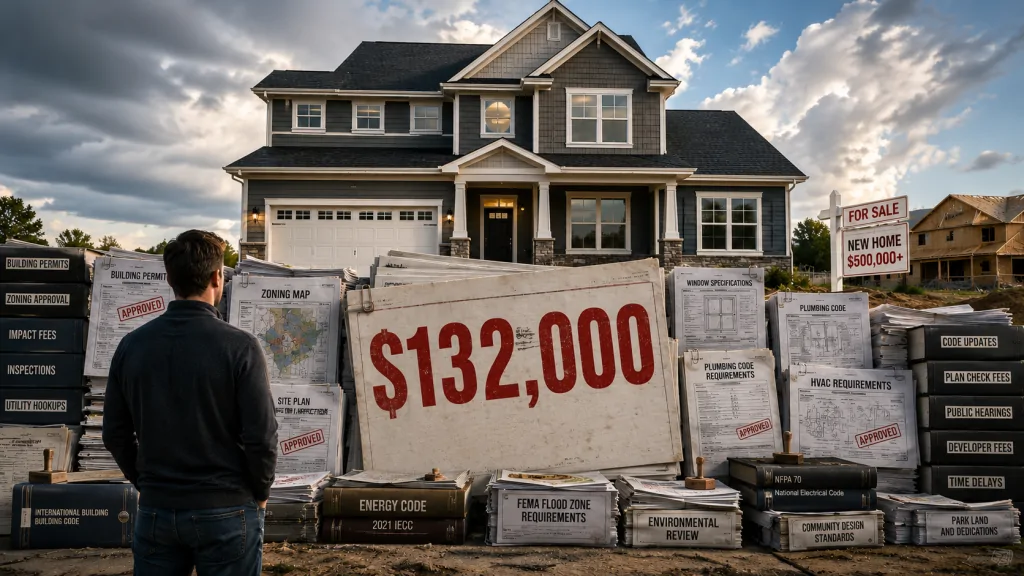
Government regulation now adds about $132,000 to the price of a new home.
That’s just over a quarter of the roughly $500,000 the average new house sold for in January.
Builders said that ten years of changes to the building code added about $40,000 to the cost of a house. That’s the cost to buy the extra materials and labor each new edition of the code demands… whether or not the buyer wanted them.
Some of those rules are reasonable— hurricane-rated windows on a house within a mile of the shore, or shock-proof breakers on the circuits that run the stove and the dryer.
But those same code changes also decided that a hot-water pipe can’t run more than 100 feet, that the outlet on a kitchen island has to pop up out of the countertop, and that an ordinary draft-vented furnace needs its own sealed, insulated room with an outside air vent.
None of those is a matter of life or death; even the furnace is an energy-efficiency rule, and the homeowner doesn’t get to decide whether the upfront cost is worth the long term savings.
Codes get adopted locally, but the model codes that cities and counties copy are drafted with help from the Energy Department, FEMA, and the EPA.
The study notes, almost in passing, that “DOE also has a budget to persuade state and local governments to adopt more stringent codes.”
In other words, a federal agency spends tax money persuading your county to make your house more expensive.
Just the energy part of the code adds between $9,600 and $21,400 to a home built to the 2021 version, and NAHB estimates it can take the buyer up to 90 years to recoup that money in lower utility bills. So maybe your grandkids will thank you, assuming the house is still standing.
This cost was made a federal requirement— a condition of every FHA and USDA loan on a new house— until a judge ruled in March that it violated the government’s own affordable-housing law. But it still stands as the building code in roughly a dozen states.
Then come the fees. Permits, inspections, impact charges, and utility hookups add about $20,000 per house after the builder buys the lot.
Like any medieval lord, the local government also takes its tribute in land. More than 85% of developers have to hand part of their parcel to the town for a park or keep it as open space, at a cost of about $13,600 per home. Of course that cost is passed on to the buyer.
Regulation also costs time, and the study only quantifies about half that cost. More than 90% of developers report delays averaging about seven months, and more than a year passes between the zoning application and the first day of work on the site.
The study puts the delay itself at about $4,000 a house. It doesn’t count the opportunity cost, or how delaying new housing supply raises the costs of everything else on the market.
And it’s quickly getting worse. Five years ago the same study put the total regulatory cost per home at about $94,000. It’s up more than 40% since then— and it has doubled since 2011.
Disposable income in the US rose 18% over the same five years. So the cost of obeying the rules is growing twice as fast as anyone’s ability to pay it.
Notice that these costs have nothing to do with greedy builders or Wall Street landlords.
Many builders have been cutting prices every month for well over a year, and new homes still aren’t selling. They’re sitting unsold— in a country that’s short 1.2 million homes— because a builder can only cut so far before he’s selling at a loss.
Ironically, on top of the federal government pushing a rule that violated its own affordable-housing law, NAHB suspects some of the rules have less to do with safety or efficiency and more to do with “aesthetics, or possibly even, in some cases, a desire to price less affluent residents out of particular neighborhoods.”
Yet the same city councils that pass them will tell you affordable housing is their top priority.
And homebuilding is just the one industry that bothered to add up the cost of insane government regulation.
The same thing happens anywhere the government writes the rule book.
Want to build a power line, a pipeline, or a mine? The White House’s own environmental council found that the average federal environmental review takes four and a half years before anyone breaks ground.
The National Association of Manufacturers puts the cost of complying with federal rules at about $3 trillion a year, roughly 11% of GDP.
All of this strangling regulation is a big part of why the economy can’t grow faster, and right now the US needs growth badly.
The national debt just crossed $40 trillion, and Congress refuses to cut a cent, even when the spending is obvious fraud.
That leaves two ways out. Either the economy grows faster than the debt, which means the country builds more, makes more, and starts more businesses than it does now… or the government prints the difference.
Without a regulation-destroying bonanza, it’s obvious which one happens. If the government can’t rein in the rules, it can’t rein in the debt. And if it can’t rein in the debt, it can’t rein in inflation, because printing the money is the only option left.