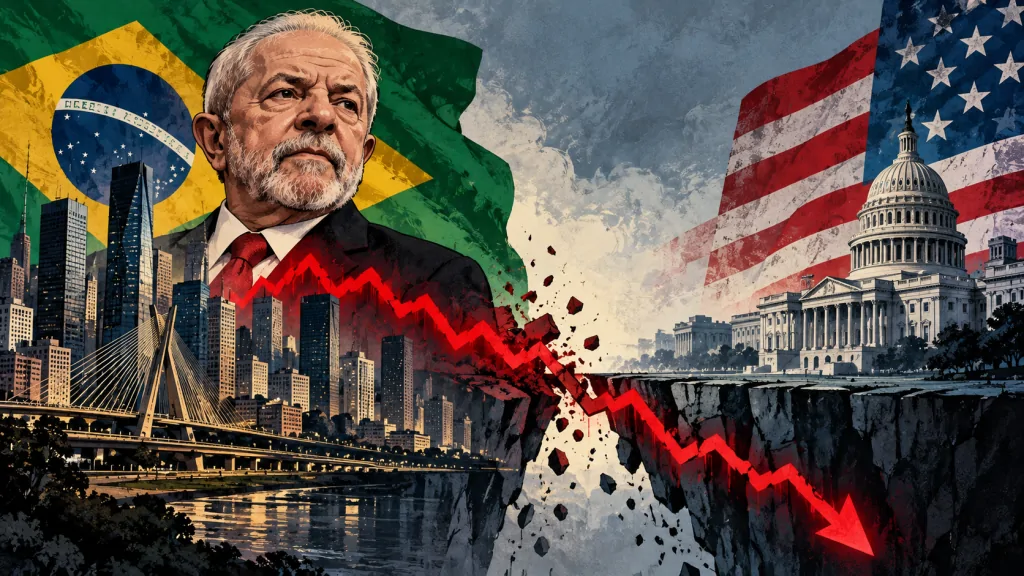
On Sunday night, Brazil re-elected its left-wing president, Lula da Silva. On Monday morning the São Paulo stock market fell so hard at the open that the exchange halted trading for the first time since the pandemic.
When trading resumed, Brazil’s stock market kept falling.
It wasn’t a minor decline, or even a sudden correction. It was a full-blown stock market crash— down about 14%, its worst day since COVID. And Brazil’s currency, the real, lost about 8% against the dollar, its worst day since the 1990s.
Bear in mind that nothing about Brazil’s economy changed over the weekend. Investors had simply bet on the other guy.
Most polls had Senator Flávio Bolsonaro, who promised to rein in government spending, winning the election. Lula, a socialist, won instead, and investors expressed their dissatisfaction by dumping every Brazilian asset they could find.
It got worse. Within a day of losing the election, Brazil’s Supreme Court ordered Bolsonaro (the guy who lost) to hand over his passports.
Suddenly he was the target of a money-laundering investigation… and apparently the day before the election there wasn’t enough evidence to take his passports?
What a soap opera. But it got me wondering how far behind the United States is. I don’t think a post-election crash like Brazil experienced is far-fetched anymore.
Think about the debt. Brazil’s government spends about 25% of its tax revenue just paying interest. That sounds like a banana-republic number. But in the fiscal year that just ended, the US government paid $1.36 trillion in interest… also roughly 25% of its tax revenue.
The 10-year Treasury yield, i.e. what the US government pays to borrow for a decade, hit a 24-year high this month and is still around 5%. A bond market crash from here means that rate jumping overnight to 6.5%, or 7%, because enough lenders decide at once they don’t want to be left holding US Treasury bonds anymore.
That’s what happened in Britain in 2022. Then Prime Minister Liz Truss announced a spending plan; the bond market didn’t like it, setting off a mini-crash. She had to resign in disgrace.
America’s next presidential race kicks off in a couple months, and one of the leading Democratic contenders is Gavin Newsom; this is a guy who helped destroy California with some of the highest taxes and most restrictive regulation in the country, plus climate rules that drove Chevron’s headquarters to Texas and shut two oil refineries.
Just wait and see what happens if Newsom gets the chance to do that to the whole country. And if it’s not him, it could easily be Democratic Socialist AOC.
Maybe there won’t be a full-blown stock market crash. But a panicked sell-off is definitely in the cards.
The Brazilian-style weaponization of justice is already a reality in America too.
Trump was indicted four times while out of office, and the FBI even took his passports in the Mar-a-Lago documents raid. Once he was back in power, his Justice Department returned the favor and indicted James Comey and New York Attorney General Letitia James, who had gone searching for something to get him on.
Now House Democrats are openly planning investigations and prosecutions of Trump officials the moment they take power.
Is it really far-fetched to think that, at some point in the next 2-3 elections, the loser feels compelled to flee the country?
These are real risks to think about. That doesn’t mean the world is coming to an end. Civilization as we know it is not on the brink of collapse.
But the key to a Plan B is staying rational and not letting fear direct your actions.
The Brazilians who had a terrible Monday were the ones with everything in one country, one currency, and one banking system. The smart ones had moved some of their savings, and some of their options, outside Brazil years ago, when nobody was frantic.
That’s the whole point of having a Plan B. You build it calmly, long before anyone has a reason to panic.
It starts with a place to go. Second residency abroad can give you a place to go if your home country ever becomes too chaotic or dangerous. It’s not a commitment to move. It’s an option.
It’s the same logic as any insurance policy. You don’t buy fire insurance because you want your house to burn down. You buy it to be protected in the worst-case scenario.
Interestingly enough, most good options are cheaper than where you live now. Thailand costs a fraction of what the US does. So does Argentina. In the Philippines, a single retiree lives well on $1,500 to $2,000 a month, and in Malaysia a good one-bedroom in a desirable neighborhood rents for about $400.
In other words, a Plan B can ALSO mean a quality lifestyle for less money.
A second passport is even more protection, because it’s forever. It can often be passed down to your children too. And there are different ways to get one, from ancestry, to naturalization after moving and living somewhere for a few years, to simply buying one through an investment program.
And then there is financial diversification, so that all your savings isn’t under the control of one jurisdiction— especially when that jurisdiction is the most indebted country in the history of the world.
Physical gold stored in a secure vault in a stable jurisdiction is a great way to keep some savings beyond a government’s reach.
Crypto is another excellent option. I’m not someone who thinks Bitcoin is going to magically become larger than the GDP of the known universe. But I do like that it’s decentralized— that you can effectively be your own bank by holding it offline (i.e. paper or memory wallet).
Real assets can also protect your wealth: productive farmland, energy, the metals that build everything, and the well-run companies that produce them. These are things the world requires no matter what the US dollar is doing. A government can print money by the trillion but it can’t print a barrel of oil.
None of this is exotic or particularly controversial. And none of it requires a crisis to make sense.
A second residency, a second passport, some savings and some real assets outside your home country are a few sensible steps that leave you with options no matter who wins the next election or what the bond market does the morning after.
P.S. Building a Plan B is what our flagship research service, Plan B Confidential, is for.
Every month it covers the specifics behind each piece: residency and citizenship pathways in the countries worth considering, foreign bank accounts, the best ways to buy and store gold, and the tax strategy to do all of it legally.
To have this all figured out before you need it, click here to learn more.