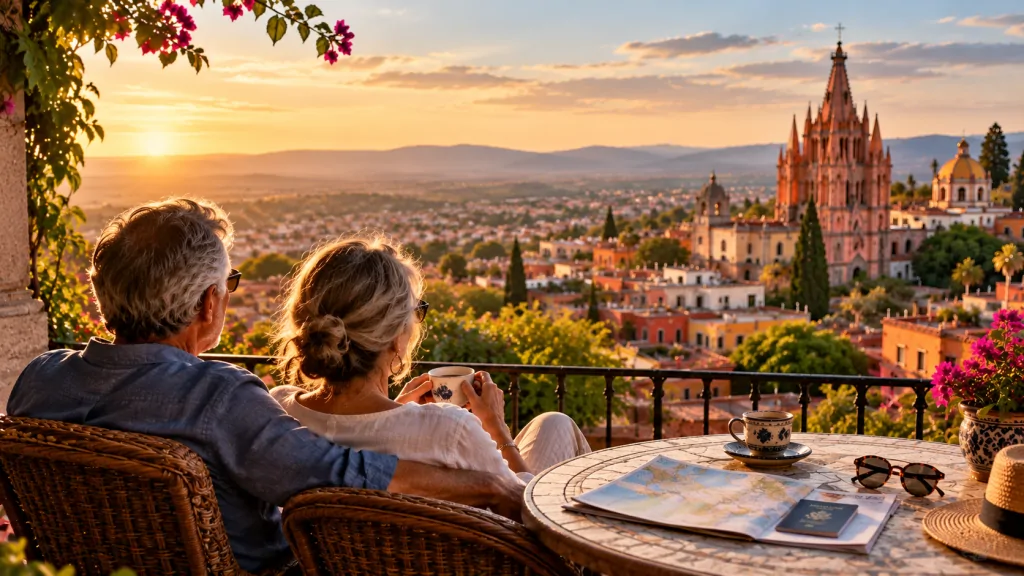
In the early morning hours of February 7, 1937, a young American named Stirling Dickinson got off a train in central Mexico and rode into San Miguel de Allende on a mule-drawn cart.
He and a Princeton classmate were months into a trip around Mexico looking for a quiet place to write, and a Mexican opera singer had told them to try San Miguel.
The town had been rich once, but by the early 1900s it was close to a ghost town. Dickinson looked up, saw the parish church rising out of the fog, and decided on the spot that he was staying. Ten days later he bought a house.
Within a year he was running the town’s new art school, and when World War II ended he spent a good deal of his time working his connections so that US veterans could study there on the GI Bill.
He had a strong pitch. The GI Bill paid a veteran’s tuition at any approved school, including Dickinson’s new art college. The GI Bill also paid a living allowance of $65 a month… and in San Miguel de Allende in the 1940s, $65 went a lot further than it did at home.
Life magazine noticed. In January 1948 it called the town a “G.I. Paradise” where veterans went to study art, live cheaply, and have a good time. More than 6,000 applied to Dickinson’s school after the story ran.
Many of the former soldiers stayed, and the town has had an American community ever since.
The US dollar still goes a lot further in some countries. And for retirees, a Social Security check is sufficient to qualify for residency in a lot of them.
Mexico still draws American retirees. But the Mexican government has raised the minimum income required to qualify for legal residency.
To qualify for Mexican residency, a retiree now has to show about $4,500 a month in income, or have about $75,000 sitting in the bank. These aren’t exactly insurmountable requirements for most, but it’s important to point out that the amount has increased substantially over the past few years.
Today’s average Social Security check, about $2,100, would have covered the Mexican requirement not long ago. Now it doesn’t come close.
And that Social Security check could soon get a lot smaller.
As we discuss frequently, Social Security’s main retirement trust fund will run out of money in 2032, according to the program’s own reports. After that, by law, the program can only pay out about 78% of scheduled benefits.
That’s an automatic 22% cut to every retiree’s check.
So for anyone retiring abroad, the question is no longer which country is cheapest, but which ones will still grant residency on the smaller check.
Two countries sit at about $1,000 a month.
Panama’s pensionado visa requires a lifetime pension of $1,000 a month, plus $250 for each dependent. It also comes with a lifetime discount card on everything from flights and restaurants to medical care.
Costa Rica’s retiree visa requires $1,000 a month from a lifetime pension too. A Social Security check counts in both cases.
Two more sit at about $2,000.
Thailand grants its retirement visa to anyone 50 or older with about $1,950 a month in income, or about $24,000 sitting in a Thai bank. Mauritius, an island nation in the Indian Ocean, wants $2,000 a month wired into a local bank account.
Then there’s the Philippines, which doesn’t test your income at all.
Its retirement visa requires a refundable deposit in a Philippine bank instead— $15,000 for a retiree over 50 with a pension. And you get the money back when you give the visa up. There’s no minimum stay either.
One more point in Panama’s and Costa Rica’s favor: both tax only income earned inside their borders, so neither touches a Social Security check.
Meanwhile, the cost of living in the US keeps climbing. The typical American rental now lists for nearly $2,000 a month, which is almost the entire check. A lot of places are simply cheaper, which is what drew the veterans to San Miguel in the first place.
In the Philippines, a single retiree lives well on $1,500 to $2,000 a month, and retired couples in smaller cities often do it on $2,000. A two-bedroom condo in Cebu rents for $450 to $700, and a private doctor visit costs $10 to $25.
Thailand costs about half of what the US does, with a furnished one-bedroom in Bangkok at $400 to $550 a month.
A Plan B means looking at the whole world as a set of options instead of assuming everything has to happen in the country you happened to be born in. A second residency somewhere that costs a fraction of what home does is one of those options, set up before you need it.
You don’t have to move. A second residency merely means you have another option. You could have legal residency in multiple countries and barely set foot there.
But if the cost of living at home becomes unbearable, you’ll have another option where your standard of living doesn’t fall.
P.S. Every program in this article has fine print the income test doesn’t show: an age floor, a minimum stay, what you can and can’t do with a deposit, and how the country taxes a pension once you’re a resident.
That’s what Plan B Confidential, Schiff Sovereign’s flagship research service, is for. Members get our country reports on Panama, Mexico, Thailand and the Philippines, with each residency route priced out, plus our research on second citizenships, foreign banking and legal tax strategies. Members also get our Rolodex of trusted contacts, from immigration attorneys to tax advisors.