It all started because the students wanted better quality education… and more teachers.
Many schools in France are overcrowded. Some lack teachers. Buildings are crumbing.
So, two weeks ago, students at a high school outside Paris blocked the entrance to their own school to protest these conditions. And the movement caught on; students at hundreds of other schools did the same.
By last week the protests had turned violent, when students (and then a bunch of people who clearly didn’t look like students) began setting fires and fighting riot police.
More than 5,000 people have been arrested so far, most of them teenagers, and 24 schools have been burned or ransacked.
Sure, this is a country where torching cars and burning down buildings is a national sport.
But it’s worth pointing out that France spends 57% of its ENTIRE economy on government. The average for rich countries is about 43%, and only Finland spends more.
So here’s a question the French might want to ask: what do you get for all that government?
For that kind of money, you’d expect the basics to be covered… like teachers. But France actually cut 3,000 teaching jobs this year, and plans to cut more next year.
At one high school in a poor suburb north of Paris, math, English, humanities, and gym classes have been canceled since the school year began because there’s nobody to teach them.
One student complained of being forced to take exams required for graduation without having had a teacher in the subject!
Yet the government spending 57% of GDP doesn’t buy proper education. Nor does it buy law and order. A protest by high school kids turned into nationwide riots, and the French state couldn’t stop it. Hundreds of students, school staff, and police officers have been hurt.
France has been here before. France’s 2005 riots began in a poor region just north of Paris, after two teenagers hiding from police were electrocuted in a power substation. The suburbs burned for weeks.
The same suburbs rioted again in 2023— and they were among the first places the school protests spread this fall.
Nearly a third of the people who live in that county are immigrants, the highest share anywhere in mainland France, and three times the national average.
France spent decades importing immigrants by the million and never bothered to integrate them. Twenty-one years after the 2005 riots, NOTHING has been fixed.
What’s crazy is that French people are demanding even MORE government to fix these problems that haven’t been fixed by their already gargantuan government.
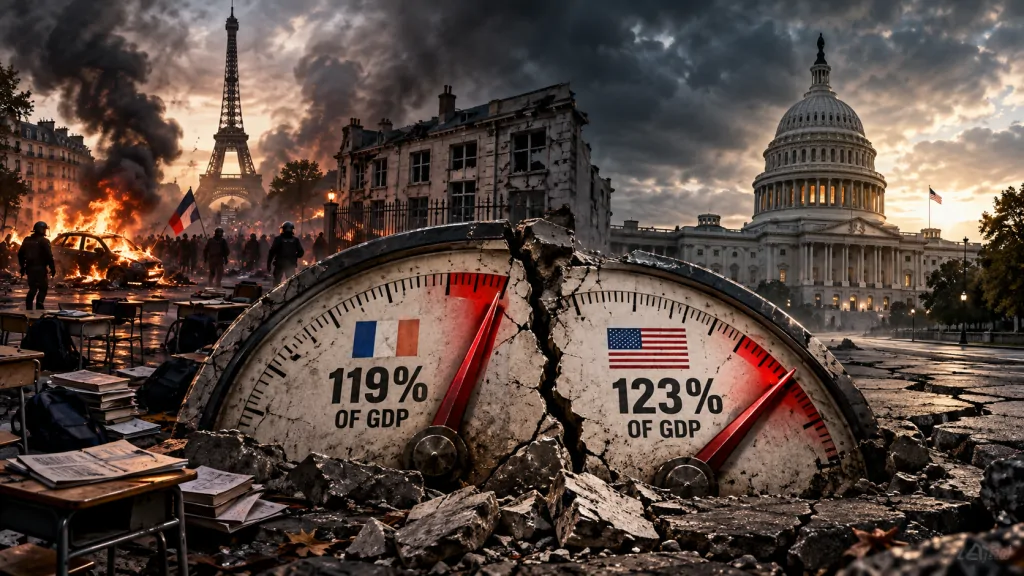
How do they plan to pay for any of it? The French are already the second-most-taxed people in the developed world, at about 44% of GDP. Yet even that doesn’t cover the spending, so the government borrows the rest. France’s national debt is now 119% of GDP.
On October 1, in the middle of the riots, the government presented next year’s budget. It expects interest on the debt to cost more than €90 billion. That’s far more than the €65 billion it plans to spend on schools, and more than it spends on its entire military.
In other words, France now pays more to its lenders than it spends on its schools OR its soldiers… and the interest bill is still growing.
Naturally, with multiple crises hitting at once, the hard left is ready to exploit the chaos.
Jean-Luc Mélenchon is a hard-left politician and one of the top three candidates in the polls for next April’s presidential election. As the protests turned violent, Mélenchon declared that the students were harmless and said the police response had “an obvious racist aftertaste.”
Mélenchon’s answer to France’s problems is MORE government. He wants to raise the minimum wage and lower the retirement age to 60.
(Remember, France already tried to fix its bankrupt pensions by raising it from 62 to 64. That caused riots too, so the plan was suspended.)
And his plan for the national debt is to simply cancel the part that France’s central bank holds.
Bottom line, France pays for more government than almost any country, and it barely even seems like an exaggeration to say its society is collapsing in real time.
France has done everything wrong, from borrowing to immigration, and now it can’t even do the basics.
But while France may be a more aggravated case, the similarities to the US are hard to ignore.
The US government owes more than $40 trillion, roughly 123% of GDP— worse than France. Interest on the debt is already larger than the defense budget.
America gets away with it, for now, because the dollar is still the world’s reserve currency. Foreign central banks hold a lot of their strategic financial reserves in US Treasury bonds, so Congress has always had a line of foreigners waiting to lend it money no matter how large the deficit.
But that line of foreigners is now getting shorter.
At peak (in 2011), foreigners owned nearly half of all marketable US Treasury bonds. Now their share is down to about 30%.
China in particular has cut its Treasury holdings in half since 2013, and they’re now at their lowest level since 2008.
When the foreign buyers stop showing up, America finds itself with France’s problem: lenders charge more, interest eats up more of the budget every year, and there’s less money left over for the basics.
France shows how quickly a society can devolve. And that’s exactly why it makes sense to have a Plan B.
P.S. You don’t have to wait around to see whether America ends up like France.
Schiff Sovereign’s flagship research service, Plan B Confidential, covers second residencies and citizenships, foreign banking, and legal tax strategies, with boots-on-the-ground reports from all over the world, so you can put the pieces in place before you’re scrambling.