[Editor’s note: This letter was written by Schiff Sovereign’s CEO, Viktorija, who is originally from Lithuania but splits her time between Mexico and Panama.]
The first thing I noticed at Seoul’s Incheon airport was the luggage.
People had just left their suitcases sitting there— against pillars, next to benches, by the exits— and wandered off to the bathroom or to grab a coffee. Nobody looked back.
Forget about thieves for a minute; just try leaving an unattended bag in a US airport, and watch the place go into lockdown while the bomb squad swarms in.
A few days later I was in a small local café when the woman next to me stood up, left her phone face-up on the table, and walked off. She was gone for several minutes.
When she came back, she picked up her phone like it was nothing.
South Korea is a high-trust society. When you’re on the ground, you feel it before you can explain it. People here just assume that everyone else is going to follow the rules, and they’re almost always right.
It’s not just the obvious stuff, like Korea’s ultra-low murder rate. It’s little things too.
Last year, for example, passengers on Seoul’s metro left around $300,000 on the trains— lost wallets, money that fell out of people’s pockets, etc. About three-quarters of that cash was returned to the rightful owners. Crazy.
The Seoul subway, by the way, is the best I’ve ever been on— and I’ve been to more than 100 countries. It’s spotless, the trains show up when the sign says they will, and a ride costs a little over a dollar.
I’ve been to Seoul before, but this time I was blown away by how much had changed. The whole city feels like living in the future.
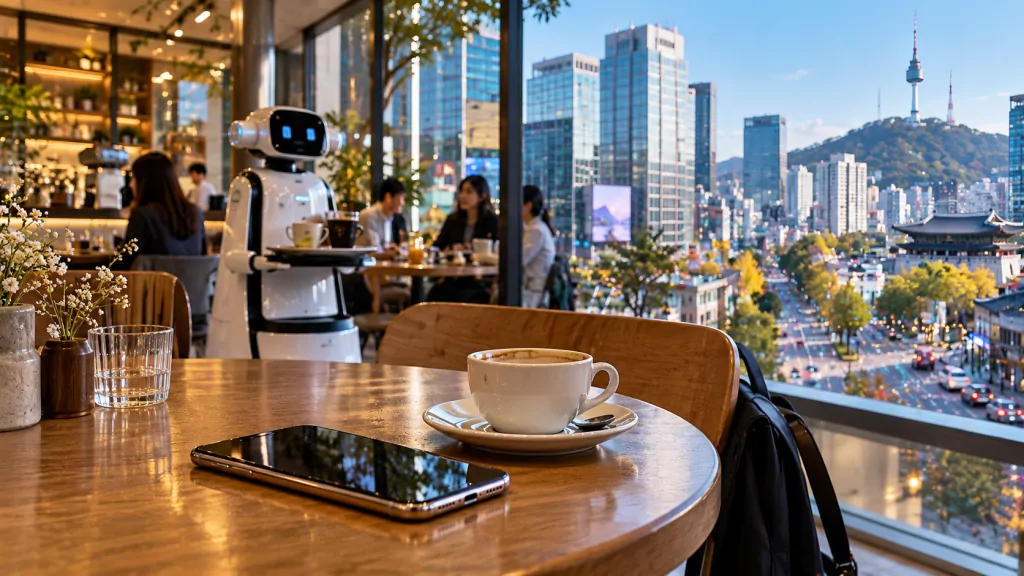
At one café, my espresso was made by a robot. At my hotel, room service arrived on a robot that drove itself down the hallway, stopped at my door, and handed over the tray.
And nobody else seemed to find any of this remarkable.
The factories are even farther along. South Korea has more robots per factory worker than ANY country in the world— about four times as many as the US.
Korea needs them. It has the same problem as America and nearly every other rich country, only worse: people aren’t having enough kids. Korea’s birth rate is one of the lowest in the world, and its working-age population is already shrinking.
But instead of waiting around for the worker shortage to solve itself, the Koreans are building machines to do the work.
I think about economic growth a lot; it’s a big part of my job at Schiff Sovereign. And South Korea’s is remarkable, if you know the backstory.
In 1960, South Korea was poorer than Ghana. Today it’s about fifteen times richer.
And the Koreans haven’t let up. South Korea puts more than 5% of its ENTIRE economy into research and development every year; only Israel spends more.
Most of that money comes from private companies. But the government keeps raising the bar too: this year’s research budget is the biggest in the country’s history.
It’s not just robotics— it’s everything from semiconductors to medical research.
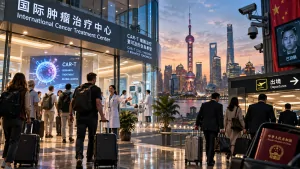
In fact medical treatment is a booming industry; about two million foreigners came to Korea for medical treatment last year, which is a record. Most of them, admittedly, came for skin treatments and cosmetic work.
But Korea is also world class in regenerative medicine— stem cell treatments that repair damaged tissue, anti-aging therapies, etc. This is serious medicine, not spa tourism.
Korean regulators approved a stem cell treatment for worn-out knee cartilage back in 2012… and more than 35,000 patients have received it since.
Since last year, Korean law has also allowed patients with severe or rare diseases to receive new cell-based treatments that haven’t finished the full approval process.
It’s amazing what can happen when a country allows science and medicine to advance instead of stifling them.
To me, it all sounds a lot like America in the 1950s.
America back then was an exciting, high-functioning, high-trust society. People had a strong work ethic and shared values, and they made intelligent decisions for the future.
When America had just become the world’s dominant superpower, the Eisenhower administration built the federal highway system, and Congress paid for it with a tax on gasoline instead of borrowing the money.
Around that time, roughly 75% of Americans said they trusted the federal government to do the right thing. Today it’s less than 20%.
Frankly I think that if you’re thinking about cutting-edge medical care, Korea ought to be be on your radar.
But ultimately, Seoul is a reflection of what a high-trust society with shared values looks like… and of what a country can become when it does rational, sensible things to focus on a better future.
P.S. Finding places that work is a big part of what we do. Schiff Sovereign’s flagship research service, Plan B Confidential, covers second residencies and citizenships, foreign banking, and legal tax strategies, with boots-on-the-ground reports from all over the world.