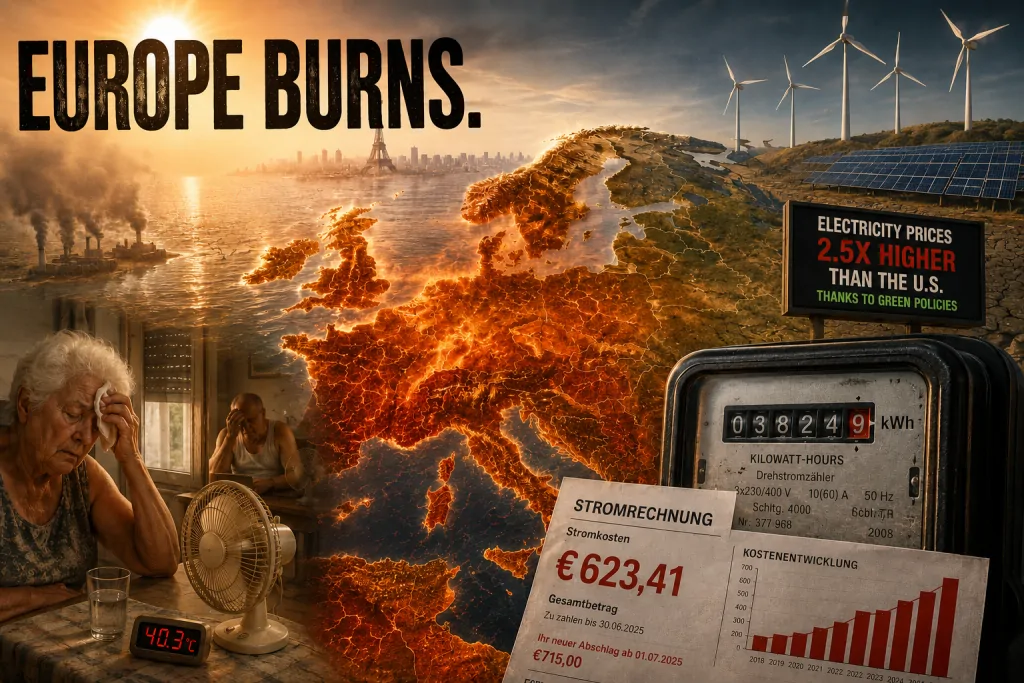
Every year around this time, a silent killer sneaks its way onto European shores and slaughters people by the tens of thousands.
Last year, it killed more people in just three months than the number of civilians killed in the war in Ukraine all year.
It killed three times as many people as traffic accidents do.
And it killed FOUR times more Europeans than gun violence killed in America.
I’m not talking about COVID. Or even the legions of migrants invading the continent.
This deadly scourge that kills tens of thousands of Europeans each year is the lack of air conditioning.
Heat killed 62,775 people across the continent in the summer of 2024, according to a study in Nature Medicine.
The World Health Organization calls it the leading “climate-related” cause of death in the region.
But in reality, these deaths are directly related to the fanatical green environmental policies of European governments, which have made the electricity to run air conditioning prohibitively expensive.
Roughly 19% of European homes have A/C, versus 90% in the US.
The simple reason is the bill: electricity in Germany costs about 2.5 times what it does in the US. Starting in 2011, Germany shut down every one of its nuclear reactors and bet its grid on wind and solar — in a country where the sun barely shines.
European media and politicians have also spent a generation making anyone who even thinks about buying A/C feel like a moral failure.
The result is a continent that has made cooling both unaffordable and shameful; then they act surprised when 60,000 people die in a heat wave.
The dead are not the only price paid. For decades, German manufacturing thrived because one machine could produce more than a thousand workers in the developing world.
But Germany’s high-tech manufacturing model only worked because the electricity to run those machines was reliable and affordable. But the German government has spent twenty years making energy either too expensive or, on certain days, simply unavailable.
Germany used to have inexpensive electricity thanks to its nuclear reactors. But the green fanatics have succeeded in shutting those reactors down, resulting in higher electric prices.
The bill for that policy lands on the factory floor. The German Association of the Automotive Industry reported on May 13, 2026 that German automakers have already shed 100,000 jobs since 2019, with another 125,000 projected to disappear by 2035.
German Chancellor Friedrich Merz has called the nuclear phase-out “a mistake,” and said “I regret this.” Yet in the same breath he explained that “it is the way it is, and we are now concentrating on the energy policy we have.”
In other words, they acknowledge that they made a huge mistake. But they also admit that they aren’t going to fix it.
Perversely, the simple act of admitting a mistake (even without fixing it) is actually progress for a politician.
Just look at their immigration policy— they won’t even admit the mistake of importing legions of gang-raping foreigners who do not respect laws and have no problem committing violence.
The bill for that policy has come due in the same way the energy bill came due: in bodies.
In August 2024, Solingen’s Festival of Diversity got a firsthand demonstration of what they were celebrating when a Syrian asylum seeker stabbed three people to death.
Four months later, a Saudi national drove a rented SUV through Magdeburg’s Christmas market, killing six and injuring 200.
In January 2025, an Afghan asylum seeker— already under an active deportation order German authorities had failed to enforce— stabbed a two-year-old boy and a 41-year-old man to death in a public park in Aschaffenburg.
By November 2025, German cities had begun canceling their Christmas markets outright. One reopened after spending more than €250,000 on concrete barriers to keep trucks from being driven into shoppers a second time.
The state’s response to imported violence is not to stop importing it. It is to cancel Christmas.
The pattern is always the same: even when governments make an enormous mistake, they lean into it. They rarely fix anything, they just continue with a destructive policy.
And anyone who actually does try to fix it gets ridiculed, canceled, or shot.
One current example from the US is the LA mayoral election.
The incumbent mayor, Karen Bass, has presided over the worst destruction the city has seen in decades. She does nothing about the homeless problem— in fact recently stated that taxpayers should pay for new teeth for homeless meth addicts so that they can have dignity.
Her only positive contribution, in her own words, is that she was “out of the country” when the Palisades wild fires started in January 2025 and that she did “not start the fires” herself. That’s a pretty low bar for success.
Her opponent, Spencer Pratt, just wants to fix the city. He presents real solutions to real problems, yet he is the one that the media paints as a fringe lunatic— not the lady who wants to give taxpayer-funded teeth to meth addicts.
Politicians do not just refuse to fix their mistakes; they save their loudest contempt for whoever is rude enough to mention them, or daring enough to fix them.
There may still be a way forward here. Maybe more responsible, more sensible people start running… and maybe voters will be responsible and sensible enough to elect them. Maybe this happens before it’s too late, and America can finally turn things around.
But there’s also a rational possibility that doesn’t happen… and that’s why it’s worth having a Plan B.