The lights went on at approximately 3pm on September 4, 1882 in New York City.
Thomas Edison (with major funding from JP Morgan) had spent roughly two years building the first-ever commercial power plant, located in Manhattan’s financial district. Its total capacity was about 600 kilowatts… barely enough to power a single rack of GPUs today.
But at the time it was nothing short of miraculous.
Edison’s coal-fired DC power plant initially served just 82 customers, and electricity was nothing more than a luxury flex by the ultra-wealthy.
But over time– especially after Westinghouse and Tesla’s alternating current became the gold standard– electrification rates in the United States skyrocketed.
At the turn of the 20th century, hardly anyone had electricity in their homes. By 1920, it was about 35%. By the time the Great Depression hit in 1929, roughly 70% of US homes were electrified, and urban areas were nearly 85%.
The systems were surprisingly reliable given the rudimentary technology of the day. Blackouts were not infrequent, but they were generally short and localized, often just affecting a few streets or houses.
And typically the biggest reason for a short, localized blackout was simply because electrical demand was increasing more rapidly than the grid could create new supply. More and more homes were being electrified, and, after World War II, consumer appliances like refrigerators and air conditioners began consuming more power. We’ll come back to that.
In response, the industry began looking for efficiencies to be able to scale more quickly. They built larger, beefier power plants and connected their independent grids to be able to share reserves and load balance.
In short, they planned for speed and scale. Not resilience. And the end result was an incredibly complex network that was highly vulnerable to systemic failure.
That failure first came at 5:16pm on November 9, 1965: a minor maintenance issue near Niagara Falls triggered a chain reaction across the entire grid. 30 million people went without power– most until the next morning, some for a few days.
It was a wake-up call… and the first catastrophic grid failure of many more to come. So naturally the government stepped in to “fix” it.
With the electrical grid’s vulnerabilities laid bare, Congress held inquiries and hearings. New rules and regulations were passed. And, before long, the US electrical industry became a confusing alphabet soup of state, local, and federal authorities– ISOs and RTOs, FERC, PJM, MISO, CAISO, SPP, and so many more.
Layers and layers of bureaucratic agencies didn’t fix anything. But technology was quite fortunately on America’s side, and over the past few decades, advances (like LED bulbs) made consumer appliances more energy efficient. Power plants also became more productive.
In fact, today the US consumes less electricity per capita than it did in 1995. And the grid produces much more power.
But this balance is starting to change rapidly.
We all know the story of data centers and their insatiable appetites for energy. Electricity is such a critical input, in fact, that data centers are typically described by their power consumption.
For example, Softbank recently announced 5GW of new data centers in France. The famous StarGate project in the US is targeting 10GW. Facebook is building a 5GW data center in Louisiana.
And various plans over the next few years go in to several hundred gigawatts.
This trend is similar to the 1950s– utility companies struggled to keep up with surging demand from US consumers who were plugging in air conditioners and refrigerators for the first time.
But supply and demand in the electricity market is a funny thing. Demand can surge very quickly… just like we’ve seen over the past year or so. But electrical supply grows more slowly.
New power plants take years to build. Thanks to the aforementioned alphabet soup, the regulatory burden alone is a minefield.
And most electrical producers aren’t willing to go through the effort, risk, and capital expenditure unless they’re sure the new power plant will be profitable. And profitability depends on the price of electricity.
That’s where politicians and the regulators have stepped in to screw it all up.
Naturally, with demand soaring and supply constrained, electricity prices are rising. You’d think that politicians would respond by making it easier for utilities to build new power plants, i.e. reduce the regulatory and permitting process to increase electricity supply.
But no. Instead, they’re capping prices.
Last year, a whole lot of state officials and federal regulators got together to set a ceiling for certain wholesale electricity prices to roughly $333 per megawatt-day.
Clearly, they’re responding to voters’ demands to rein in inflation and reduce the cost of living.
Unfortunately, $333/MW-day isn’t high enough to justify investment in new power plants.
Existing power plants are old. Sometimes extremely old. They already own their land, and their construction loans are all paid off. So $333/MW-day is sufficient for them to pay for fuel, conduct maintenance, and turn a small profit.
But $333 isn’t enough to build a new plant– to cover the additional costs of construction, land purchases, permitting, etc.
In fact, the regulators themselves estimate that electricity prices need to be about $500/MW-day (i.e. 50% higher) to justify investment in new power plants.
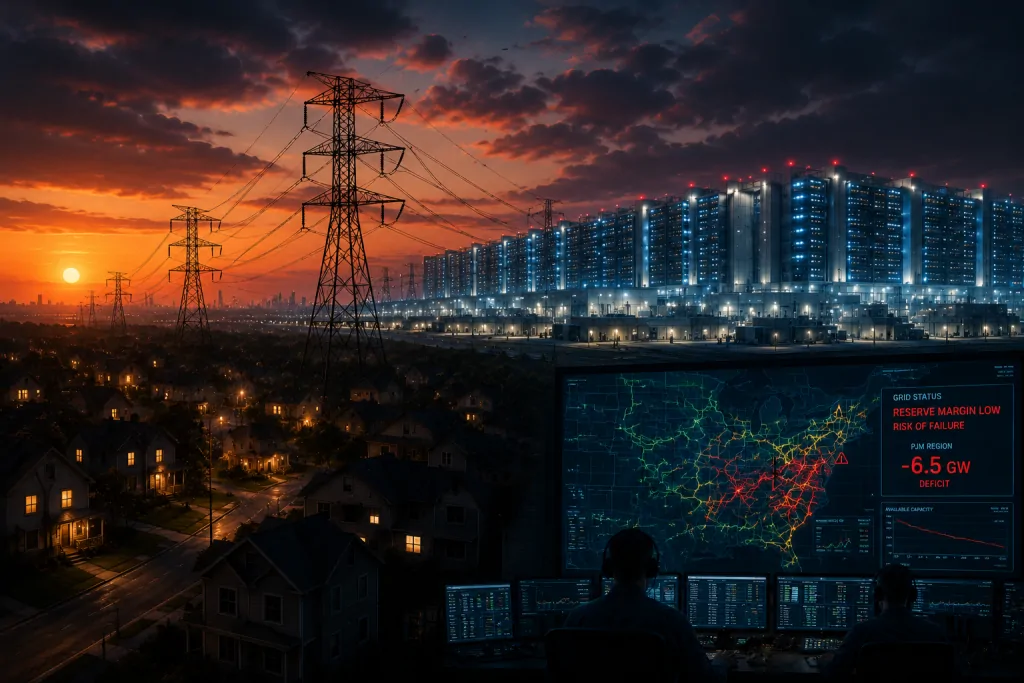
This means there won’t be enough new commercial power plants built to sufficiently supply the grid. In fact the northeast grid (known as PJM) is already in a 6.5 GW deficit against its own reserve requirement for the first time ever, increasing the chance of failure next summer.
This is essentially a form of shrinkflation. i.e. paying the same amount of money but getting less for it. We’ve all seen it at grocery stores and restaurants– same price, smaller portions.
In this case, electricity prices are supposedly remaining flat. But you’re getting less for it– potential grid failure. All because the maze of political and regulatory authorities won’t do the obvious thing and make it easy for new power plants to be built.