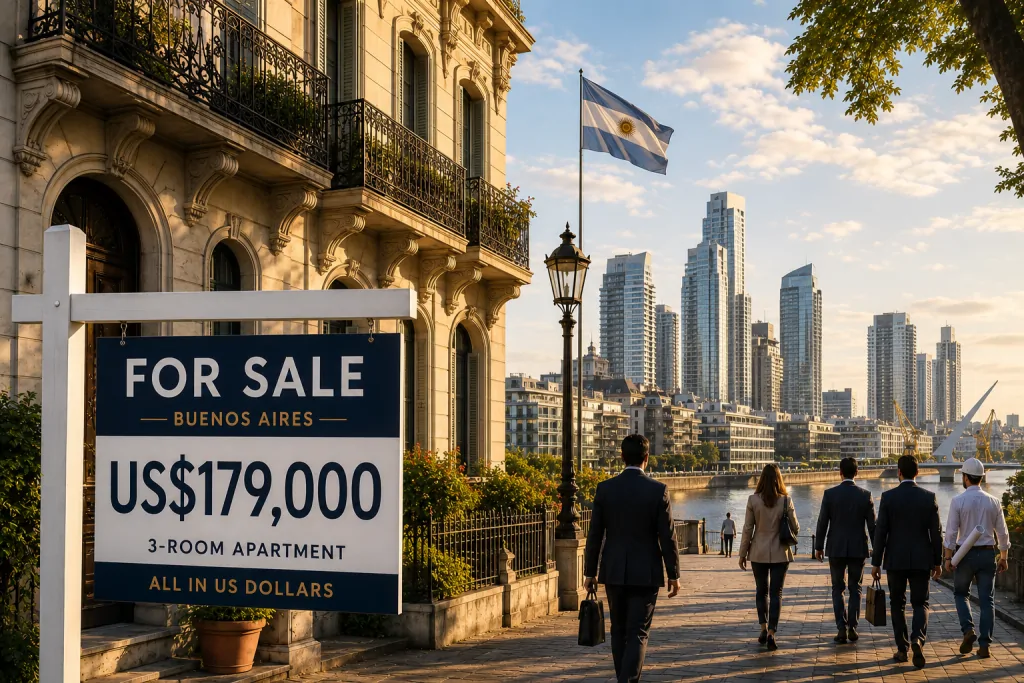
If you have a budget of $179,000 to spend on real estate in the United States, I hope you like renovated sheds. Or a six-hour drive to the nearest airport.
But right now, $179,000 buys a typical three-room apartment in Buenos Aires, the “Paris of South America” (minus the Islamic terrorists).
Studio apartments in Argentina’s capital are going for $108,000. All of it is quoted and paid in US dollars, because Argentina’s property market gave up on their local currency for real estate transactions a long time ago.
But this is arguably the last cheap sector of Argentina. Prices of every other asset have gone up dramatically thanks to country’s general economic recovery; ever since President Milei was elected, he has slashed government spending and delivered the country’s first budget surplus in over a decade. The stock market has surged. Every asset is up. Except for apartments.
Remember, a century ago, Argentina was one of the ten richest countries in the world; its people were better off per capita than the French or Germans.
Then came Juan Perón. Elected in 1946, he nationalized everything— railways, utilities, etc. He regulated wages and prices. It was full-blown command socialism.
Perón was thrown out in 1955, but the machine he built outlived him by seventy years. He had created a permanent bloc of voters— paid by the state— and every government that tried to cut spending found out it could not survive doing so. So they printed money instead.
That is where the price controls, the capital controls, the repeated defaults, and the chronic inflation all came from.
Milei took office at the end of 2023 and started taking the machine apart. He cut the number of federal ministries in half and fired tens of thousands of government employees. He scrapped the price controls and stopped the central bank from printing money to cover the government’s bills.
It hurt. Poverty jumped before it came down, and real wages fell before they recovered.
The month Milei took office, prices rose 25.5%. That was the MONTHLY inflation figure, not the annual one. By June 2026, monthly inflation was down to 1.9%.
To be clear, that is still astronomical by North American or European standards. Argentina is still a high-inflation country. But they’ve come a long way in bringing inflation down, and the country is no longer collapsing. There’s clearly a light at the end of the tunnel.
And it got there using the same playbook every country that climbed out of a hole this deep has run.
For example, in 1965 Singapore was an impoverished backwater with no resources and a third of its population squatting in slums. Lee Kuan Yew cut the tariffs, kept taxes low, and threw the doors open to foreign companies. Today Singapore produces more than $90,000 per person— more than the United States.
No country is permanently rich, and no country is permanently poor. For the first time in a very long time, Argentina is heading the right direction.
Foreign capital has noticed. Under a new incentive regime, companies have launched roughly $95 billion of projects. The state oil company YPF filed a $25 billion shale development in Vaca Muerta in May, and Chevron committed more than $10 billion to the same basin.
Companies do not pour concrete and steel into countries they expect to collapse.
The financial markets repriced accordingly. Argentine stocks have run hard, and the main US-listed Argentina fund is up more than 230% over five years.
After a run like that, you could argue the stocks are no longer even cheap. Even the bonds have moved: the extra interest Argentina must pay to borrow compared to US government bonds fell in July to its lowest level in eight years.
Which brings us back to that $179,000. The citywide Buenos Aires apartment index rose just 1.6% over the past twelve months. And that’s in US dollars.
In other words, every asset in Argentina has repriced, but the apartments aren’t even keeping pace with inflation.
The reason is credit, or rather the total absence of it; nine out of ten home purchases in Buenos Aires are paid in cash, without a mortgage.
And prices settle at whatever buyers can pay in cash.
The same condition holds across much of Latin America, and Colombia shows where it leads. Only around 3% of Colombian adults carry a mortgage, so prices sat at cash levels there too.
Then foreigners discovered Medellín. Buyers from North America and Europe arrived with money and bought apartments that looked absurdly cheap to them. In El Poblado, the neighborhood the expats favor, prices have jumped 66% in three years.
We think the same thing is going to happen in Argentina, with a bigger catalyst behind it, because the country is becoming an investment destination and an expat destination at once. It happened in Medellín, Mexico City, and other places in Latin America. It’s basic supply and demand.
There is still risk— Argentines vote again on October 24, 2027… so if Milei’s political movement collapses, the country could return to its old ways. But that’s pretty much the same anywhere. Every country carries risk.
For example, I doubt anyone is rushing to buy British assets right now. Britain’s finances and politics have genuinely deteriorated, and its government now pays close to 6% to borrow money, the most since 1998.
Now that Marxist Andy Burnham has taken over as Prime Minister as of this morning, the situation will likely get worse before it gets better. At some point Britain will get cheap enough that its stocks and bonds become attractive again. But today is not that day.
And American assets are no automatic refuge either. Just wait and see what happens if Gavin Newsom gets the chance to do to the whole country what he did to California.
Argentina, at least, pays you to take its risk. The apartments are cheap, and the catalyst pushing them up is already arriving.
It is also a serious Plan B destination. Living there costs roughly half of what it does in the United States, and it draws far fewer foreigners than the places everyone has already found.
Our flagship service, Plan B Confidential, just published a full report on Argentine real estate, covering which neighborhoods hold their value, how to move money in and out, and where residency and citizenship stand.
If you’d like to see everything Plan B Confidential covers, you can learn more here.