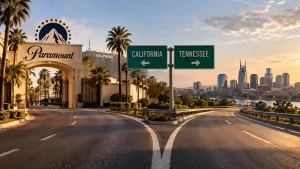

Hollywood is synonymous with California. It’s where the entire industry of motion pictures was born and raised for a century.
The sign in the hills above Los Angeles might be the most famous advertisement on earth, and the industry built the state’s fame, its mythology, and a good part of its fortune.
That industry is dying now. And on Monday, California’s attorney general stood in front of the sign and showed the world exactly why.
Rob Bonta announced that California is leading twelve states in a lawsuit to block Paramount’s $110 billion acquisition of Warner Bros. Discovery, a deal that would combine two of Hollywood’s five major studios.
Asked about reports that Paramount might respond by pulling out of California entirely, Bonta called them “a desperate last-ditch effort to try to blackmail my office.”
Think about that. In Bonta’s mind, a company weighing whether to stay in his state isn’t a customer he’s about to lose; it’s a criminal trying to extort him.
Paramount is doing what it thinks is best for itself. California is suing to make it stop.
And the state’s top lawyer says that taking your business elsewhere is blackmail.
Gee, I wonder what’s making them want to leave?
It’s even more absurd once you know that Paramount had been begging to stay.
According to the news outlet Semafor, the company offered regulators a consent decree committing it to release 30 films a year in theaters, keep both of its historic California studio lots open, and keep spending roughly $30 billion a year on content, a huge share of it in a state that has been bleeding entertainment jobs for years.
Bonta sued anyway, despite the fact that the US Justice Department had already spent eight months reviewing the merger and approved it in June, concluding the deal would actually increase competition. Antitrust enforcers from Australia to China signed off without a peep.
Yet twelve state attorneys general apparently understand the media business better.
Even the people who do mergers for a living can’t figure out what Bonta is after. One M&A lawyer put it this way: “He doesn’t know what he wants, but he knows he needs to want something.”
Actually, he knows exactly one thing: this merger is something a billionaire wants. Paramount’s CEO is David Ellison, whose father, Larry Ellison, co-founded Oracle and is one of the richest men alive.
Bonta is on the ballot for re-election this year, and he understands his voters: blocking a rich man’s deal counts as fighting for the people, even when it costs those same people the studios, the jobs, and the spending that Paramount was begging to keep in the state.
The merger and Paramount’s offer to stay added up to a win/win, for the company and for California. But Bonta will happily trade a win/win for a lose/lose, as long as the billionaire ends up one of the losers.
So Ellison is now listening to the advisers pushing to move the corporate headquarters out of California, redirect much of that $30 billion in annual spending to friendlier states, and expand the nearly 300,000-square-foot studio lease Paramount signed last year in Bayonne, New Jersey.
The only problem… New Jersey happens to be one of the twelve states suing to block the merger. The state positioned to catch billions of dollars in fleeing Hollywood production is simultaneously in court trying to strangle the company doing the fleeing.
New Jersey, of all states, should know how this movie ends. Its own attorney general sued ExxonMobil in 2022 for supposedly deceiving the public about climate change; a judge eventually threw the case out, but the message landed, and just a few weeks ago Exxon’s shareholders voted to move the company’s legal home to Texas after over a century in the state. Apparently the lesson didn’t take.
Other states can smell the opportunity. Tennessee’s deputy governor, Stuart McWhorter, sent Ellison a letter earlier this month inviting Paramount to move its headquarters to a state built on “fiscal discipline, low taxes, predictable governance,” a pitch that reads less like salesmanship than a list of everything California has abandoned.
And Ellison wouldn’t need a map. He kept a home in Tennessee for more than a decade, and the Oracle campus rising in Nashville belongs to his father’s company, which pulled its own headquarters out of California in 2020.
Bonta shouldn’t need a crystal ball. Since 2022, America has lost some 73,000 film and television production jobs, two-thirds of them in Los Angeles. Eighty-one countries now dangle film incentives to lure productions away, and Los Angeles production workers have started comparing their city to Detroit.
Capital goes where it’s welcome and leaves where it’s punished, and California keeps finding new ways to punish it: one of the highest income tax rates in the country, a proposed “one-time” wealth tax on billionaires that even its own architect admits won’t be one-time, and now an attorney general who calls a company’s freedom to relocate blackmail.
And what’s true for a $110 billion company is true for anyone.
Notice what actually gave Paramount its leverage this week. It wasn’t the lawyers, and it wasn’t the size; it was the ability to exit. Paramount already has other options. It set them up in advance so it didn’t have to scramble for them now.
That is the entire logic of a Plan B.
You set up the second residency, the foreign account, the assets beyond one government’s reach while everything is still calm, precisely so you never end up begging an ambitious politician for permission to run your own life.
P.S. Paramount has an army of advisers mapping its exit. Most people just need a place to start. That’s exactly what our Plan B Confidential service is for: actionable intelligence on foreign residency programs, second citizenships, international banking, legal tax strategies, and real asset investments, drawn from sixteen years of boots-on-the-ground research and a global network of trusted service providers.
Click here to learn more about Schiff Sovereign’s Plan B Confidential.