It was September 2006— roughly two years before the 2008 financial crisis annihilated much of the global economy. But Greece was already in deep trouble.
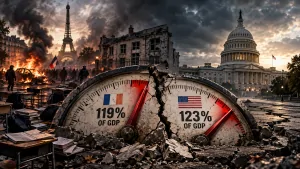
Unemployment was hovering around 9%. Youth unemployment was a staggering 25%. And government finances were in the toilet, with official debt-to-GDP at 100% and annual budget deficits at nearly 8% of GDP.
The deficit issue was especially troubling; as part of the Eurozone, Greece was legally obliged to keep its annual budget deficit below 3% of GDP. But the government was simply incapable of doing so.
Yet if they didn’t significantly reduce their deficit-to-GDP ratio, Greek politicians faced the prospect of EU bureaucrats from Brussels taking charge of the government and imposing austerity.
So, rather than cut spending and reduce the deficit, the Greeks cooked up a creative way to magically increase their GDP—overnight.
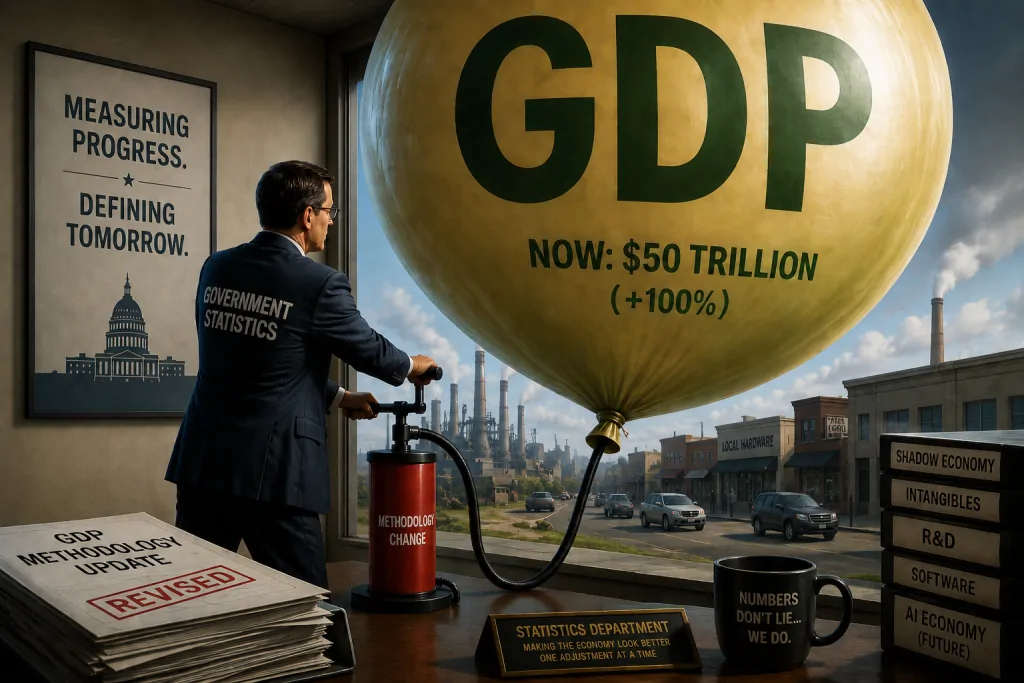
And on September 26, 2006, the Greek National Statistical Service announced they were changing the way they were calculating GDP; among other things, the Greek government would include “illegal activities like drug trafficking and prostitution” in their GDP estimates.
Laughter and facepalming ensued immediately around the world as global economists collectively groaned at the Greek government’s desperation.
And yet, they still went through with it: poof. Overnight, Greece’s GDP magically grew by 25% because of the change in their calculation.
Frankly this idea is not uncommon in economics; plenty of countries have seen overnight surges in their GDP simply by changing the way they count economic activity.
Italy famously increased its GDP by nearly 20% overnight back in 1987 when they started including estimates of their shadow economy in the GDP numbers.
Nigeria ‘rebased’ its economy in 2014, nearly DOUBLING its GDP. One day it was a $270 billion economy, and literally the next day it was a $510 billion economy.
Ghana did the same in 2010, increasing its GDP by 60%.
But the world record goes to west Africa’s Guinea-Bissau, which, in 2005, increased GDP by a whopping 142%. Overnight.
Now, sometimes these updates aren’t completely ludicrous. Econometrics is an imprecise field that often relies on outdated modes of information gathering.
More importantly, statistical agencies over-concentrate their efforts collecting data on has-been industries while ignoring ‘new economy’ sectors. And this can seriously distort the picture.
That’s why, even in the United States, government agencies occasionally make changes to their econometric methods. Measuring an economy as dynamic as America’s absolutely has to change from time to time. And they have.
In 1999, for example, the Bureau of Economic Analysis began classifying software as a long-term asset (rather than an expense), immediately adding about 0.4% to the prior year’s GDP growth.
In 2013 the same agency went even further and began counting R&D expenses, artistic content, and more in GDP calculations. This change added $560 billion to the US economy.
To be fair, these were not political mandates or desperation moves. Instead, they were necessary adjustments to reflect changes that had taken place in the US economy; it makes sense to include R&D in GDP calculations when so much of the economy is R&D.
Typically, these adjustments to US methodologies take place every few years. And, as of yet, the US government has NOT yet updated its measurements to include AI.
And this is what may ultimately lead to a Greek, Ghana, or even Guinea-Bissau boost to GDP.
Economic activity from AI is extremely difficult to measure. Sure, there are sales of Nvidia GPUs and data center spending.
But think about all of the things that people are doing with AI—things which have economic value, but the government has no credible way to count.
Here’s an easy example: every time I’m at the grocery store, I browse the meager selection of children’s books for my kids. I almost never buy anything, though, because most of them are garbage… so the resulting economic activity is very low.
Lately I’ve been using AI to create my own books for the kids—which they seem to be enjoying very much. But since no dollars actually changed hands (i.e. I make the books myself), there is no economic activity recorded in this case either.
This is a critical point to understand, so I’ll say it again: in both situations, i.e. me NOT buying a book at the store, versus me creating one with AI, no recorded economic activity took place.
And yet, when I make my own books, something of economic value IS being created. I value them. My kids value them. The books have some value, hence value is being created.
I’m just one guy. Hundreds of millions of people are doing the same thing. And none of that value is being recorded, i.e. none of it is showing up in the GDP numbers.
It turns out the US government’s Bureau of Economic Analysis is already considering ways to incorporate AI into the GDP numbers.
And frankly that impact could be dramatic… for a couple of reasons.
First, because the impact of AI really IS dramatic. And growing. But second—because the US government REALLY needs to cut its deficit-to-GDP and debt-to-GDP ratios.
And since, like Greece, they seem to have no interest in actually cutting spending and reducing the debt, they’ll use AI as a way to suddenly boost GDP.
So don’t be surprised if we wake up one day and are told that the US economy is now $50 trillion because of AI… and hence America’s debt-to-GDP level immediately falls to 80%.
I suppose counting the economic value of cat memes and unicorn stories is better than drug traffickers and prostitutes. And it would be an interesting way for the US government to dramatically improve its fiscal condition overnight.