On the afternoon of September 6, 1901, President William McKinley stood in a receiving line at the Pan-American Exposition in Buffalo, New York, shaking hands with a crowd of well-wishers.
One of the people in the crowd was a young man named Leon Czolgosz… who was patiently waiting with a revolver wrapped in a handkerchief. When he reached the front, he fired twice into the president’s abdomen.
McKinley died eight days later, and, Czolgosz, an unemployed factory worker, went to the electric chair without a trace of remorse. He insisted it was his duty to strike down a symbol of oppression.
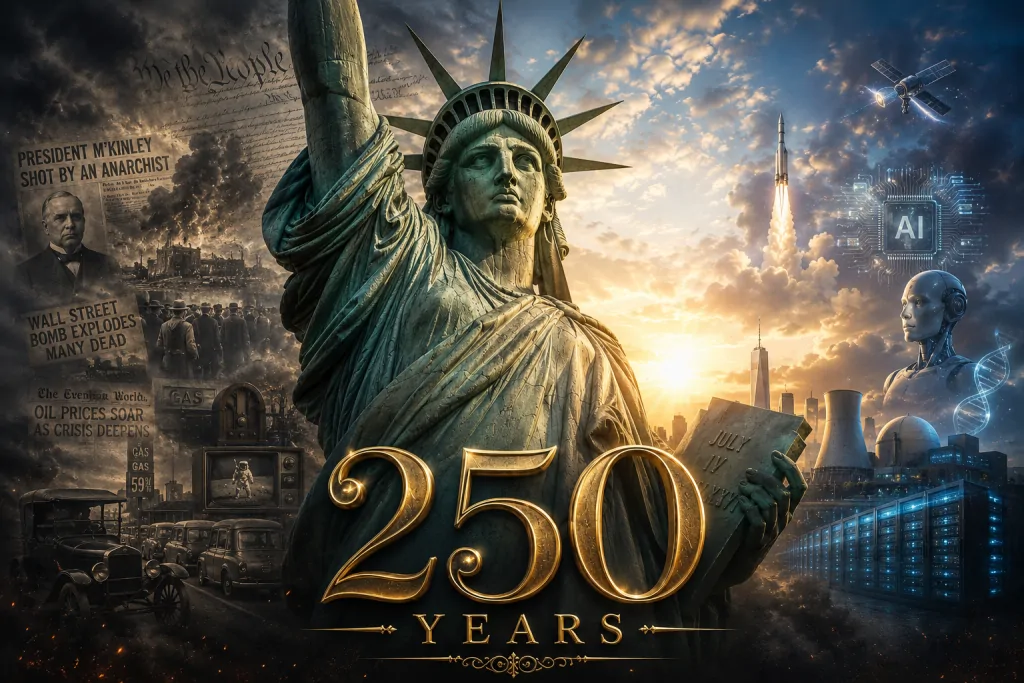
Czolgosz wasn’t a crazed madman, but rather a product of his time. The America of 1901 was 125 years into its history— the exact midpoint between the Declaration of Independence and today.
And despite the US economy already being the largest in the world at that point, the year 1901 did not feel like a nation striding confidently into the American Century.
The US financial system lurched from panic to panic, and to a great many observers, the young republic looked less like a rising power and more like a country unraveling.
The rich versus poor divide was growing, and violent socialist movements spread. Political assassinations, terrorism, and bombings became a recurring feature of public life.
The political violence did not end with McKinley’s assassination, either. Followers of the Italian anarchist Luigi Galleani waged a years-long bombing campaign against judges, politicians, and businessmen.
It peaked at noon on September 16, 1920, when a horse-drawn wagon packed with explosives detonated in front of the headquarters of J.P. Morgan on Wall Street, killing thirty people and wounding hundreds more. The case was never solved.
Many of these anarcho-socialists were immigrants, which poured gasoline on the raging blaze of backlash against widespread immigration.
In 1907 alone, more than a million people passed through Ellis Island. Immigrants were arriving faster than anyone knew how to absorb them, and people were getting tired of it.
Congress passed legislation that imposed a literacy test on immigrants, then banned entire countries. At first, people from Asia and the Middle East were shut out. Subsequent legislation set strict quotas, slamming the door on the southern and eastern Europeans who were considered undesirable.
Yet the instability continued… as did the government’s push to consolidate power.
After the Panic of 1907 nearly brought down the financial system, Congress used the scare to establish the Federal Reserve in 1913. This was the first step toward money that could be printed at will.
Also in 1913, the Constitution was amended, giving Congress the power to tax income.
The income tax (16th Amendment) was sold to the American people as a tax on the very rich that would only affect the top 2% of US households. Idiotic socialists at the time believed the lie and supported the amendment; after all, the rich should pay their fair share.
Within decades, three quarters of Americans were paying income tax.
With a new central bank and tax power in place, Washington then raced to join World War I (despite being an ocean away), and borrowed on an unimaginable scale to do it.
Frankly it all looked pretty bleak.
And yet, while all the bad news and turmoil was ongoing, America was simultaneously producing miracles.
Henry Ford put the country on wheels with the Model T and the moving assembly line. Motion pictures went from novelty to industry. Radio turned from a tinkerer’s hobby into a machine that could broadcast to every home in the nation.
These were American breakthroughs that rewired the entire global economy and powered better times ahead.
Seventy-five years later, America’s 200th birthday looked little better. In 1976, the economy was mired in stagflation that “experts” had previously sworn was impossible.
Oil shocks had humiliated the country at the gas pump. American dominance looked spent in the wreckage of Vietnam, and the nation had watched President Richard Nixon resign in disgrace.
Terrorism was back. Plane hijackings were somewhat commonplace. Crime rampaged across the cities.
And yet what followed was the personal computer, the Internet, the longest peacetime expansion in the country’s history, and a comeback almost nobody standing in a gas line in 1976 would have believed.
Which brings us to the 250th birthday, today.
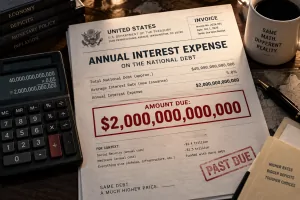
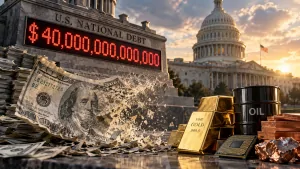
Political violence is back in American life. Immigration is once again a major issue. Fraud and corruption are rampant (and hardly anyone pays the price). And Washington’s finances are in worse shape than at any point in the country’s history, with the national debt larger than the entire economy.
Yet at the same time, American companies are building artificial intelligence, next-generation nuclear power, robotics, and biotech breakthroughs that could rewire the global economy even more than the assembly line and the Internet did. Chaos and invention have always lived side by side in the US, and they still do.
America was born out of revolution, and it has endured a civil war, two world wars, a depression, a decade of stagflation, and repeated financial panics.
Every one of those episodes brought years of real pain, but every time, the country that looked terminally ill came back stronger than ever.
There is an old saying in politics (usually credited to Winston Churchill, though apparently first quipped by an Israeli diplomat): Americans will always do the right thing… after exhausting all the alternatives.
Apocryphal or not, that is the pattern: the right thing comes eventually, but the pain comes first.
America is not just a country; it is an idea, and it may be the most extraordinary idea human beings have ever assembled. It stands on the shoulders of giants— Greek thought, Roman law, Judeo-Christian values, and free-market capitalism, fused with a conviction about individual liberty balanced by personal responsibility.
Betting against that idea has been the worst trade of the past 250 years.
To be clear, having a Plan B is not a bet against America either. The concept is not to hide in a bunker with canned food and guns because the end is near.
The point of a Plan B is to be honest about the road between here and the recovery: more inflation, higher taxes, and a stretch of instability, and to make sure you have the options available to come at it from a position of strength.
At 250 years, I truly believe the best days are still ahead. But there will be some rough ones in between.