George Villiers should have been a nobody.
Born into a minor family from an irrelevant English village far from London in the late 1500s, young George grew up with no real prospects for his future.
But he did have one thing going for him: according to reports at the time, George Villiers was extremely handsome. Like, there’s ‘handsome’, and there’s ‘George Villiers handsome’.
But when you think of good-looking English men these days, apparently Villiers’ good looks were less Henry Cavill, and more fem-boy.
The Spanish ambassador even described Villiers as “so beautiful he seems like a woman. . .”
Villiers’ overly ambitious mother knew her son was a handsome boy. So she groomed him from the start to use his good looks to climb the social ladder.
The training worked. Villiers was 22 years old (in the year 1614) when he was first introduced to King James I, i.e. the namesake of the world’s most prominent Bible translation.
The King took an immediate liking to the young lad and immediately made him the royal cup-bearer, then nicknamed him “Steenie”– a reference to having a face like an angel.
Within two years, the King knighted Villiers and appointed him “Gentleman of the Bedchamber”, which is pretty much what it sounds like. The title signified tremendous status, granting access to the monarch’s inner sanctuary, and it was typically only reserved for the closest confidants… or lovers.
The King was obviously smitten with ‘Steenie’, and it was an open secret in the royal court that the two were having a torrid romance.
King James reportedly would “clasp [Villiers] about the neck with his arms and kiss him” in front of other courtiers, and the two would engage in “lascivious” acts in public.
Moreover, the King sent Villiers love letters, many of which survive. In one entry, the King wrote, “I desire only to live in this world for your sake.” In others, he referred to Villiers as his “sweet child and wife” (there was a nearly 30-year age gap between the two).
By 1617, the King began granting more and more high ranks and offices upon his young lover; it was like an avalanche of noble titles– Lord Lieutenant of Buckinghamshire, Master of the Horse, Lord High Admiral, Earl, Marquess, etc.
And by 1623, the King went so far as to make him a Duke– one of the highest noble ranks in the realm.
But Villiers was apparently more than just a pretty face. He shrewdly and deftly used his new titles and vast influence over the King to consolidate power and effectively position himself as the most important person in the English government.
He single-handedly pushed for a number of ill-fated military expeditions, including invasions in Spain and France. Every one of them was a disaster, costing tens of thousands of lives and millions of pounds sterling.
One of the worst was the Ile de Re campaign in France in which 50% of the English force was killed and had to retreat under fire. The folly wasn’t just a costly tactical defeat; it was a national humiliation.
James I died in 1625, but Villiers’ power continued under the king’s successor, Charles I. Villiers at one point wrote to his new king, “Sir, I am so confident of your love that I dare undertake anything for your service.” It was a clear sign that Villiers was still in charge and free to run the country into the ground.
In time, Villiers’ corruption knew no limits. He sold offices and noble ranks. He granted monopolies to private businesses that paid him enough money. He took bribes from foreign countries– including both Spain and France at the same time!
He used the power of the state to go after his political opponents– imprisoning them, bankrupting them, or trying to ruin their reputations socially. Pretty absurd tactic for a guy who slept his way to the top.
Everyone knew he was corrupt. Shakespeare mocked him in plays (like 1624’s A Game at Chess, which Villiers had shut down after nine days). Alexandre Dumas portrayed Villiers as a glamorous villain in The Three Musketeers.
Even Villiers’ portrait, painted by the great Rubens, portrayed the Duke as a petty, arrogant figure.
In short, the guy was an arrogant, ambitious, corrupt failure.
In the end he nearly bankrupted the nation; the national debt tripled thanks to Villiers pitiful stewardship. The military was in shambles. The government– and soon English society– became deeply divided, culminating in the English Civil War in 1642.
Yet he never took responsibility; everything, he claimed, was done in the name of King. Villiers convinced everyone that he was speaking for the King and had the authority of the King… or that he was acting with the King’s knowledge and consent.
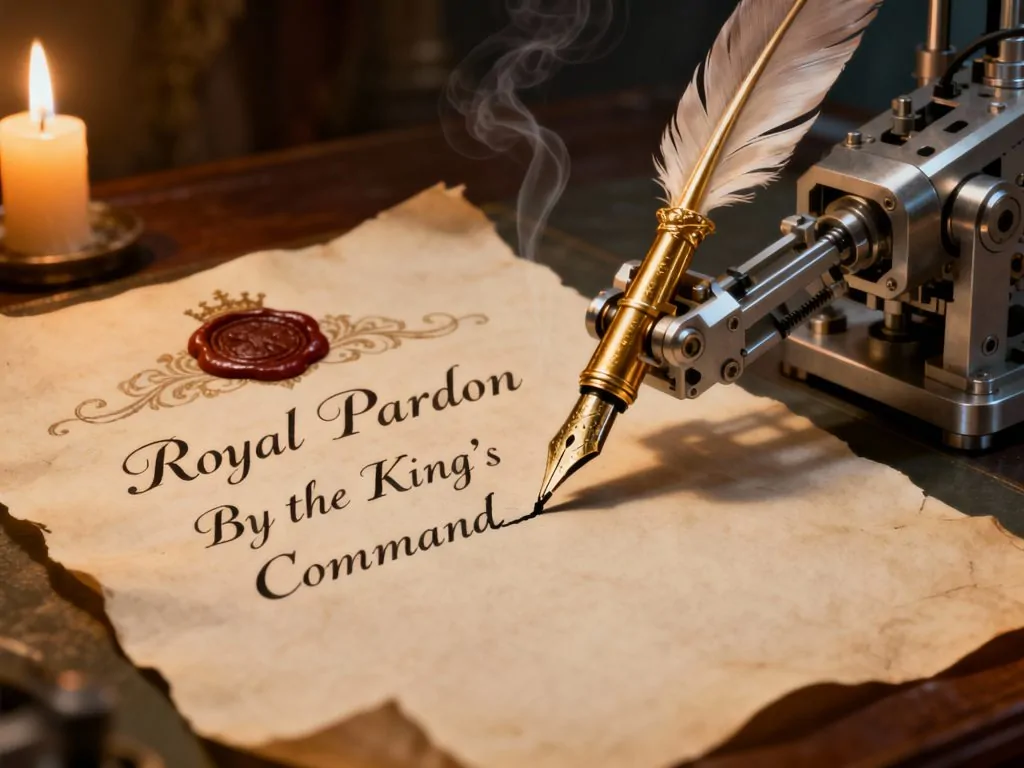
It was basically the modern equivalent of controlling King James I’s autopen signature.
And that includes the royal pardons that Villiers issued, including the pardon he issued to himself. In the name of the King, of course.
This story of George Villiers is nowhere near the first time in history that enormous political power was hijacked by a petty, ambitious sycophant. And it certainly wouldn’t be the last.
We’ve obviously seen this in our own time, most recently with the backroom dealings during the Biden presidency, where you had an obviously incapable, enfeebled, demented man who was being propped up—both figuratively and literally in some cases—by staffers who hijacked the power of the presidency for their own vanity projects.
Power is a dangerous drug. And in modern political systems it’s far too easy for someone who is extremely incompetent to gain power.
We see that every day in the Western world. One need only look to the US Congress to see the complete buffoons who manage to get themselves elected every two years.
That is dangerous enough. It’s more dangerous when people who aren’t even part of the process seize the opportunity to hijack that power for themselves surreptitiously, deceitfully, and illegally.
We’ve seen these people use that power to make extreme, widespread changes across the country, in every realm from finance to the military to public health policy to energy policy—and yes, even issuing pardons signed by autopen.
The long-term destabilizing effects are obvious. In England’s case, the country had to go through a civil war and a revolution for things to get back to normal.
America will probably heal more quickly, but we should consider ourselves lucky that Tony Fauci wasn’t better looking.