On November 27th in the year 176 AD, Marcus Aurelius promoted his 15-year old biological son Commodus to be Co-emperor of Rome.
Marcus Aurelius never realized it, but he was sealing Rome’s fate… and essentially marking an end to the Empire’s golden age.
Commodus was quite popular in his youth— reportedly handsome, athletic, and gregarious. But after Marcus Aurelius died a few years later, the popularity and support that Commodus had enjoyed for so long began to wane.
It didn’t help that he heavily debased Rome’s currency, contributing to widespread inflation and economic decline. He spent lavishly at taxpayer expense, ignored even the most basic affairs of imperial administration, and murdered his enemies.
Finally, on New Year’s Eve in 192 AD, Commodus was assassinated, kicking off a period of political instability in which five different men would sit on the throne in a single year; in fact 193 AD became known as the Year of the Five Emperors.
Eventually Rome landed on Septimius Severus, who ruled for nearly two decades with an iron fist. His reign— though stable— is regarded as one of the cruelest in Roman history. And he, too, contributed immensely to inflation and rising taxes.
His successor, Caracalla, ruled briefly and incompetently. Soon came Elagabalus— history’s first transgender emperor who promised to give away half of the empire to any physician who could turn him into a woman.
Along the way the infamous “Crisis of the Third Century” became worse and worse: migrant invasions, economic depression, hyperinflation, plague, and unprecedented political instability— including the year 238 AD in which six different men claimed the title of Emperor.
It was as if Rome lost the ability to produce a decent, capable leader anymore.
I thought of this historical lesson yesterday morning watching Andy Burnham, the former mayor of Greater Manchester, become Britain’s seventh prime minister in a decade.
That’s an unprecedented level of instability for a modern, major power. Even worse, Britain’s leaders have become more incompetent over time, each one chipping away at the country’s economy and social stability.
Liz Truss lasted just 49 days, the shortest tenure of any prime minister in British history. Her plan for £45 billion in unfunded tax cuts set off a panic in the bond market, launching the pound into freefall.
And government borrowing costs spiked so violently as a result of Ms. Truss that the Bank of England had to step in to prevent British pension funds from collapsing.
Prior to Truss was Boris Johnson— a one-man scandal machine who was fined for quite hypocritically throwing big parties in Downing Street during his own COVID lockdowns.
Then came Rishi Sunak, who threw Britain’s doors wide open to immigration. Sunak seemingly woke up every morning and said: Give me more Somalis. Give me more Islamic terrorists.
Along the way, Britain imported some of the worst ideas of the American Left and made them its own.
Britain is now the wokest place on the planet, and to an Orwellian standard; British police arrest people over tweets, and the England flag itself is now treated as a symbol of racism.
To cap it all off, Sunak was succeeded by Keir Starmer, probably the worst leader of a major power in modern history— and that includes Joe Biden.
When Parliament took up a national inquiry into the grooming gangs that had raped thousands of English girls over decades while local officials looked away, Starmer’s party voted it down, and Starmer dismissed the calls as “the bandwagon [of] the far right.”
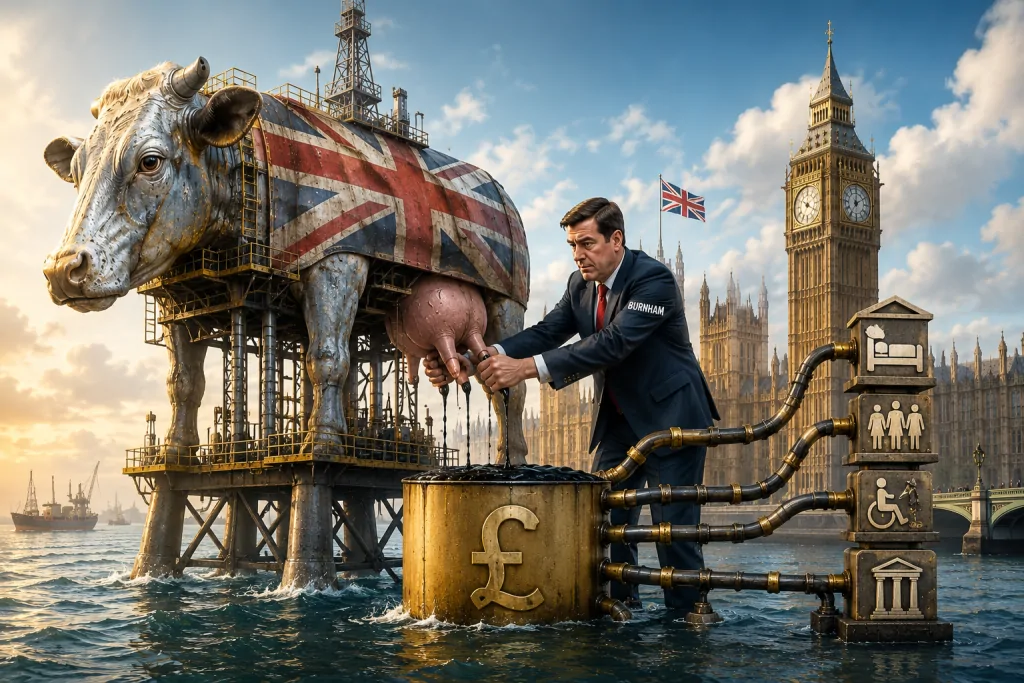
Starmer spent his tenure finishing off the oil industry, taking the headline tax rate on North Sea producers to 78% and banning new exploration licenses.
By the time Starmer resigned last month, the UK had a tax burden heading to its highest level since records began in 1948. Borrowing costs are higher than any other major economy, with 10-year government bond yields well above those in the US, France, Germany, and Japan.
Plus, wealthy Brits are heading for the exits in record numbers after Starmer abolished the centuries-old non-dom tax regime.
Starmer was so widely despised that his own party finally threw him out. Their solution? A slightly younger, slightly less vapid version of Starmer.
His name is Andy Burnham, and all of his ideas come straight from the Communist Manifesto.
In his opening remarks as prime minister, Burnham said not one word about the national debt or Britain’s borrowing costs. Nothing about the migration crisis. Nothing about justice for the grooming gang victims. Nothing about turning the economy around.
His first order of business, Burnham announced, was taking care of homeless/migrants with a new £340 million benefit program.
To his credit, Burnham has sense enough to know that he cannot throw around that kind of money without a way to pay for it. Borrowing more money is out; in fact he spent the past year complaining that Britain must get beyond “being in hock to the bond markets.”
That only means one thing: higher taxes.
So, days before taking office, his team began preparing approvals for two North Sea oil and gas fields— the same ones that his own party spent years trying to shut down.
This is not because Burnham suddenly cares about energy security. He’s just looking for more money to steal.
All of those homeless migrants need handouts, so Burnham needs a new revenue stream, i.e. something else to tax.
So he’s allowing two new North Sea fields— with the existing 78% rate in place.
In short, Burnham did not decide that energy matters. He decided it hasn’t been milked entirely dry yet.
This is a cannibalist mentality. Britain is sliding into its own Crisis of the 21st Century, and the “conservative” politicians who presided over the first half of the decline were anything but. Starmer and now Burnham are straight-up Marxists.
We wrote about Argentina just yesterday, where nearly every asset in the country is surging. It’s not hard to understand why: Argentina hit rock bottom, threw out the people who destroyed the country, and started climbing under new leadership.
Britain can reverse its fortunes the same way. Unfortunately, it is probably going to have to hit rock bottom first. And we can already see the shape of how this ends.
First the money will run out, the benefits will be cut, and the people who came for free stuff will go home.
Then, with markets in the dumps, this highly educated and productive country will eventually reverse all of its idiotic policies from the past and one day become among the most interesting places in the world to invest.
There’s an old saying credited to a Rothschild about investing when there’s “blood in the streets.” He may turn out to be right. But he probably wasn’t picturing London when he said it.