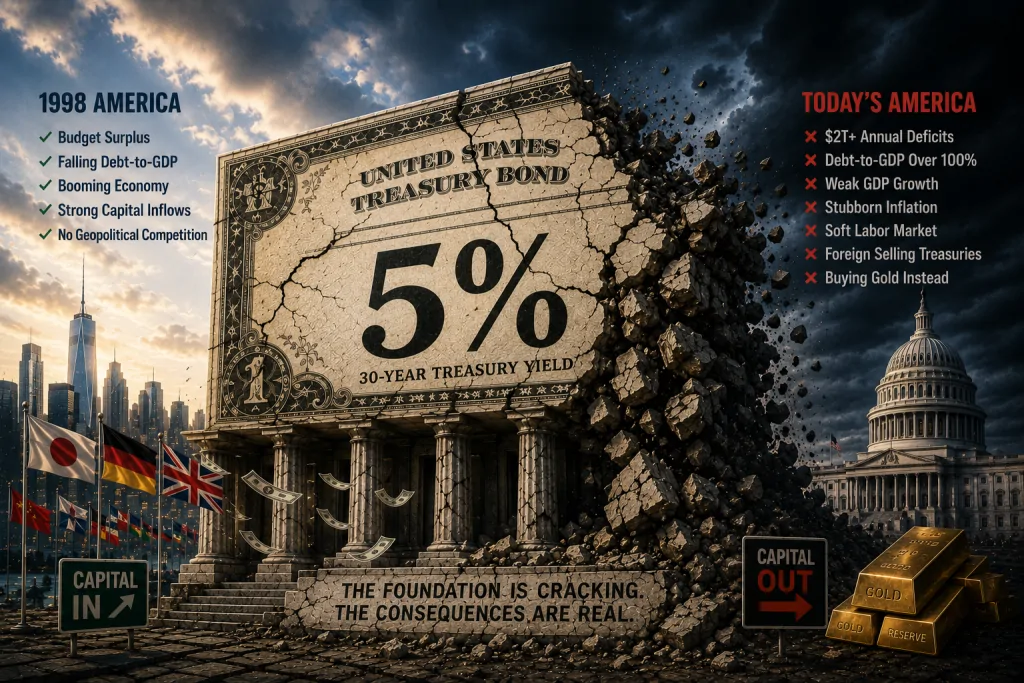
The year was 1998. Titanic was still pulling people into theaters. Mark McGwire and Sammy Sosa were chasing Roger Maris’s home run record. And the Dow Jones Industrial Average had punched through 9,000 for the first time.
The Cold War was over. The Internet and cell phones were starting to take off. And America’s biggest problem was the President getting frisky in the Oval Office.
The US economy was certifiably booming in 1998; unemployment was at a thirty-year low, the economy was growing leaps and bounds, and Washington was, by its own modest standards, somewhat functional.
The federal government had just posted its first budget surplus in three decades, and America’s debt-to-GDP ratio was falling. Plus there was zero geopolitical competition. China was still an impoverished backwater. Russia was toast. The euro didn’t even exist yet.
So foreign investors flocked to America as the ONLY place to invest. Capital inflows surged… and as a result, the US 30-year Treasury yield fell to around 5%.
Remember that rates had been 15% or more in the 80s, and 10% in the 90s. So for the 30-year yield to touch 5% was almost shocking. And rates remained low for the decades that followed— with the 30-year reaching an all-time low of 1.89% in 2020.
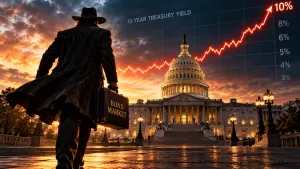
Today, the 30-year Treasury yield is back near 5%. But this is no 1998 America.
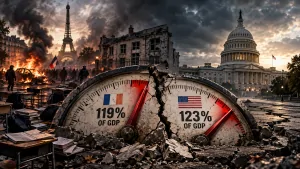
The federal government is not running surpluses, rather $2 trillion annual deficits. Debt-to-GDP is rising (now well over 100%) instead of falling. Treasury is on track to spend more than $1 trillion this fiscal year just on interest, nearly triple what it spent just six years ago.
And unlike the booming economy of the 90s, Q4/2025 GDP growth came in at a pathetic 0.5%. The labor market is soft. Energy prices are rising. Inflation is stubbornly high.
Most importantly, back in the 90s, foreign central banks were flooding the US with capital. Today they’ve sold more than $80 billion in US Treasuries— JUST since the Iran war started in late February. And they’re buying gold at the fastest pace in modern history.
As a result of weak foreign demand for US government bonds, yields are rising.
In 1998, yields fell to 5% because America was winning. Today yields have risen to 5% because the US is a hot financial mess.
The increase in the 30-year yield from 1.89% in 2020 to 5% today took six years. But I’d expect that pace to accelerate as it hits 6% then 7% then 8%.
Almost nobody in Congress is doing anything to fix it. Politicians laugh at the idea of spending discipline; they won’t lift a finger to eliminate rampant fraud.
That’s why so many foreign countries are heading for the exit.
Case in point: this past Monday, nearly 50 leaders of the European Political Community — including France, Britain, Poland, etc. gathered to declare themselves a “third superpower” in addition to the United States and China.
Even Canadian Prime Minister Mark Carney showed up as the first non-European leader ever invited— the implicit message being that Canada is now picking Europe over the US.
Of course, the whole concept is laughable; these people honestly think signing papers can make them a superpower.
These are the same governments that spent two decades dismantling their own economies in the name of net zero and multiculturalism, then destroyed their own rule of law to prosecute anyone who complained.
The state of Mississippi — the poorest in the United States by GDP per capita — now produces more than France, Italy, or the United Kingdom.
The gap between Canadian and US GDP per capita became twice as bad under former PM Justin Trudeau-Castro, and the OECD projects Canada will rank dead last in the developed world for growth through 2060.
They have gutted every actual engine of becoming a superpower status; now they’re just cosplaying.
BUT America does depend on them for one thing: buying its massive amount of US government bonds.
These are the long-duration, sticky foreign buyers that have absorbed Washington’s debt for decades and kept yields artificially low, even when the fiscal numbers got ugly.
And they are looking for the exit. Countries that used to stampede INTO Treasuries during a crisis are now stampeding the other way.