
Late Monday night on a quiet residential street in north Belfast in Northern Ireland, a man pinned his neighbor to the pavement and literally tried to cut off his head with a kitchen knife.
Bystanders screamed that he was trying to decapitate the man before someone intervened. The victim survived, though he lost his left eye. And within hours the footage had traveled around the world.
The perpetrator caught on video is Hadi Alodid, a 30-year-old Sudanese asylum seeker who flew from Paris to Dublin in 2023, rode a bus across the completely unchecked border into Belfast, and claimed asylum on arrival.
Within months he was granted permission to remain for at least five years. Hadi Alodid has now been charged with attempted murder.
Yet for the woke media covering the story, “attempted murder” was far too harsh a term. After all, the poor Sudanese man clearly had a ‘troubled background’ and fled from an ‘oppressive regime’.
So the terminology for NPR, CNN, the Washington Post, etc. quickly shifted to phrases like “alleged assault”, or, at worst, “knife attack”.
Anger boiled over among the Irish, and riots broke out the following night.
But Northern Ireland’s First Minister Michelle O’Neill saved her harshest words— not for the Sudanese criminal, but for the angry crowds. She described their rage as “outright thuggery”.
Note the Left’s changing definitions: an African migrant’s attempt to behead a local citizen was an “alleged assault.” People being upset about it is “outright thuggery”.
But those aren’t the only definitions that changed this week. So in the spirit of public service, here’s the rest of your vocabulary update.
In Albany, New York lawmakers just passed a bill replacing the word “mother” with “gestating parent” and “father” with “non-gestating parent” throughout the state’s family court and custody laws.
The Left has also updated its definition of the term “Nazi”. We’ve all gotten used to the word describing anyone who questions immigration policy or supports free speech.
But now the Left has made it clear that “Nazi” does not include people who get literal Nazi tattoos, like Graham Platner, Maine’s new Democratic Senate nominee.
Several stories broke recently where Platner’s ex-girlfriends described him as physically abusive. Others called him demeaning and serially unfaithful— on top of earlier reports of sexually explicit texts he sent to other women while married.
He won Tuesday’s primary anyway. “We all have skeletons in our closet, and we’ve all made mistakes,” one supporter explained. Senator Bernie Sanders suggested “maybe we have to do a little bit of forgiveness.”
Forgiveness is a wonderful principle. We just seem to remember that, in 2018, a single uncorroborated allegation about a house party in 1982 was treated as disqualifying for Brett Kavanaugh’s Supreme Court nomination.
The updated definition seems to be that everyone has a past— unless you’ve been nominated by the wrong party, in which case a forty-year-old rumor is sufficient to smear you.
And then there is Los Angeles, where “protecting democracy” got its annual revision.
Spencer Pratt, the reality-TV personality who ran for mayor, ended election night nine points ahead of Councilmember Nithya Raman for the runoff’s second spot. By the next day his lead topped 40,000 votes.
Then mail-in-ballots ballots started pouring in… counted at an overwhelming margin for Raman. Nearly a week after election day, she passed Pratt and was up nearly 22,000 votes when the media called the race.
Less than a week before the election, Governor Gavin Newsom had signed a law making it illegal for election observers to challenge vote counters if a mail-ballot signature is questionable. So now county officials in California have the final say on which signatures count, i.e. which ballots count. And nobody is allowed to challenge them.
So we’re being told to believe that a weeks-long vote count— with a dramatic mid-count swing— is completely normal election administration. Asking questions about it is “election denial”. And making it illegal to challenge the ballot counting is “protecting democracy.”
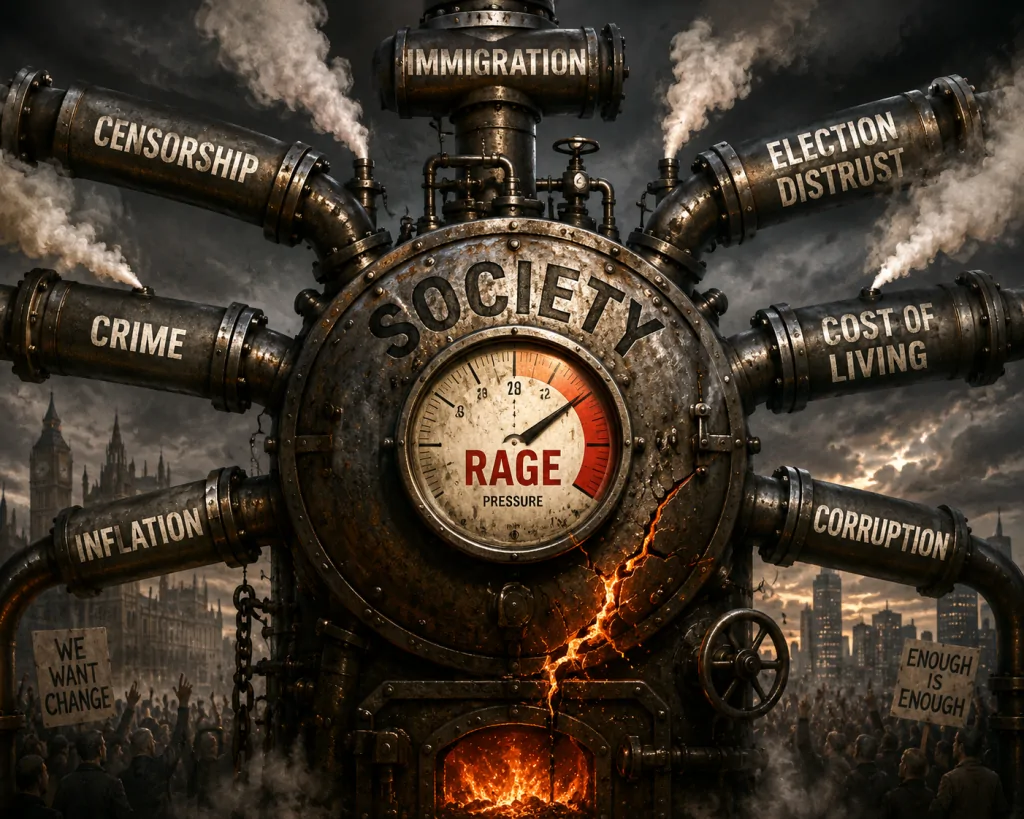
Here’s the thing: people aren’t that stupid. They know they’re being screwed. And they’re angry.
The politicians know it. Perhaps that’s why police in places like the UK are making roughly 33 arrests per day for online messages deemed “grossly offensive” or likely to cause “annoyance” or “anxiety.”
In other words, they have to criminalize free speech in order to keep their critics in check.
And this week, as Belfast burned, Northern Ireland’s police chief pledged to pursue not only the rioters but “those inciting and encouraging it” online, using “every piece of legislation, every resource and every tactic available.”
Let’s be honest— burning down your own neighborhood is a terrible idea and will not solve anything. But it is a natural response to feeling helpless and powerless.
All over the UK, people tired of having their civilization destroyed are fighting back with whatever outlet they have. Many of them no longer trust the electoral process— as I imagine a great many people in LA now feel.
For people in Belfast, the decision of housing African refugees isn’t even made by local politicians; it’s the UK Home Office in London that decides who gets settled in Northern Ireland, and where.
So there is no one to vote out, and no policy referendum to repeal. They’re just stuck with the dolts who keep foisting more and more refugees upon them. And as the police chief just reminded everyone, complaining about it online can be a crime.
Rage is the natural byproduct of all of this.
When you feel like your vote doesn’t count, or literally is NOT counted, then it’s hard to have confidence that democracy is the answer.
And when the problem is as serious as being potentially beheaded in your own hometown— and the cops arrest the people who complain about it— then rage becomes the only language people feel like they have left.