Henry VIII probably thought he was being extremely clever when he started debasing his currency in 1544… and assumed that, if he reduced the silver content slowly and gradually enough, perhaps no one would notice.
But the King was hilariously wrong.
Despite centuries of warfare, invasions, and plagues, English rulers prior to Henry had been remarkably disciplined in maintaining 92.5% silver in their coins.
In fact, England’s kings were so serious about their coinage that, at one point in the 1100s, one of Henry VIII’s forebears rounded up every private minter who skimped on the silver content in their coins— and had the man’s testicles removed.
But Henry VIII did not share his ancestors resolve. So, drowning in debt, divorce, and too much war, he started to reduce the silver content and replace it with copper.
His new coins still looked vaguely similar to the original ones because they were given a cheap, silver wash. But the wash wore off quickly— especially on the side where Henry’s profile was carved.
Londoners soon began to notice that the king’s nose would turn orange once the silver sheen wore off, giving rise to the nickname “Old Coppernose”.
And yet the debasement continued— and this was Henry’s ‘clever’ idea.
There wasn’t a single shock or dramatic crash. Henry’s ‘Great Debasement’ was a years-long operation of slowly robbing prosperity from his subjects. Each year their coins would buy less. Prices would rise. Their cost of living increased. And overall they were worse off.
This is the same story of our own time.
Gallup reported last week that 55% of Americans believe their personal finances are getting worse; that’s the absolute rock bottom reading in 25 years of the survey.
It is worse than 2008, when the financial system was actually breaking. It is worse than the pandemic, when the economy was shut off.
And that 55% statistic is in a year when headline employment numbers and stock indices are supposed to be telling everyone they’re doing fine.
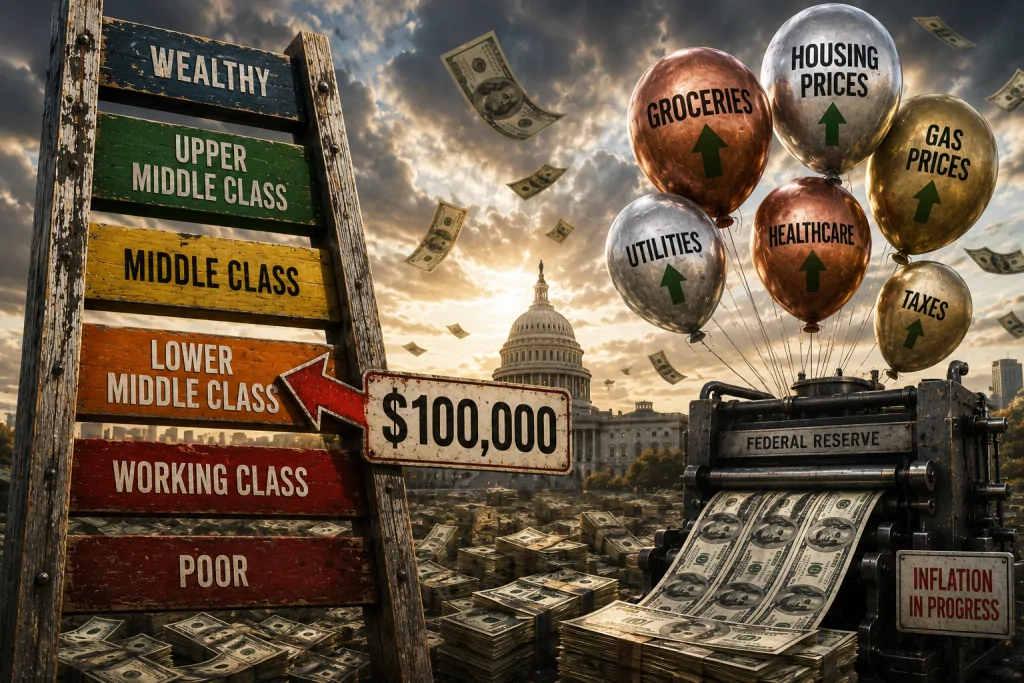
Perhaps even more alarming is a recent analysis by a group called MoneyLion, which looked at Census data and found that, in 12 states in the US, a $100,000 income is now considered LOWER middle class.
For those who remember what life was like 25 years ago, making six figures was solid “made it” territory.
Not anymore. In Massachusetts, the lower-middle ceiling has crept up to $116,476. In New Jersey, $115,882. In California, $111,277.
Of course, it isn’t hard to see what those states have in common. They tax heavily, regulate aggressively, and treat business and wealth as plump dairy cows to milk.
This isn’t magically going away if the Strait of Hormuz opens, or Congress passes a ban on corporations buying homes to rent.
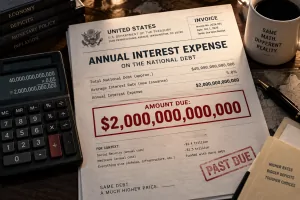
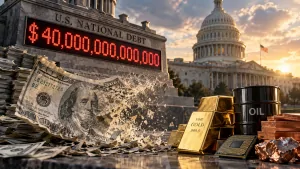
The federal government runs trillion-dollar deficits every year, the Treasury borrows the difference, and the Federal Reserve accommodates the whole arrangement by expanding the money supply by trillions.
Long term inflation doesn’t slow down until Washington decides to be fiscally responsible— and there is little evidence that’s about to happen.
If you bought a house in 2010, or even 2021, the same forces hollowing out the dollar have been inflating the value of your assets; your house cannot be printed by the Federal Reserve, so as the money supply increases, your house costs more in nominal dollars.
That’s why the people who feel worst about this economy are young people.
A recent Generation Lab survey found that more than 8 in 10 Americans aged 18-29 — the cohort least likely to own a home or hold meaningful investments — now describe the economy as bad or terrible. Only 2 percent of them call it “excellent.”
This is why real assets matter. The Fed can manufacture as many dollars as it wants, but it cannot manufacture the things that actually have value: precious metals, energy, critical resources like uranium or copper, a profitable business producing something the world cannot function without.
Because every single time governments are given the choice between inflation and discipline, they pick inflation.
And just like Henry VIII, they think no one is going to notice.