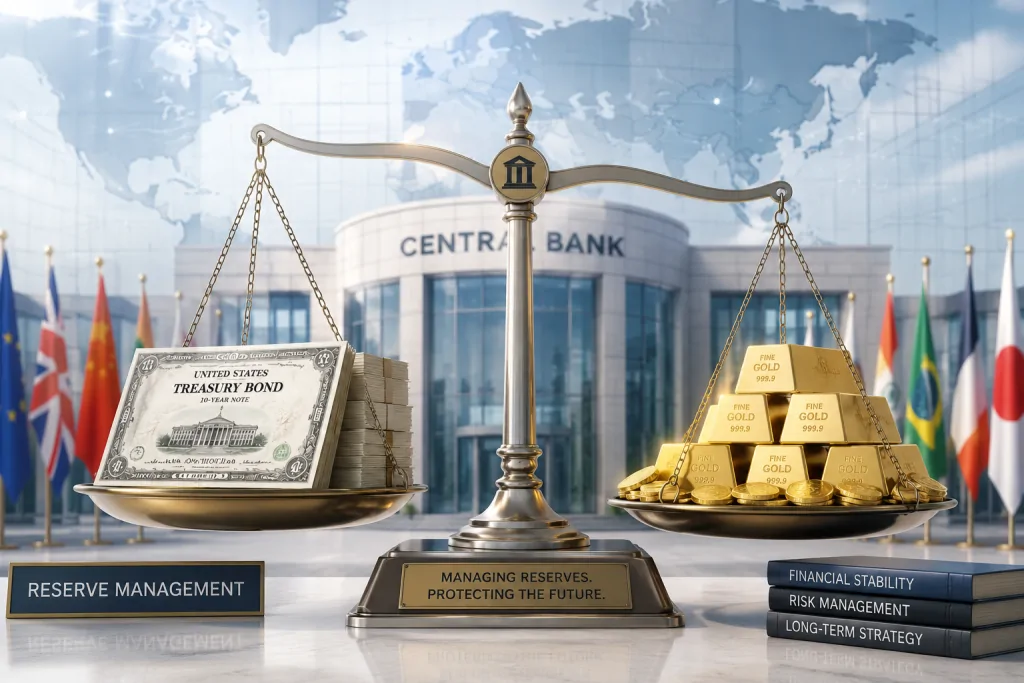
Every country on earth keeps a rainy-day fund: a pile of emergency savings, managed by its central bank, set aside for wars, crises, and currency runs.
These stockpiles of cash around the world are known as a nation’s “reserves”, and the people who manage those funds are called reserve managers.
Due to America’s superpower status, managers tend to hold the vast majority of their nations’ reserves in US dollars— most commonly in US government bonds like the 10-year note.
Now, every year, a London institute called OMFIF surveys dozens of these reserve managers who collectively hold more than $10 trillion— and OMFIF asks the same question each year:
What does your central bank plan to do with its US dollars?
This year, for the first time, more reserve managers said they planned to cut their dollar holdings than increase them.
Reserve managers are the least excitable people in finance. Their job is to be boring, to hold safe assets, and to never make news. So this is not an emotional knee-jerk reaction. It is a decision that has been decades in the making and accelerated over the past few years.
The critical moment came in February 2022 when Russia invaded Ukraine; the US government froze roughly $300 billion of Russia’s reserves, i.e. assets that were held outside of Russia.
Interestingly enough, many of those frozen Russian assets were actually held in EUROPE, not the United States. But the US government still exerted control, pushing Europe to freeze those Russian-owned bonds.
Every reserve manager on the planet learned the same lesson that day: if you ever land on America’s bad side, the US government will lock you out of your national savings in an instant.
And it was at that point that central banks around the world started shopping around for more secure reserve assets that the Treasury Department cannot freeze.
Given that foreign countries collectively hold tens of trillions of assets (most of which is denominated in US dollars), they couldn’t exactly dump their holdings overnight. No one is willing to shout “FIRE” in a crowded theater; but they are, however, calmly making their way to the door.
But this process will take years, perhaps even a decade or more.
The key question is— where are they going to park their reserves, if not US dollars? There certainly have been a number of lingering options, from the “BRICs dollar” to China’s digital currency.
But the obvious answer (as we have been writing about for years here) is gold.
From 2022 through 2025, central banks bought a few hundred billion dollars worth of gold (above their normal purchases). This amounts to roughly 2% of their reserves.
Yet by parking just 2% of their reserves into gold, gold prices more than doubled from ~$1,600 back then to more than $4,000 today.
It’s important to note that the sudden spike in gold prices to $5,600 early this year wasn’t from central bank purchases— that was mostly hedge funds and retail investors piling in.
Gold prices slid back down to $4,000 as those investors exited. But central banks have started buying again; net central bank purchases amounted to 244 tonnes in the first quarter of 2026— well above their five-year average. And net purchases continued in April and May.
The big headline is that those same central bank reserve managers recently told OMFIF that they plan on moving AT LEAST another 7% of reserves out of dollars over the next decade.
Most likely the bulk of this reserve diversification will go into gold.
In other words, 2% of reserves more than doubled the gold price between 2022 and 2026. Now they plan to invest over three times that amount over the next decade. Any guesses where the gold price is headed?
These bankers also expect to pay more for gold; 61% of the central banks OMFIF surveyed estimated a gold between $5,000 and $6,000 an ounce by June 2027. And yet, even at record prices, most of them still plan to buy gold over the next two years.
Think about that. The institutions that just bought the gold price dip expect the price to go up within a year… and their stated plan is to keep buying more.
Most individual investors are very short-term in their thinking. They look at day-to-day price fluctuations and tend to follow popular trends.
Central bankers, on the other hand, ignore daily, monthly, and quarterly noise. They think strategically… and their time horizon is in years if not decades.
They’re not doing this to make money; they aren’t planning to trade their US dollars for gold, only hoping to trade their gold back for more US dollars down the road.
Rather, they’re trying to protect their national savings by purchasing strategic assets that the US government cannot confiscate.
Ultimately this is why we believe that the long-term direction of gold is still much higher— because the largest buyers in the market are still buying, and they plan to continue buying for years to come.
P.S. When retail investors dumped gold this year, they dumped the gold producers too. But these companies were built to survive far lower prices, so at today’s gold they are still enormously profitable, still throwing off cash, and still trading at low multiples of the cash they generate.
Schiff Sovereign’s Strategic Assets is monthly investment research on exactly these kinds of businesses: already profitable, little or no debt, trading at a low multiple of free cash flow, with catalysts the market has not priced in.
Strategic Assets comes with a 30-day money-back guarantee. Click here to learn more.