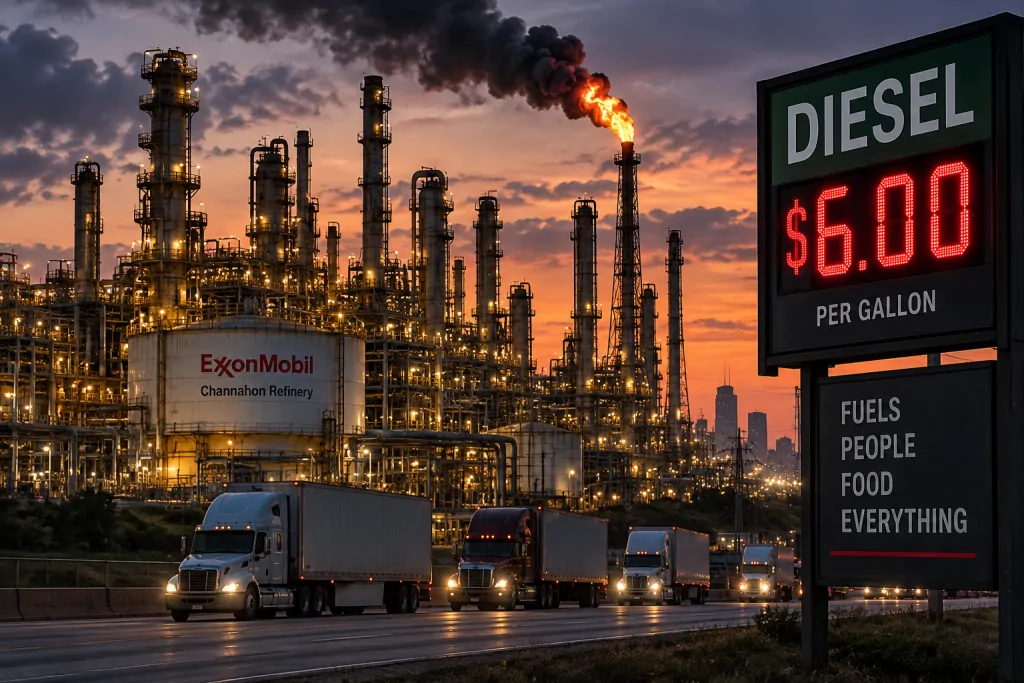
On Sunday afternoon, the power went out at ExxonMobil’s refinery in Channahon, Illinois, a southwest suburb of Chicago.
Oil refineries run at tremendous heat and pressure, so whenever the power goes out, all that heat and pressure has to go somewhere. It’s basic physics. Hence why the plant burned it off through the flare stacks, with black smoke visible for miles.
The power came back around 7 p.m., but the plant stayed down, and as of Monday ExxonMobil still hadn’t said when it would restart, likely up to a week.
Bear in mind this is a plant that processes about 275,000 barrels of crude a day— close to 10% of the region’s fuel supply.
But that’s not what caused the highest diesel prices ever.
Even before this refinery was taken out of commission, the national average price of diesel went above $6 a gallon last week for the first time ever. Filling up a long-haul semi truck now costs more than $1,000.
It’s important to note that a barrel of crude oil is almost useless until somebody turns it into something. A refinery cooks the crude and breaks it apart into gasoline, diesel, jet fuel, heating oil, the raw material for plastics, etc.
Everyone knows about the squeeze on oil due to the war with Iran. But the shortage of REFINERIES is another issue.
Sure, the wars have taken a toll on refineries and other fuel plants. Iran bombed Bahrain’s only refinery, shut ever since. It also wrecked half of Shell’s Pearl GTL in Qatar, the world’s largest plant for turning natural gas into diesel, jet fuel and lubricants. Ukrainian drones, meanwhile, have cut Russia’s refining by roughly a third.
And the rest of the world’s refineries can’t pick up the slack.
US refineries are already running at almost 98% of capacity. There’s no spare refining capacity, and that’s because governments have treated refining as the enemy of humanity for the past decade.
For example, ten years ago Britain had six refineries. Then the UK government announced a ban on new gasoline and diesel cars and piled punitive taxes specifically on refineries, and today Britain is down to four.
I guess the “Just Stop Oil” fanatics are happy now. They actually declared victory last year and hung up their hi-vis (oil-based) vests, and quit (oil-based) gluing themselves to things, because “no new oil” had become official government policy in the UK.
California, meanwhile, imposed a new penalty tax on refinery margins, and then passed climate change regulations for refineries that are virtually impossible to achieve.
Unsurprisingly, in the past year, California lost two refineries: Phillips 66’s in Los Angeles and Valero’s in Benicia near San Francisco. That’s 17% of California’s refining capacity.
Then Newsom panicked and changed his tune, realizing that California fuel prices would surge. He suddenly promised to “work closely with refiners.” He directed his own energy commission to pause the punitive refinery tax for five years. He even pushed legislators to consider paying hundreds of millions of dollars to Valero to keep their plant open.
Too little, too late. The refiners left, or idled their plants. You can only bite the hand that feeds so many times before they take action.
But of course, everyone will pay for Newsom’s idiocy, because diesel moves everything. So much of American imports arrive at California ports (like the Port of Long Beach), and trucks haul it across the country from there. Trains do the rest.
And nearly every big truck and freight train runs on diesel, which is now a lot more expensive in California. So the cost of Newsom’s lunacy is paid by every consumer.
Harvest is starting across the Midwest right now, and everything from tractors to grain dryers burns fuel. Phosphate (another critical fertilizer ingredient) is mined and hauled with diesel.
So the farmer pays $6 a gallon, the trucker pays $6 a gallon… and consumers reimburse these costs in the form of higher prices.
And let’s not forget, winter is coming.
Heating oil is diesel by another name (it comes out of the same refinery), and about 5 million American homes heat with it, more than 80% of them in the Northeast. One Gulf oil executive warned last week of “a very difficult winter coming in Northwest Europe. This is only the beginning.”
Bottom line, the power outage at Channahon is a problem. But it’s a small problem compared to the larger war on refineries.
With the spare refineries gone, even the slightest issue at remaining refineries now shows up in the price of diesel, food and everything else that moves on a truck.
Unexpected disruptions from war and power outages are one thing.
But governments deliberately villainizing refiners and chasing them out of town, for the crime of creating the energy the world desperately relies on, is another.
Their green policies and ESG mandates also helped drive a decade of underinvestment in the physical things civilization runs on: ships, mines, oil fields, smelters… and refineries.
Now the world is in the midst of a destructive war. When there is no spare capacity, every disruption has to be resolved by price, and the companies that own the scarce, strategic assets collect the difference.
And owning a piece of those companies yourself is the best way to protect yourself from higher prices and inflation.
P.S. That’s the whole point of Schiff Sovereign’s investment research newsletter, Strategic Assets: profitable, low-debt companies that own or move real things, bought while they’re still cheap.
Two oil tanker owners we featured when nobody wanted them are up more than 180% and 130%— one of them runs the ships that haul diesel— and our palm oil grower is up nearly 140%.
If you’d like to see the full research, you can learn more about Strategic Assets here.