It was January 2000. AOL had just announced it was buying Time Warner in what was then the biggest merger in history. Fourteen dot-com companies had bought Super Bowl ads, one of them starring a sock puppet that sold dog food.
The US economy was growing at one of its fastest paces ever; GDP was up nearly 5% the year before— and that’s real growth, before adding inflation, which itself was just 1.4%.
Unemployment was 4%, the lowest in thirty years. And there was no other country on the planet that could come close to rivaling America’s dominance.
Best of all, the federal government was running a surplus… a real one. It was so strong that, even excluding the Social Security surplus, the government took in $86 billion more than it spent.
So the Treasury didn’t need to borrow any money. Naturally it still held bond auctions, because when you issue the global reserve currency, you have to give investors a safe place to park their money. But Treasury was retiring more debt than it issued, and even started buying its own bonds back early.
And after wondering what “the meaning of the word is is”, Bill Clinton bragged that the country was “on track to pay down nearly $300 billion in debt” by the end of the year.
And in the middle of all that, the 10-year Treasury yield hit 6.79%.
In other words, investors wanted a 6.79% annual return to hold extremely safe US government bonds… at a moment when America was on top of the world and the government’s finances were in their best shape in decades.
That interest rate was not a crisis. After all, the government didn’t have to borrow to keep the lights on or the military funded or Social Security solvent. So they didn’t really care.
The Treasury’s interest bill was shrinking as a share of tax revenue every single year.
Imagine that.
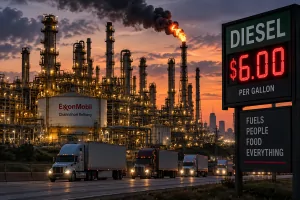
Fast forward to earlier this week, and after a hot inflation report and with oil back above $100, the same 10-year yield briefly crossed 5%.
The reaction was instant panic.
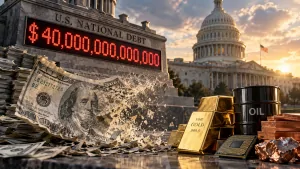
Imagine being able to go back in time for a moment… back to January 2000. Imagine talking to an economist back then. You explain that you’re from the future, and that in 2026, the national debt is $40 trillion and growing faster than the economy. The foreign central banks that used to buy America’s debt are dumping Treasuries and buying gold instead.
You explain that there are wars in Ukraine and Iran, socialism is creeping back into American politics, and Congress can barely function.
You then ask the economist from January 2000 to guess where they think the 10-year yield would be, given all of that bad news.
They’d probably guess 10%, maybe 12%, and they’d be amazed to hear it only just crossed 5%.
So why did it take so long?
Because after the 2008 financial crisis, the Fed cut rates to zero… and left them there for seven years. There were a few ceremonial hikes, but when COVID arrived, the Fed slashed rates right back to zero.
It was able to do this because the Fed conjured trillions of dollars out of thin air… and used that money to buy bonds and suppress yields.
The 10-year was so low, in fact, that the federal government could issue those notes at less than 0.5%.
For thirteen years money was essentially free, and an entire generation came to believe that was normal. It wasn’t, and that era is clearly over.
Think about what an opportunity that was: when you can borrow at 0.5%, $2 trillion in debt costs just $10 billion a year. Investing that money at even a measly 1% means the government would be making money on its debt.
A 1% hurdle rate is not particularly high. But Congress couldn’t manage even that much.
Despite racking up tens of trillions in debt, there’s realistically nothing to show for all of that money: the national debt has quadrupled since the financial crisis, while the economy has only doubled.
Now, each year, much of the national debt matures, and the Treasury doesn’t have the money to pay it back. So they have to issue new debt to repay the old debt.
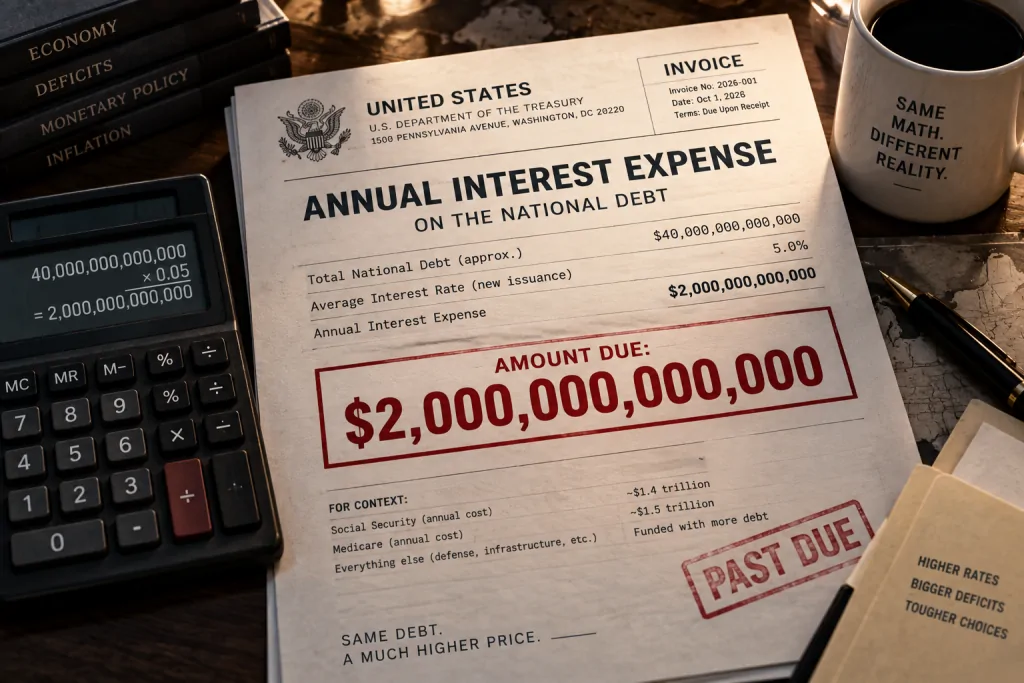
Problem is, the new debt is issued at much higher rates. They were paying 0.5% on the old debt. The new yield of 5% is TEN times the interest on the same amount of debt.
And with an average maturity of about six years, most of the $40 trillion rolls over within just a few years… which means before long the annual interest bill will reach $2 trillion per year.
Add nearly $3 trillion for Social Security and Medicare, and that’s the vast majority of tax revenue.
Literally everything else, including the military, roads, and light bill at the White House, is funded with more debt.
In 2000, the government could shrug at a 6.79% yield because it was paying debt down. Today everyone’s panicking at 5% because Congress borrows $2 trillion a year and can’t stop.
So, is Congress going to suddenly find its inner fiscal discipline?
I’m not holding my breath.
That leaves exactly one way to get the 10-year back down, and it’s the same way the Fed did it back in 2020: conjure more money out of thin air and make capital infinite.
And as the world discovered shortly after in 2021 and 2022, the consequence of that policy is inflation.
P.S. In 2000, a 6.79% Treasury with 1.4% inflation was a fantastic deal. Today’s 5% Treasury with the inflation that’s coming is a losing one.
Real assets are where you come out ahead: gold, energy, and industrial metals rise when the dollar falls. The profitable, debt-free companies that produce them are what we research in Schiff Sovereign’s Strategic Assets.