At 4:15 in the morning on November 4, 1956, Soviet artillery opened fire on the city of Budapest. And the subsequent firestorm was nothing short of devastating.
Two weeks earlier, students and factory workers had risen up against the Soviet-installed puppet government in Hungary. They pulled down Stalin’s statue, rampaged across the city, and even managed to push Soviet forces out of Budapest.
Moscow initially signaled that it was ready to negotiate and consider a full withdrawal. The bells of freedom started ringing. But it turned out to be a ruse— and Soviet leader Nikita Khrushchev swiftly sent in the tanks.
The Soviets brutally crushed the uprising in days, killing around 2,500 Hungarians and displacing 200,000 who fled the country.
In the reprisals that followed, tens of thousands more were arrested, and hundreds were hanged— including Hungary’s prime minister, who was tricked into surrendering with a promise of safe passage.
President Dwight Eisenhower condemned the invasion and opened America’s doors to roughly 30,000 Hungarian refugees. He then made his case to the United Nations, where the UN General Assembly demanded a full Soviet withdrawal from Hungary. Kruschev ignored them.
Eisenhower was clearly opposed to Soviet aggression. But America did exercise restraint— the President did not touch Soviet money that was held in the US.
It’s crazy to think that, even during the height of the Cold War, the Soviets held a stockpile of US dollars within the US financial system. They had no choice. Global commerce (including oil sales) took place in dollars, so even America’s mortal enemy needed to hold US currency.
Eisenhower could have easily confiscated Soviet assets. Yet not one Soviet account was frozen. Not one asset blocked… even as Soviet tanks shelled a defenseless European capital.
Similarly, twenty-three years later when the Soviets invaded Afghanistan, President Jimmy Carter reacted harshly. He cut off certain trade with the USSR, including grain and technology. And most famously he led a 65-country boycott of the 1980 Moscow Olympics.
But even Jimmy Carter did not freeze Soviet assets.
Decades later, in August 2008, Russia invaded the Republic of Georgia. President George W. Bush condemned the invasion, sent humanitarian aid to Georgia, and ended support for Russia’s World Trade Organization bid.
Yet he did not touch any Russian money held in the US.
Three presidents from both parties, across five decades, watched America’s biggest adversary invade other countries… but they still chose to keep the money out of it.
America had become Switzerland: a neutral custodian that fiercely protected anyone’s savings, regardless of politics. The trust ran so deep that through every proxy war and nuclear standoff, even the Soviet Union held their enemy’s currency inside their enemy’s financial system. That’s how confident the Soviets were in America’s financial neutrality.
That wasn’t about keeping Moscow happy. It showed the world that assets in America were safe… and that was traditionally a huge reason why foreign governments parked trillions of dollars in US government bonds… and why the Treasury Department could borrow endlessly to fund its deficits.
But this policy of financial neutrality changed in February 2022, after Russia invaded Ukraine. The US pushed its allies to freeze roughly $300 billion of Russian assets.
To be clear, this is not a moral discussion. I’m not arguing whether it was right or wrong; rather, this is about setting precedent. Russia did not attack or invade the United States; they attacked Ukraine— a country with which the US did not have a mutual defense treaty.
For years leading up to the Ukraine invasion, the US government had started politicizing its financial system, weaponizing the dollar, and levying occasional sanctions when foreign countries or banks stepped out of line.
But freezing the reserves of a major power was a massive acceleration.
Consequently, America’s reputation as a financial safe haven vanished on the spot.
Foreign governments were already worried about the gigantic US national debt, political dysfunction in Washington, and deep social divisions. The Russian asset freeze was the proverbial straw that broke the camel’s back.
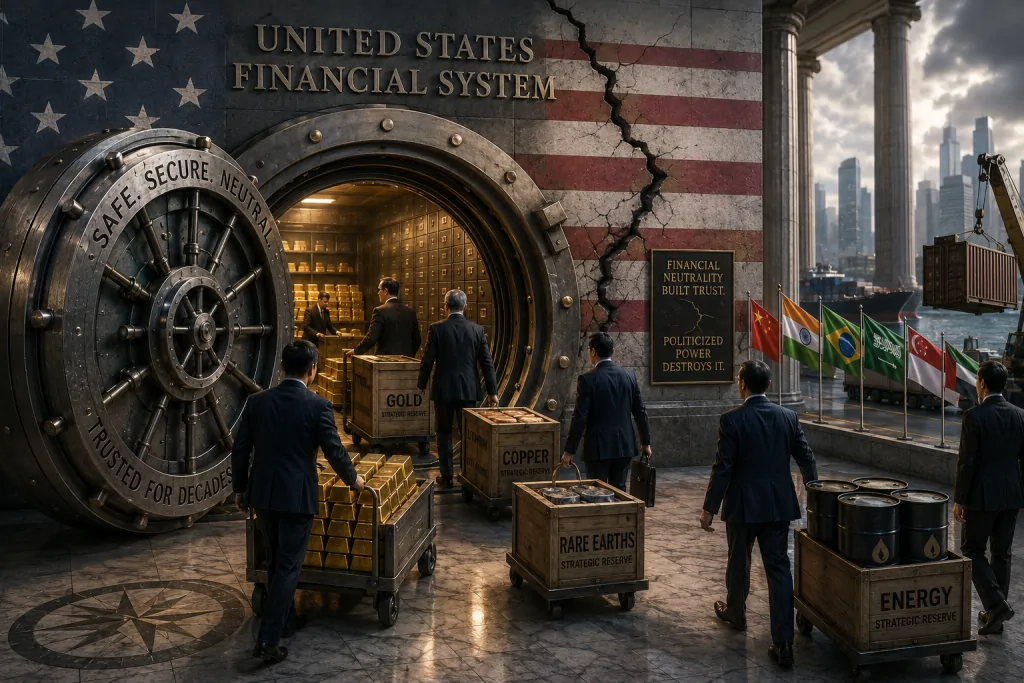
The first lesson that foreign nations concluded was the importance of holding gold as a strategic financial reserve.
Rather than deposit US dollars in a big Wall Street bank, or hold US government bonds, foreign governments concluded that it was much safer to have physical gold sitting in their own country— no one could confiscate it, freeze it, or inflate it away.
That’s why central banks around the world began diversifying out the US dollar and into gold: roughly 2% of strategic reserves (above normalized annual net purchases) between 2022 and 2025 was invested in gold.
And that modest shift— just 2%— caused the gold price to more than double. As we covered earlier this week, central banks plan on investing a whole lot more into gold.
Gold was the key lesson of Ukraine. Then came the lesson of Iran.
Until this year, few governments worried much about the availability of critical assets like energy, food, fertilizer, microprocessors, etc.
But then US and Israeli forces struck Iran in late February, and Iran responded by closing the Strait of Hormuz. More than five months later, the strait is still too dangerous for most commercial traffic, and many countries are running short on those same critical resources that transit the Gulf.
The lesson of Iran is that the world runs on strategic assets, and access to them can vanish overnight.
Their conclusion is that, again, rather than stockpile US dollars via government bonds and bank deposits, it makes a lot more sense to stockpile strategic assets— like fertilizer, energy, etc.
At a minimum, whenever the situation in Iran comes to its conclusion, countries will have to buy oceans of oil just to top off their strategic petroleum reserves. Our guess is they’ll go far beyond that and build the capacity to store even more.
And not just oil. Anything critical and strategic is now a candidate for the stockpile, because the old days of global cooperation and easy trade are gone, replaced by mistrust, conflict, and resource nationalism.
That means base metals, rare earths, and technology itself, from memory chips to sovereign compute capacity.
This trend is still in its early stages, and the companies that own and produce these critical assets stand to do very well.
We’ve featured many of them, from energy to metals, in Schiff Sovereign’s investment research newsletter, Strategic Assets.
And this environment has been very good to them: several are trading at all-time highs right now; the crude tanker company we covered just reported the best quarter in its history, and a zinc producer is up almost 3x in under nine months.
In the most recent issue, we told readers about a small oil producer which is becoming wildly successful profit machine; it has no debt, excellent management, yet trades at just three times its current free cash flow.
If you would like to read the full case, you can try Strategic Assets with a 30-day, no-questions-asked money-back guarantee. Click here to learn more.