On June 7, 1939, US President Franklin Roosevelt signed a new law authorizing $100 million (a lot of money back then) to buy rubber, tin, tungsten, etc., and put it all in storage.
The United States was still at peace at the time. World War II had not yet broken out, and global trade was still relatively seamless.
But anyone reading a newspaper could see what was coming. Hitler had annexed Austria the year before and swallowed the rest of Czechoslovakia that March. Japan had been at war in China for two years.
Every commodity on Roosevelt’s list had one thing in common: America produced next to none of it. Nearly all of the rubber used by US companies, for example, came from British Malaya and the Dutch East Indies. A lot of tin came from Malaya as well.
Congress and Roosevelt were being appropriately cautious. And within a short time they had stockpiled hundreds of thousands of tons of these strategic assets.
Then came the War. Then Pearl Harbor. And then full-blown economic chaos.
By March 1942, for example, Japanese troops had overrun Malaya and the Dutch East Indies… meaning that about 90% of America’s rubber supply vanished overnight. Fortunately, their foresight to build stockpiles cushioned the blow.
This critical lesson in self-sufficiency is easily forgotten. As long as global peace and cooperation feel permanent, governments never think about resource scarcity. They assume they will always be able to trade for what they need… so why waste money stockpiling?
But global peace and cooperation can quickly turn to conflict and tension, and that is the environment we are in today.
The last major global conflict was World War II. Before it was over, 730 delegates from 44 nations literally sat down at a conference and hammered out a new framework for economic cooperation that made the US dollar the world’s undisputed reserve currency.
As a result, every country on earth has parked its savings in US government bonds for the past eight decades.
It hasn’t always been easy. The US formally ended the convertibility between the dollar and gold in the 1970s, and there was some thought to creating a new financial system. But the dollar managed to survive as king.
The dollar’s status has also been at risk throughout this century, between the skyrocketing US national debt and heavy-handed legislation (like FATCA) that the US government forced on the rest of the world.
But, still, the dollar survived. And foreign countries kept buying dollars and Treasury bonds.
But everyone has a breaking point, including foreign countries.
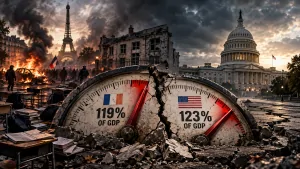
The US government’s response to freeze Russian assets in 2022 was the start. Then came last year’s so-called “Liberation Day”, when decades of trade policy were upended, overnight. Then came the Iran war. And now a $40 trillion national debt with no end in sight.
This has all been enough for foreign governments and central banks to finally reverse course; at first they slowed their purchases of US Treasury bonds. Now they’re actually selling… and diversifying away from the dollar.
The immediate beneficiary has been gold. And we’ve written about this— gold is the most logical asset for central bank diversification because it is already a traditional reserve asset… plus the gold market is very large and liquid.
We believe this trend will continue; gold prices will rise as a result, and quality mining companies should prosper.
But there’s a second element to this diversification story.
After Iran closed the Strait of Hormuz— which carried a fifth of the world’s oil and a host of other critical resources— every government on the planet re-learned the same lesson of World War II: trade and cooperation can vanish in an instant.
And now the entire globe feels a sense of urgency to prepare for the next conflict.
Will China invade Taiwan? Will the US and China go to war? Will Russia and NATO come to blows? Nobody knows, and no government wants to be caught flat-footed, unable to import the critical resources that their economies need to function.
In Roosevelt’s era it was things like rubber and tin.
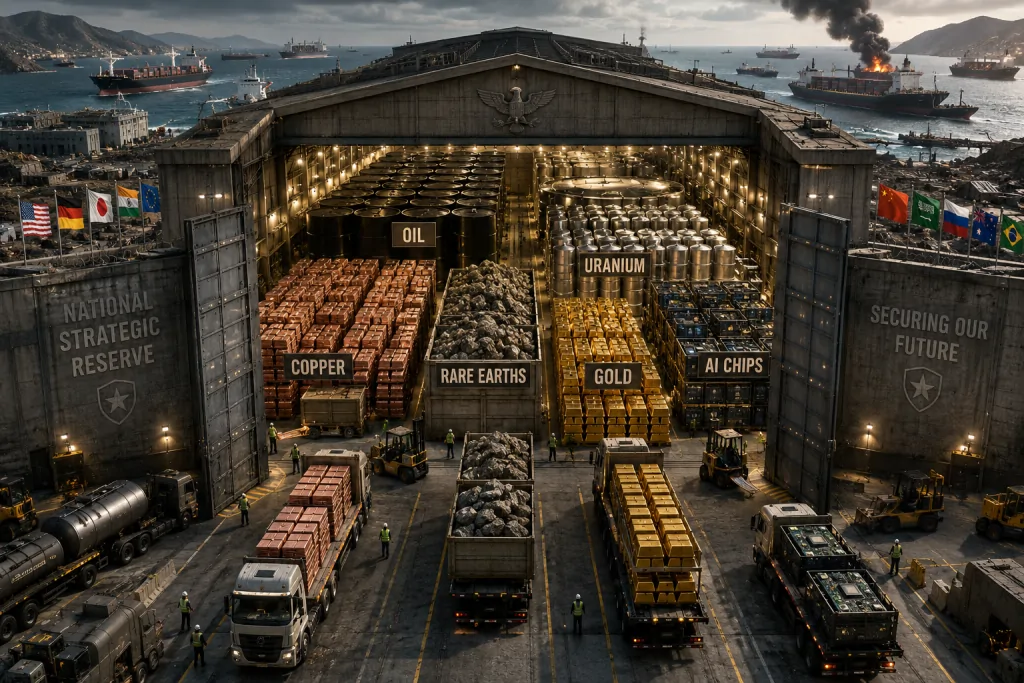
Today, these critical resources (what we refer to as ‘real assets’) start with energy— oil, natural gas, even coal… plus uranium for some countries.
Now, not every commodity is a real asset. Sugar is a commodity… but the world would be just fine without it. No government is going to stockpile orange juice, lumber, or wool. Or even rubber anymore.
But cut off a country’s oil supply and it reverts to the Dark Ages.
That’s why countries are now stockpiling the strategic assets that are the vital inputs to their economies: copper, rare earths, and even the IP and hardware that power AI.
China is the clearest example. In 2025 alone it added more than a million barrels a day to an oil stockpile and now holds roughly 1.4 billion barrels— the world’s largest reserve.
When Hormuz closed and the US and 31 other countries released 400 million barrels from their emergency reserves, China barely touched its pile and by July was adding to it again.
Its nuclear-fuel imports hit a record last year too, far beyond what its reactors burn; the excess went into stockpiles. And this summer Beijing put a new $9 billion state company in charge of buying mines around the world.
Saudi Arabia, on the other hand, produces plenty of oil, so they don’t need to stockpile it. But they are building nearly two gigawatts of data centers at home rather than risk being cut off from computing power.
A government that sells a Treasury still has to put the money somewhere, and the sensible places are the assets that the US government cannot freeze… and that no central bank can print. That is why the long-term direction of gold is still up.
But it’s also why energy, industrial metals, productive technology, and other vital resources— plus the companies which produce them— have a bright future.
This is the thesis behind Schiff Sovereign’s investment research newsletter, Strategic Assets. A world that no longer trusts the US government moves into gold, and a world that can no longer count on trade cooperation secures its own stockpiles.
We provide research on companies that mine, pump, and build what governments are stockpiling.
Subscribers who acted on our research locked in more than 10x on a small silver producer and more than 6x on a gold and silver producer, both in under a year.
A tin producer featured last summer is up more than 3x, a zinc producer more than 2.5x, and a tanker company about 2.5x. Across the companies we have closed out, winners and losers together, the average return is 172%.
We cordially invite you to learn more about Strategic Assets by clicking here.