In 1938 the airline business was brand new— only 35 years had passed since the Wright brothers’ first flight at Kitty Hawk.
Hardly anyone had even seen an airplane. A coast-to-coast round trip cost about $260, half the price of a new car, so passengers were mostly very wealthy.
The airlines were small, and during the Depression they were losing money. Congress was afraid they would undercut each other into bankruptcy, and the country would lose an industry it needed for its mail and its defense.
So lawmakers created the agency that became the Civil Aeronautics Board. For the next forty years, the Board set the airfare on every interstate route in America. They even decided which airlines were allowed to fly those routes.
The idea was well intended; they viewed airlines as an element of national security that needed protection.
But whatever good intentions the Board started with, by the 1970s it was just a soulless bureaucracy that stifled competition and said “no” to everything new.
An airline that wanted to CUT its prices needed the Board’s permission. So did anyone who wanted to start a new major airline.
Between 1950 and 1974, 79 new airlines applied to the Board. Zero were approved.
The consequences were obvious; remember, the Board only regulated interstate routes, so the public could see the difference.
For example, in 1965, a California airline called PSA flew Los Angeles to San Francisco for $11.43. Because the route was within the state, it was unregulated.
Meanwhile, the cheapest ticket from Boston to Washington— about the same distance, but across state lines and hence regulated by the Board— was $24.65.
In other words, federal regulation more than doubled the fare.
By the late 1970s Americans were hurting. The Arab oil embargo of 1973 had nearly quadrupled the price of oil, which stayed high. It was the decade of stagflation: prices had nearly doubled in ten years, inflation was running near 9% by the fall of 1978.
President Jimmy Carter was looking for anything he could do to bring prices down.
He understood that more competition means lower prices. “Of all our weapons against inflation,” he told the country in a televised speech on October 24, 1978, “competition is the most powerful.”
That same day he signed a law phasing the Board out, and by 1985 it no longer existed.
Sure enough, within six years the average airfare had fallen, even though inflation was still raging elsewhere in the economy.
And this was Jimmy Carter… hardly a free market champion.
Yet he kept doing it. In 1980 alone he deregulated banking, trucking, and the railroads, calling it “the capstone of my efforts… to get the federal government off the backs of private industry.”
Ronald Reagan beat him that November… and in his second week in office finished Carter’s phase-out of federal price controls on oil, and continued deregulation from there. Two presidents who agreed on practically nothing agreed on boosting competition.
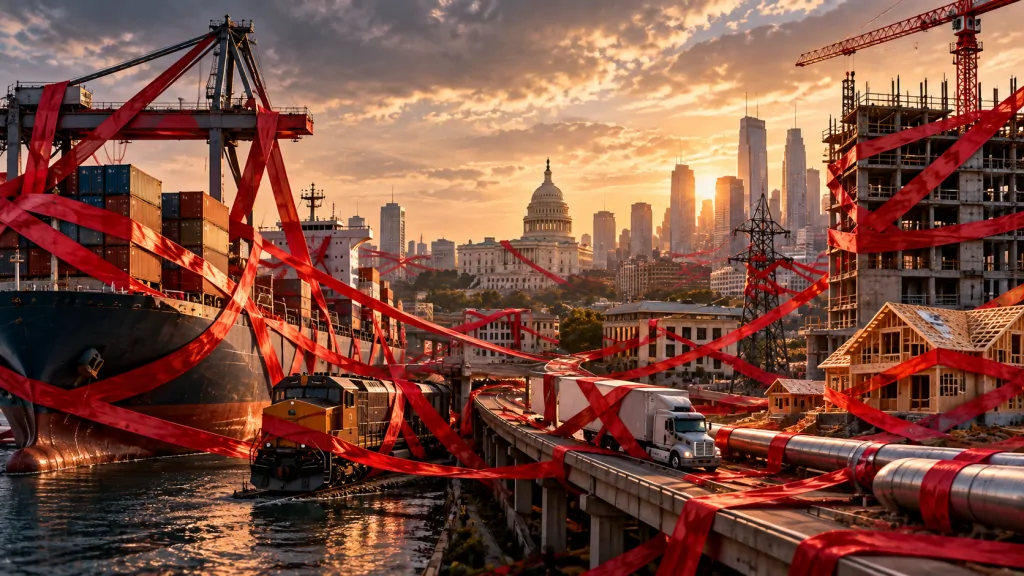
Nothing on that scale has happened since. For forty years the pile of rules has kept growing, and you pay for it every day.
Start with the airlines, where the ban on competition outlived the Board. No foreign airline may carry passengers between two American cities. Europe opened its domestic routes to airlines from other EU countries in 1997. Comparable fares there are well below America’s.
Under the Jones Act, a 1920 law, anything shipped between two American ports must travel on an American-built ship owned and crewed by Americans. Fewer than 100 large oceangoing ships qualify.
No American yard has built a liquefied natural gas tanker since 1980, so no American-built ship can carry Texas gas to Boston. New England consequently buys its winter gas from overseas instead.
Ironically, after hurricanes pummeled Puerto Rico in 2022, the government suspended the Jones Act so a foreign tanker could bring diesel to the island; this suggests that politicians already know how cumbersome and expensive the Jones Act is.
Hospitals need permission to exist, too. In 35 states medical facilities can’t open or expand without state approval, and states with these laws have about 30% fewer hospitals per person.
The National Association of Home Builders found that regulation adds about $132,000 to the price of a new home. Hardly any of that has to do with safety or quality.
Want to build a power line, a pipeline, or a mine? Consulting firm McKinsey estimates $1.5 trillion of investment is stuck in federal permitting.
Want to cut hair? That takes nearly a year of state-mandated training. One in five American workers now needs government permission to do their job.
And right now the government is keeping cheaper cars out. Chinese companies build a decent mid-size SUV for around $20,000 that American automakers would have to compete with. So Chinese cars face a 100% tariff, and the Commerce Department, citing national security, banned cars with Chinese-linked software. Americans pay more as a result.
The pattern is hard to miss: wherever the government gets involved, prices go up.
It has happened every single time the government stepped in to make something more affordable— education, housing, child care, healthcare.
Competition and technology are the only forces that have EVER brought prices down for good, and almost every rule in that pile exists to stop one or the other.
America got rich on competition yet has spent forty years legislating it away.
A real overhaul of the rules would do for the whole economy what Carter’s law did for airfares. Clear them away and the country will build more, make more, start more businesses…
None of this is difficult. Jimmy Carter did it with a signature. But the politicians refuse, and waiting on them is not a plan.
And that’s exactly why it makes sense to have a Plan B.