When Walmart founder Sam Walton passed away in 1992, his family fortune made him the wealthiest person on the planet… by far. His Walton Family Enterprises was worth $23.8 billion— nearly four times as much as Bill Gates at the time.
And if he were still alive today, Walton would be the second-richest man in the world, just behind Elon Musk… and ahead of Zuckerberg, Ellison, the Google guys, etc.
That’s a pretty impressive feat for a guy whose core business is basically being a gigantic grocery store.
Selling food is an extremely low margin business. And Walton’s success was built on a fanatical adherence to cost control and efficiency— being able to squeeze every penny of savings possible from the entire supply chain, and passing those savings on to the customer.
In short, he made a fraction of a cent on every sale… but generated more sales than any company in the history of the world.
It’s fascinating that Sam Walton dedicated his life to perfecting this business model. Yet Comrade-Mayor Zohran Mamdani— who has never operated a business in his entire life— thinks he can do a better job than Walton.
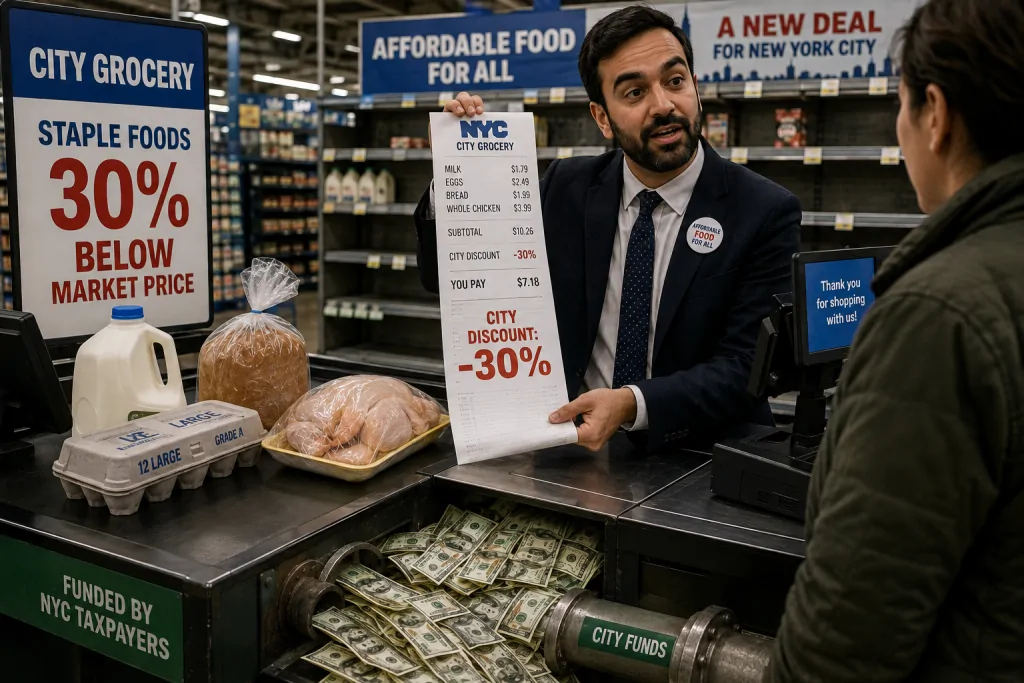
A few weeks ago, Mamdani’s team published their formal RFP (request for proposal) for contractors to build five city-owned grocery stores in New York City— one per borough.
Mamdani’s objective is to sell staple foods like milk, eggs, bread, etc. at a 30% discount to the supermarkets down the street.
So apparently these socialists believe that 30% is the amount that “Big Grocery” is gouging them… which shows just how little they understand about business.
Again, groceries are notoriously low margin businesses. If they sell you something for $1, their gross profit is about a penny. Cutting prices by 30% guarantees they will lose money.
Staple consumer items like milk, eggs, chicken, and bread— exactly the products that Mamdani intends to sell at a discount— are some of the LOWEST margin products in the grocery store. Grocers already sell those at rock bottom prices just to get shoppers in the door.
For example, the Giant Eagle supermarket chain sold eggs at or below cost in all of its stores during last year’s bird flu outbreak. Costco sells over 150 million rotisserie chickens a year at $4.99 and loses tens of millions of dollars on them.
Grocers treat these staples as loss-leaders; they make up for it by generating small profits from the rest of the shopping cart, i.e. items like soda, snacks, prepared foods, and specialty items.
There is simply no fat to cut on staple items… and certainly nowhere near 30%. In fact, let’s take a quick look at how the supply chain works— starting from the grocery store and working backwards.
We already showed how grocers will barely break even, i.e. they sell a staple food for $1, and they make no money.
Before them are the major food distributors who supply the grocery stores.
Sysco, the country’s biggest food distributor, keeps about two cents out of of every dollar it charges. The transportation companies hauling the food keep around three cents.
One step further back is the food processor. Tyson Foods, the largest meat company in America lost a billion dollars selling beef last year. Its core chicken business is generally profitable, but highly cyclical, and they have swung to nine-figure losses when feed costs spike.
Yet even the farmers themselves who supply the processors or grow the grain typically lose money; over 1,000 American dairy farms closed last year alone, and Illinois farmers growing the feed corn are on track to lose $70 to $110 an acre on this year’s crop, their fourth losing year in a row. And that’s after their government subsidy checks.
Nobody in the food chain for staple goods is making real money. Farming, feed, processing, trucking, distribution, retail: every link runs on pennies. A 30% price cut cannot come out of anyone’s profit, because the profit does not exist.
Comrade-Mayor Mamdani and his merry band of socialists either don’t understand that, or have decided it doesn’t matter because the taxpayer will absorb it.
Now, the city won’t run the stores itself. Mamdani will pay a contractor to run them… But since the stores are designed to lose money, the city will send the operator a check every year to cover the losses.
How big will the check be? Nobody knows.
But on opening day, if the city really is selling the cheapest chicken in the borough, people will come buy all of it. Restaurant managers will stock up on cheap chicken to resell to their customers. Consumers will fill their freezers with it.
All that chicken will vanish in an instant, just like a deep-discount TV during a Black Friday sale.
Naturally the Comrade-Mayor will take steps to prevent this. But how?
Initially they said you would need to show ID at the grocery store. But they quickly backtracked because, obviously, ID is racist. So now they’re pitching the idea of something like a library card.
You need to show ID to get the card, and the card to buy the chicken. But apparently that’s not racist?
Naturally the card would need to track how much chicken a single consumer purchases in order to prevent people from going to multiple stores and buying out the whole inventory.
But if that’s the case, it’s not a library card. It’s a ration card. And that’s been a staple of every socialist disaster for over a century.
Running a grocery on a tiny margin is one of the hardest operating problems in retail. Order too much fresh food and it rots in the back room; order too little and the shelves sit empty.
Walmart survives on that knife’s edge with some of the most advanced logistics technology on earth.
For example, they discovered decades ago that that strawberry Pop-Tarts sell at seven times their normal pace ahead of a hurricane— which is why trucks full of them roll toward the Florida coast before a storm hits.
Capitalism works through specialization— specialists spend their entire careers perfecting one tiny sliver of that machine to claw back a fraction of a point of margin.
The farmer, the trucker, and the supply-chain engineer each spend a lifetime becoming ruthlessly good at one narrow thing, and the penny of margin is the reward for doing it almost perfectly.
Mamdani quotes Karl Marx and thinks he can do a better job… even though his government cannot even reliably pick up the garbage.
These are the same people who want to run health care, housing, and energy.
Frankly I couldn’t be happier. The socialists finally got what they wanted: they’re in power, in the spotlight. And they’re about to prove once and for all that their entire ideology is a complete and total disaster.