
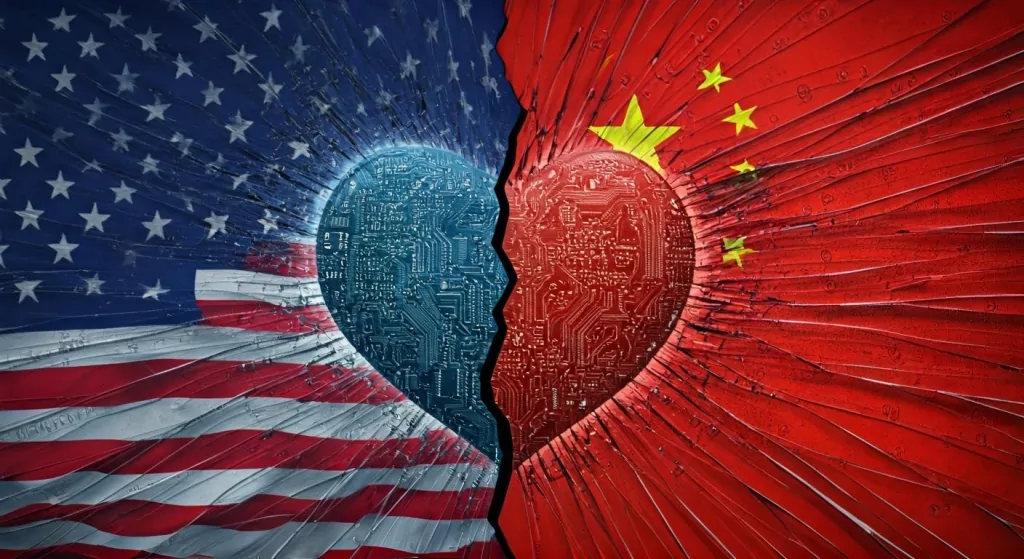
The US has revived a Cold War dating policy in China: if she’s into you, assume she’s a spy.
Four US government personnel stationed in China have anonymously told the media that every government worker and contractor stationed in China was explicitly banned from having sexual or romantic relationships with Chinese citizens.
The policy applies to US diplomatic facilities across mainland China—including the embassy in Beijing and consulates in Guangzhou, Shanghai, Shenyang, and Wuhan—as well as the consulate in Hong Kong.
If they are already in a relationship with a Chinese national, they can apply to their boss for permission to continue dating. Very romantic— I filled out form 53X for you, babe.
And if their bureaucrat boss is ugly and jealous and denies permission, the government worker must either break off the relationship, or quit their job.
You see, in the world of espionage, the “honeypot” is a time-honored tradition—where one country sends in an attractive agent to, shall we say, tenderly extract classified information. The Soviets used it. The Chinese have used it. The Americans probably use it too, though let’s be honest—given the average government employee’s charm level, it’s likely less effective.
(I can only imagine how turned off a Chinese asset would be with an American romantic partner complaining about pronouns…)
And the threat isn’t theoretical. Just ask Congressman Eric Swalwell, a California Democrat and sitting member of the House Intelligence Committee. He found himself awkwardly entangled in a scandal when a suspected Chinese spy named Christine Fang—or “Fang Fang,” apparently her Bond-girl nickname—got a little too close for comfort.
She fundraised for his campaign, helped hire an intern, but left the bedsheets cold and vanished right around the time the FBI came knocking.
Swalwell claims he cut ties the moment he was briefed, but still—having a spy embedded in your social circle is not exactly a résumé booster when you’re handling classified intel.
That’s the risk. Honeypots aren’t about romance—they’re about leverage. And the CCP doesn’t need you to spill nuclear secrets over dinner. Sometimes all it takes is access to your calendar, a casual glimpse at your laptop screen, or just enough dirt to ensure you’ll play ball the next time someone asks for a “favor.”
In China, Beijing’s Ministry of State Security reportedly assigns entire teams to ‘monitor’ high-value US personnel. If you’re a diplomat, there’s a decent chance your neighbor, your gym buddy, and that cute barista with dimples and broken English work for the CCP.
And just to be clear, Victorian morals have not infiltrated the US government— this is a flashing neon sign that says: The Cold War is back.
This new “no love in China” rule is part of a broader escalations of trouble between the US and China.
In just the past week, we’ve seen China slap the US with an 84% retaliatory tariff, while US Treasury yields have surged at a pace not seen since the 1980s—likely the result of China dumping US bonds.
Trade war? Check. Financial war? In progress. Now we’re moving into personal territory—where even dinner dates are viewed as potential national security risks.
What’s next? Export restrictions? Cyberattacks? Asset seizures?
We don’t know. But what’s increasingly obvious is that this conflict is no longer confined to spreadsheets and trade agreements. It’s starting to touch everything—markets, interest rates, the cost of living… and now, even the love life of Beijing bureaucrats.
When romantic entanglements are seen as national security threats—and policies start reflecting that—it’s a clear signal: trust has completely broken down.