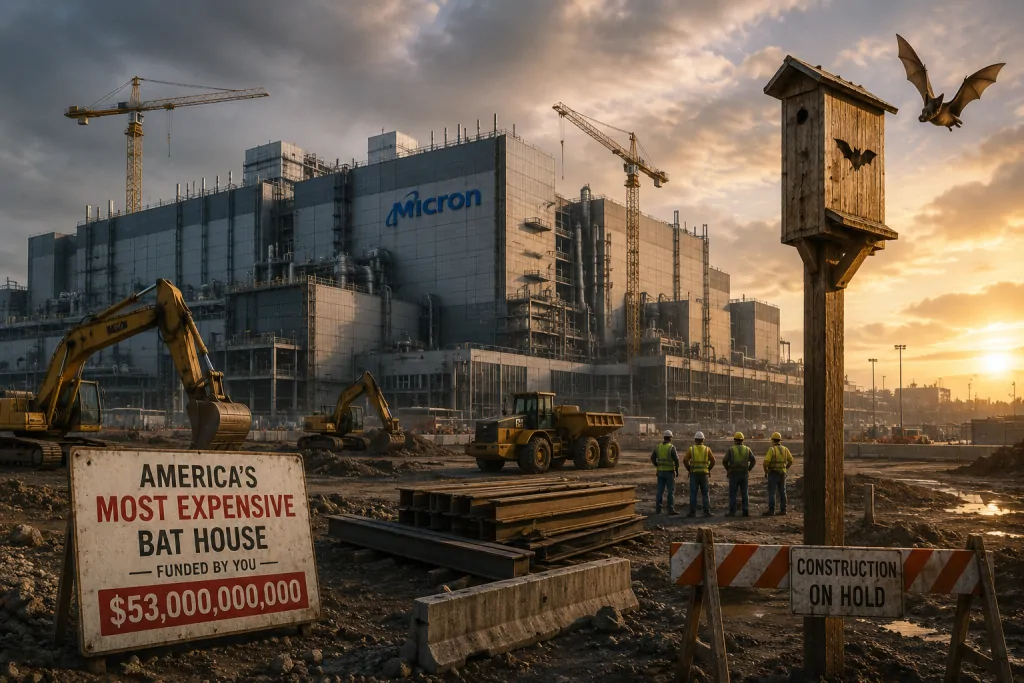
There’s a reason why your next iPhone is about to get a lot more expensive: the northern long-eared bat.
This species of bat is federally recognized as endangered, and it nests in a stretch of forest in upstate New York. And it’s the reason why tech companies can’t build a $100 billion memory plant there.
Memory is a big deal in tech right now. Apple CEO Tim Cook blamed global memory chip shortages for the coming iPhone price hikes.
And the Wall Street Journal estimated that memory prices could rise as much as four-fold this year, adding somewhere between $200 and $300 to the price of an iPhone. Nintendo, Sony, and Microsoft are raising prices on consoles and laptops.
Congress, of course, already spent a fortune to prevent exactly this. In 2022 they passed the CHIPS Act, containing roughly $53 billion in subsidies plus a 25% tax credit to drag chip manufacturing back onto American soil.
So four years later, where are the chips!?!?!?!?
New York Senator Chuck Schumer wrote and championed that law, and then made sure his home state landed the prize.
In October 2022 he stood beside Governor Kathy Hochul to announce that Micron, America’s largest memory chipmaker, would build chip plants in the town of Clay, near Syracuse, in part with those federal subsidies.
“With the CHIPS and Science bill I wrote and championed as the fuse,” Schumer boasted, the investment would transform the region into a global manufacturing hub.
Yet four years later, almost nothing has been built.
Start with the problem nobody mentioned at the first press conference: the finished plant will draw more electricity than New Hampshire and Vermont combined— about 1.85 gigawatts, running around the clock.
That would be a problem in any state. But it is even more of a catastrophe in New York, because state politicians have spent the last decade methodically dismantling their own power generation.
In 2019, New York passed the Climate Leadership and Community Protection Act, mandating 100% carbon-free electricity by 2040.
To get there, the state inexplicably went after its two cleanest sources of reliable power. It started forcing natural gas plants, the cleanest-burning fossil fuel, to shut down.
Then it closed the Indian Point nuclear plant in 2021, two gigawatts of zero-carbon baseload.
New Yorkers now pay roughly 70% more for electricity than the national average and still lean on imported power from neighboring states and Canada to keep the lights on, while the state’s own grid operator warns of shortfalls.
So the government that legislated away its own power has promised a single factory more electricity than two states combined can produce.
But before Micron can even worry about the electricity, it has to deal with the bats.
Schumer sold the site as “open fields.” What’s actually there is hundreds of acres of forest and wetland that happen to house protected bat species.
Federal and state rules forbid Micron from cutting a single tree between April and October, while the bats are roosting.
Micron agreed to spend $1 million protecting them and to install ten “bat houses.” The environmental review ran 719 pages, backed by some 20,000 pages of supporting material.
Tree clearing was supposed to begin two years ago; it finally started this January, at which point environmental groups promptly sued to stop it.
The whole thing pretty well sums up modern American government.
Washington borrowed money it doesn’t have to end a chip shortage, then handed it to the Senator who wrote the law.
He sent it to the state he represents— but that state outlawed the very power that the new chip plant needs to operate.
Then federal and state regulations drowned the facility in environmental reviews.
Then activist groups filed a lawsuit to stop production entirely.
Congress did not need to bother spending $53 billion to bring chip-making home. They just needed to stop making business in America so difficult.
If New York could generate cheap power and let companies build, Micron wouldn’t need a subsidy, and the federal government wouldn’t be borrowing money to create one.
Every regulation that blocks a factory also blocks the tax revenue that factory would have generated. They create the problem, borrow money to “solve” it, and then block their own solution.
That is the real cost here. Not the billions wasted, and certainly not the bats. It is an economy where nothing can get built by anyone, subsidy or not, run by people whose answer to every failure is to borrow more and spend it on the next one.
Here’s the bottom line. Washington won’t cut spending. And it doesn’t look like they’re going to cut regulations either. They seem to have no interest in shoring up an abusive judicial system. They won’t even tackle obvious fraud when it smacks them in the face.
I wouldn’t count on that pattern to change. Which is exactly why you need a Plan B.