Yao Tongbin was one of the most important scientists in Maoist China. He had earned a doctorate in metallurgy in England, spent three years at a research institute in West Germany, and left it all to return to China in 1957.
He spent the next 11 years building China’s first-ever modern missile program, with unparalleled knowledge and experience he had accumulated in the West.
But when he came home for lunch on the afternoon of June 8, 1968, a gang of thugs from a rival political faction was waiting for him. They beat him to death in his own apartment. He was forty-five years old.
Yao’s crime was that he was educated, expert, and Western-trained— exactly the kind of man that Mao’s Cultural Revolution had taught the country to hate.
From 1966 to 1976, Mao turned China against its own educated class, rooting out political opposition and handing the power to young revolutionaries.
Professors were dragged before their students in dunce caps and beaten mercilessly. Universities shut their doors. Millions of educated young people were shipped off to work camps. And engineers were ranked near the bottom of the social order.
China spent ten years treating intelligence as a crime, and the country paid the price for a generation.
Meanwhile, over in the West at the same time that Mao’s Red Guards were beating engineers to death, American technological geniuses developed the world’s first microprocessor and lit up the first nodes of the internet… effectively giving birth to the digital age.
It was a night-and-day difference between the US and China. China was actively, stupidly making itself worse off, while the US was developing the technology that would change the world forever.
America remained the epicenter of technological innovation for decades; in fact, the unofficial ‘scoreboard’ of the world’s most technologically advanced nation was whoever could build the fastest supercomputer.
And the answer was obviously the United States… until Japan shocked the world in 1995 and beat the fastest US supercomputer. America quickly reclaimed the top spot, only to be bested by Japan again in 2002.
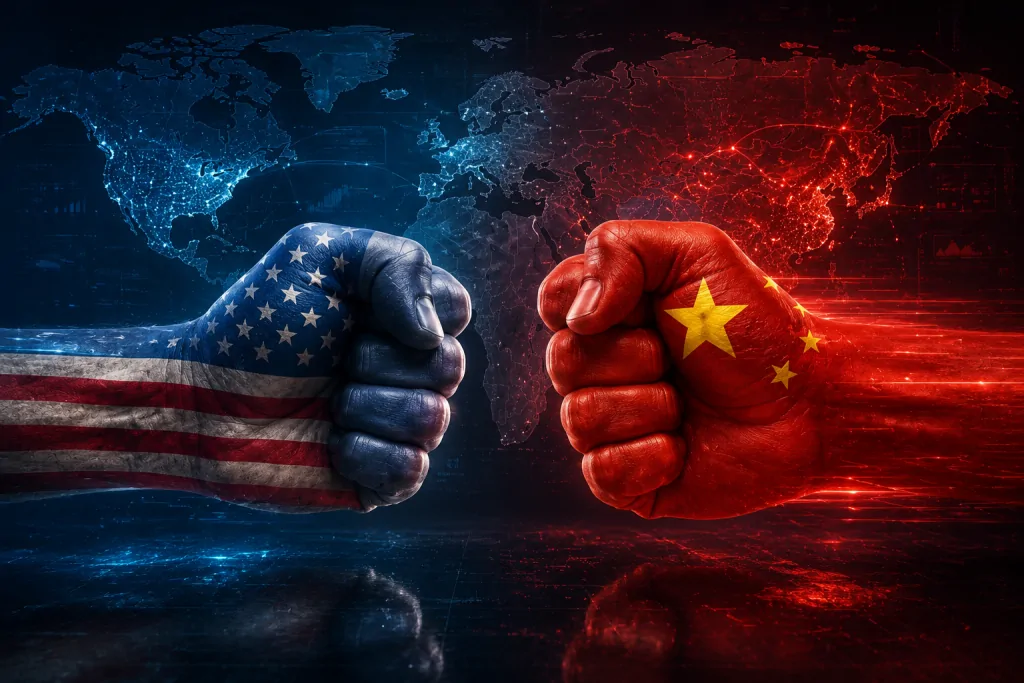
The two great technological powers jostled for #1 for the next several years until the unthinkable happened in 2010: China developed the world’s fastest supercomputer.
For the past sixteen years, those three powers— America, Japan, and China, have traded the trophy. And China just retook it from the US again last week.
This is a symbolic, albeit critical competition— especially now as there are so many challenges to America’s economic, military, and geopolitical leadership.
Why is America falling behind? Because of its own soft “Cultural Revolution” driving out competence and rewarding the people who build nothing.
During COVID, the government and media conspired to destroy the careers of anyone who questioned Tony Fauci.
Shortly thereafter, the DEI cult took over. From transgender Bud Light influencers to absurdly woke Disney movies to mandatory diversity quotas in corporate boardrooms… and it went all the way to the most powerful institutions in America.
Joe Biden promised a female running mate as his Vice President, and a black woman as a Supreme Court justice. His obsession with diversity over merit resulted in two extremely unqualified people in some of the nation’s highest offices.
He appointed Rachel Levine to Assistant Secretary for Health for being transgender; Levine’s big contribution to America was trying to get tech companies to censor “misinformation” about gender affirming care.
Biden further appointed Sam Brinton, a non-binary LGBTQRSTUVWZYZ activist to oversee America’s nuclear waste program. Brinton turned out to be a kleptomaniac and was criminally charged with repeatedly stealing women’s luggage from airport carousels while serving in government.
The end result has been predictable across the military, public health, medicine, and the media, institutions that increasingly selected for ideology over competence.
Mao destroyed his most capable people on purpose, and it cost China a generation. America is now doing the same thing to itself in a softer way.
But regardless of the tactics, any country that pushes out people who can design the chips, fly the planes, run the labs, and keep the lights on, is shooting itself in the foot.
Here’s another interesting example—
On a recent, private call for our top-tier Total Access members, we spoke with a really unique American entrepreneur based in Africa who sees this DEI rot every single day.
China, he told us, runs a “full court press” in Africa. The Chinese government fights for its businesses and helps them invest aggressively in the strategic resources that China needs back home. Food production. Energy. Water. Minerals.
Meanwhile, as China rapidly scoops up critical resources and builds relationships on the continent, the US-funded Western NGOs are busy with DEI and climate change initiatives.
He told us about one particular NGO, a group that pulled out of a critical agricultural investment over concerns that there weren’t enough women involved and too much CO2.
The difference in priorities between China and the West could not be more obvious.
Now, none of this means that China takes over the world. America has faced down a rising manufacturing rival before. It absorbed Japan’s challenge in the 1980s, and it out-produced and out-innovated the Soviet Union as well.
The United States still commands the deepest capital markets on earth, enormous pools of talent, and a genius for inventing and building that no rival has ever matched.
China’s problems, by contrast, are far greater.
It shares borders with fourteen countries, including North Korea, Pakistan, India, and Afghanistan. It doesn’t have trusted relations with a single one of them.
China is the largest oil importer in the world by a wide margin and has astonishingly thin per-capita reserves. It is lean on water and quality farmland. Its regional governments are buried under mountains of debt.
And it is, quite bizarrely, facing a massive demographic crisis of its own making (from years of its idiotic one child policy) while simultaneously and precariously trying to keep a population of 1.4 billion people under strict authoritarian control.
Plus, let’s be honest— a centrally planned economy will not deliver maximum innovation. Yes, America has its own idiots in office. But for every Lizzie Warren and AOC, China has plenty of its own morons in government service who make painfully idiotic decisions.
America’s problems are gargantuan, yes. But at their core, they are completely fixable. Three simple approaches would dramatically move the needle. Quickly.
- Cut the federal deficit by reducing obvious fraud and exercising common sense restraint.
- Boost economic productivity by eliminating pointless federal and state regulations.
- Focus exclusively on merit rather than DEI credentials.
Those three are very simple and straightforward, and they would dramatically move the needle. And that’s before tackling other challenges like Social Security, immigration, and election reform.
China might have temporarily taken the top spot in supercomputing. But this is still America’s race to lose.
The plan is maddeningly simple. Unfortunately, if history is any guide, Congress will probably do nothing until there’s a bad-enough crisis to force them to act. And that’s why it makes so much sense to have a Plan B.
PS: That conversation with the investor in Africa came from a private call for our Total Access members. Total Access is the top tier of Schiff Sovereign membership, built for those who value global networks of like-minded people.
Members get all of our research — Plan B Confidential, Strategic Assets, along with the deepest second-passport discounts we can negotiate, events, boots-on-the-ground explorations, and a network of people quietly building their own Plan B.
There are still a few opening for our exclusive Total Access event in Panama in September. Click here to learn more.