
Arguably the most famous man on the planet throughout the 1700s was the famed writer Francois-Marie Arouet, known to history as Voltaire. He wasn’t just a celebrity writer and philosopher, however; Voltaire was also a wealthy capitalist and nobleman who almost single-handedly turned the impoverished region of Ferney into a highly productive watchmaking hub.
Through his fame and creativity, Voltaire managed to attract a small army of Swiss watchmakers to relocate across the border into France and set up shop in Ferney. As part of the deal, he personally negotiated special tax incentives for his watchmakers, exempting them from some of the most onerous French national taxes.
Voltaire’s tax incentives were personally signed off by France’s comptroller general, Jacques Turgot… and all of Ferney celebrated their success.
Unfortunately, even a formal deal with the French government didn’t stop the local “tax farmers” from coming to collect.
For most of the 1700s, the royal court in France had delegated the collection of its complex system of taxes and duties to private citizens who were known as tax farmers. Tax farmers would essentially bid against each other to pay the government a fixed sum of money up front each year, which the treasury would then claim as tax revenue. Tax farmers would then have the full authority of the state to go all over the cities and the countryside to collect.
As they were obviously running a business, their primary motivation was to generate the highest possible return on investment by any means necessary. And it didn’t take long for tax farmers to turn into mafia-like organizations that would send roaming gangs across the country to threaten and extort every last penny they could get from French citizens.
Even though Voltaire had negotiated directly with the French government for his region’s tax exemptions, the tax farmers still came to Ferney and brutalized the local population. Voltaire wrote to a friend in late 1775 that the tax farmers “marched about in groups of fifty, stopped all the vehicles, searched all the pockets, forced their way into all the houses and made every kind of damage,” to collect money from the citizens of Ferney.
This was not an aberration; stories of widespread abuse by tax farmers were legendary in pre-revolutionary France. In the year 1783 alone, tax farmers carried out more than 4,000 house searches and arrested roughly 20,000 people. Confiscation of property, homes, clothes, and horses was routine. And the financial incentives were perverse, with the person who ratted out a suspected tax delinquent earning one-third of the confiscated property.
Unsurprisingly, most of these tax farmers would be put to the guillotine after 1789.
Sadly, this concept is starting to make a comeback in the land of the free, where governments are outsourcing tax collection to private businesses, which have a financial incentive to be excessive and overly suspicious.
A large part of this is because roughly half of the states are in financial distress. This is a consequence of the federal government pulling the plug on certain slush fund programs that have fattened state coffers since the COVID days.
As a result, states are having to find ways to make ends meet. And that starts with keeping their tax codes deliberately complex and outdated. Doing so means that almost everybody is going to be guilty of some violation, because it’s nearly impossible to remain in compliance with a tax code that often contradicts itself.
States then empower private companies to go out and collect, to find infractions wherever they may be, and extort money from productive citizens. This is a much easier approach for them than doing the hard work to balance their budgets and live within their means.
Here’s an easy example: it’s completely normal now for a business to have remote workers. And often those workers might be in another city, another state, or even another country.
Tax rules in many states have never caught up to this new paradigm. Hence, many state governments still want their pound of flesh, even though workers don’t set foot anywhere near their jurisdictions.
Rules in New York state, for example, are completely incomprehensible. A nonresident employee who works remotely from another state can still be considered a New York worker whenever staying home is for the employee’s convenience rather than the employer’s necessity.
There is, of course, no guidance on how necessity versus convenience is determined. It’s a gray area and leaves a lot of room for interpretation by a tax collector who has a financial incentive to extort businesses with out-of-state remote workers.
The fact is, it’s impossible for businesses with several employees in several states to get all of this right.
Every multi-state business is in violation of something, somewhere, and the only question is who finds it first.
And this is only one small example. There are literally hundreds, if not thousands, of outdated tax regulations at the state and local levels for which compliance is simply not feasible.
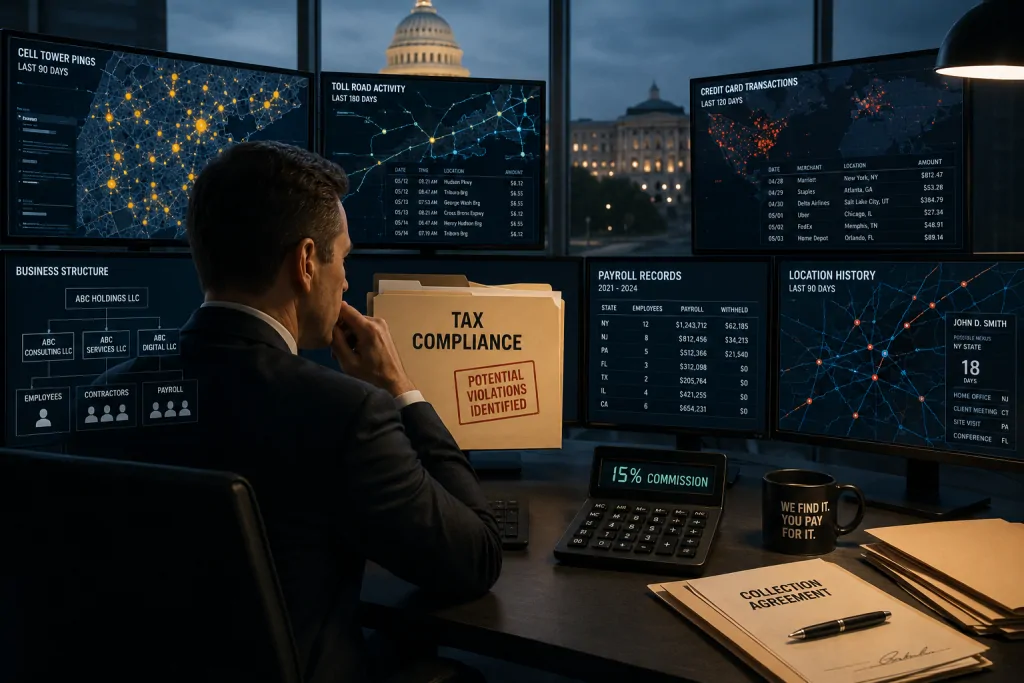
Private companies receive anywhere from 12% to 20% of the amount they collect, and they engage in any number of creative ways to find delinquents. They’ll license proprietary location data, including cell phone tower logs, toll records, and even credit card statements, and when all else fails, sometimes they’ll just make stuff up to intimidate taxpayers into writing a big check.
You will absolutely hear more about this, if not experience it for yourself. Readers of this letter know without a doubt that the US federal government is in deep financial turmoil, with a national debt of nearly $40 trillion and roughly $2 trillion in annual deficits.
But many states are in far worse shape. And they don’t have the luxury of being able to print the world’s reserve currency to make ends meet. Rather than make the difficult choices to balance their budgets, they will turn to milking their citizens like dairy cows and outsourcing the collection to a new generation of tax farmers.
P.S. Working out where your business, your assets, and your family legally belong is exactly what our flagship research service, Schiff Sovereign’s Plan B Confidential, was built for.
Every month it covers second residencies and citizenships, foreign banking, legal tax reduction, and real assets, reported from more than 120 countries so the options come with real costs attached.