Some time in the middle of the second century AD, on the shores of the extremely picturesque Lake Iznik in modern-day Turkey at the site of the ancient city of Nicaea, a boy named Cassius Dio was born into a locally prominent family.
His father was a Roman politician, his mother was Greek, and young Cassius Dio grew up in a bilingual household speaking Greek and Latin at a time when the Roman Empire was at its absolute peak.
There was widespread peace and prosperity— so much so that the emperor at the time, Antoninus Pius, spent his entire 20+ year reign without ever coming within 500 miles of a Roman legion.
His was the most peaceful reign the empire ever had. The imperial government busied itself with foreign trade missions, including to Han China; and with perfecting the delivery of clean drinking water across the empire— a feat that wouldn’t be repeated until 1804.
In short, the Romans had a 19th century standard of living as far back as the 2nd century AD, and this is the environment of wealth and abundance in which young Cassius Dio grew up.
But by the time he was an adult and had followed in his father’s footsteps to become a politician, things had changed.
In the decades between his childhood and adulthood, Rome had taken a turn for the worse. The empire had seen multiple wars, plague, barbarian incursions, and assassinations of several emperors.
At one point the Praetorian Guard had even auctioned off the empire to the highest bidder.
But Cassius Dio knew his history, and he knew that Rome had seen tough times before. There had been the civil war between Julius Caesar and Pompey, the depravity of Caligula, and the insanity of Nero. Yet Rome always came back better and stronger than ever.
So Cassius Dio assumed at first that this time would be no different. Rome was in the midst of difficult times by the 190s and early 200s, but it would recover stronger than ever, just as it had in the past.
It was only later in life, after watching things go from bad to worse that he realized this time actually was different. Rome was not coming back.
And it was at this point that he wrote, rather bitterly in his histories of the empire, “Our history now descends from a kingdom of gold to one of iron and rust.”
This is how we opened our Plan B conference this past weekend in Panama City, Panama— with a historical tale. We told the story of Cassius Dio and explained that, yes, dominant superpowers often go through tough times, and they often recover.
France under Louis XIV went through multiple peasant rebellions and a civil war, yet it recovered and maintained its status as a superpower.
The US went through World Wars and financial crises, and also maintained its status as the dominant superpower.
But sometimes superpowers reach a point where this time really is different. Nothing is certain, and recovery is still possible. But it makes perfect sense to prepare for challenging times ahead.
If the US dollar, for example, loses its status as the global reserve currency, there will absolutely be consequences, and the impact will be widely felt. Ditto for the rising US national debt.
The rest of our event focused ways to mitigate those consequences.
We had attendees and speakers from all over the world, which was quite refreshing. We even had the mayor of Panama City open the event, welcoming our guests at dinner on Thursday night, and come again to our farewell dinner on Saturday night.
It was really nice to see someone of influence in government who was bending over backwards to support anything and everything that our members needed.
My friend and partner Peter Schiff was also on stage with me, and he told the audience where he sees serious cracks in the bond market. This has major implications for the US dollar, the prospect for inflation, and the general future of the United States.
Peter and I both agree that not all is lost. I presented some very simple ideas for the US to get back on track, none of which are remotely controversial.
Bottom line, with the prospect of continued productivity growth from AI, robotics, small modular nuclear reactors, and cheap energy, combined with some modicum of fiscal responsibility, the US can still be OK.
But, at least at the moment, there does not seem to be any interest in Congress to rein in spending and stop the explosion of the national debt.
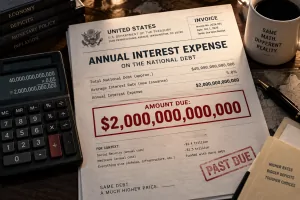
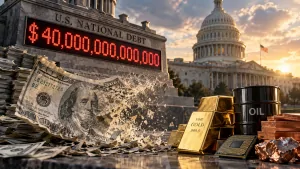
And this is why having a Plan B is so important. It would be completely foolish to believe that a $40 trillion national debt, the looming insolvency of Social Security, $2 trillion annual deficits, and an annual interest bill that mops up 25% of tax revenue will all be consequence-free.
That’s why we presented so many options from around the world. We had speakers presenting about second citizenship programs, foreign residency, global real estate, tax planning, multiple options for gold storage, as well as some discussion about tokenization and crypto.
We even had bankers from a well-capitalized private bank opening accounts for people on the spot.
This is important stuff. A good Plan B is like an insurance policy— you don’t wait until your house burns down, you get sensible coverage in advance to mitigate specific risks.
The whole point of a Plan B is to be in a position of strength regardless of what happens, or doesn’t happen, next. It’s not complicated, but it takes some sensible and deliberate planning.
For more than 15 years we’ve been providing some of the best research in the world on these topics.
Every month it covers second citizenships, foreign residency, foreign banking, and legal tax strategies, with boots-on-the-ground reports from more than 120 countries and a Rolodex of vetted service providers for when you decide to take action.
So even if you weren’t at our event, make sure you have access to Plan B Confidential. Click here to learn more.