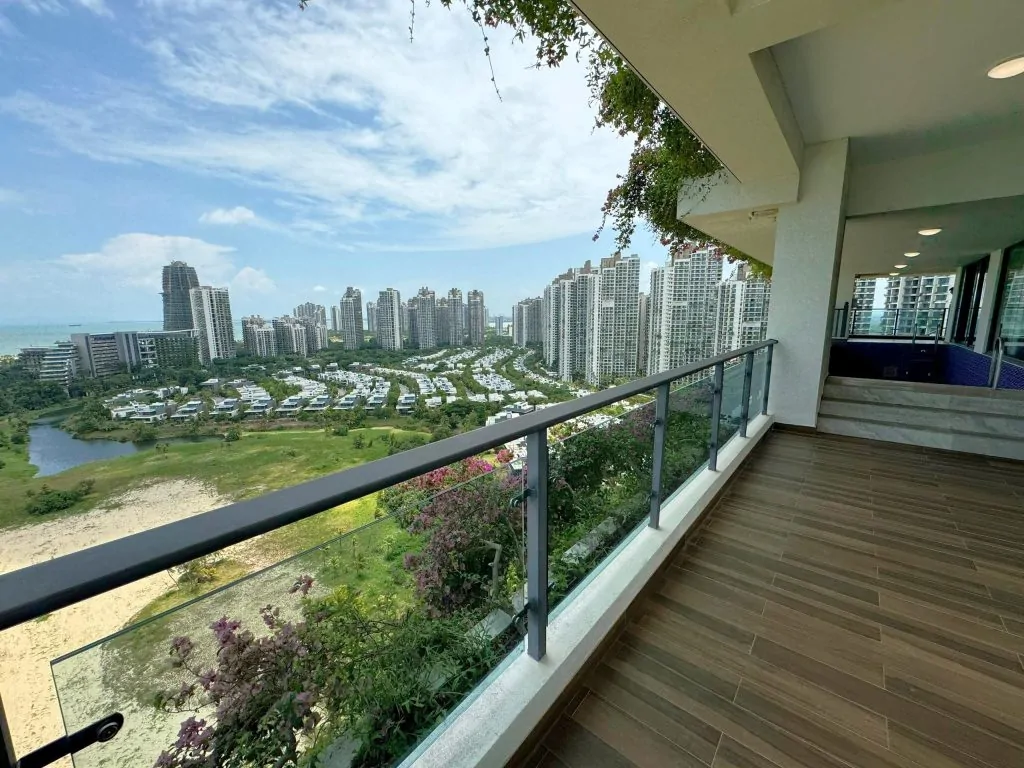
On March 6, 2016, Malaysia’s prime minister, Najib Razak, turned up for the grand opening of a city that did not exist yet, two kilometers off the coast from Singapore.
It was called Forest City, and the plan was enormous. One of the largest property developers in the world came in to build four artificial islands in the strait and put a “smart, green” city of 700,000 people on them, at a cost of roughly $100 billion.
Originally they were targeting wealthy Chinese buyers who wanted to park capital in foreign real estate. Unfortunately the CCP stopped letting its citizens do this, so the project hit a wall early on.
Fast forward to today— only one island was ever built, and now it’s a bit of a ghost city, with only 10,000 residents (versus the 700,000 projected).
But it’s also one of the cheapest ways to get the legal right to live in a country where a couple can get by on about $1,500 a month.
Malaysia’s standard long-term residency program requires a $150,000 deposit in a Malaysian bank and the purchase of a home for at least $147,000, or $245,000 in the capital, Kuala Lumpur.
The Forest City version has the same two parts, a deposit and a home purchase, but the deposit drops to $32,000 if you’re 50 or older, and the visa runs ten years with no minimum stay requirement. And by Forest City’s own guidance you don’t even have to live there. You could live in another part of Malaysia, or outside the country entirely.
The catch is the home purchase. It has to be a residential unit in Forest City itself, bought directly from the developer for at least $122,000 (and often more), and held for ten years. So you still put up about $155,000 in total, but only $32,000 of it sits in the bank. The rest goes into the condo.
This isn’t for everyone; even if you’re the adventurous type, Forest City is a speculation with a visa attached. You’re betting that the tax breaks will spur more demand, that the government will continue to push for the project’s success, and that nearby Singapore (with its outrageously priced real estate) will help fill all of those empty units.
Malaysia has other options as well.
Sarawak, a Malaysian state on Borneo with its own immigration powers, runs its own residency program, separate from the federal one and the Forest City option.
It doesn’t require a property purchase, but it does require a $122,000 deposit in a Sarawak bank and spending a month each year in Sarawak to maintain residency.
Bear in mind that the deposit is not a fee. It sits in a Malaysian bank in your name and could earn a couple of percentage points of interest. Half of it can come out later for a home, school fees or medical bills, and the rest stays there for as long as you hold the visa.
And spending a month there each year is no hardship. Sarawak’s capital, Kuching, is a river city of about 750,000 people with good private hospitals, an international airport, and the rainforest and national parks of Borneo at the door. English is widely used, and a one-bedroom in the center rents for about $350 to $400 a month.
The rest of the year you can spend outside the country or in another part of Malaysia.
Penang is the classic choice: an island of about 800,000 people whose capital, George Town, was a British trading port in the 1700s and has some of the best food in Asia. The long-term foreigners settle a little north of town along the coast, and the private hospitals are high quality.
The capital, Kuala Lumpur, is a big modern city with international schools, serious hospitals, and an expat district where a two-bedroom condo with a pool, a gym and security rents for $700 to $1,100.
The country’s main draw is the cost of living. Malaysia is remarkably affordable for what you get. Outside Kuala Lumpur a good one-bedroom in a desirable neighborhood rents for about $400 a month, a meal at a basic restaurant costs $4 or $5, and part-time household help runs about $8 an hour.
A couple could get by on about $1,500 a month, in a country where English is widely spoken, the roads and airports and private hospitals are second only to Singapore’s in the region, and the food is some of the best anywhere.
That’s really what a Plan B is about. You look at the entire world as a set of options for solving problems and reducing risk, instead of assuming everything has to happen in the one country where you happened to be born.
One of those problems is inflation. The cost of living at home keeps climbing, and the plain reality is that a lot of places are simply cheaper, often with a standard of living to match. Malaysia is one of them, and a residency there is worth considering for that reason alone.
And you don’t have to move there: this second residency is an option, not a requirement. You can hold it from home for years and never use it. But if you ever want it, you aren’t a tourist whose stamp runs out in a few weeks. You can stay as long as you like, rent or buy a home, open a bank account, and get on with life.
If the cost of living at home becomes unbearable, you have the legal right to live somewhere that costs a fraction as much, on a few days’ notice, with no application to file and no one’s permission to wait for.
But these residency programs change constantly. Portugal stopped letting people qualify by buying property in 2023. Spain shut its program entirely last year. Greece has sharply raised its minimum purchase. The deal that’s open today is not guaranteed to be open when you finally get around to it.
That’s why it doesn’t pay to procrastinate when you find a second residency that works.
P.S. If you’d like to explore this option, or the others we’ve covered this year, from Thailand and the Philippines to Mexico, Brazil and Argentina, that’s what our flagship research service, Plan B Confidential, is for.
Members get the full Malaysia report, with every route priced and the Forest City units compared new against resale, plus regular country reports like it, along with our research on second citizenships, foreign banking and legal tax strategies. Click here to become a member.