There’s a college degree that pays about $100,000 right out of school, which is pretty good money for a 22-year old. Within a few years, that pay could easily double.
Yet hardly any young person wants the job.
It’s not dangerous, it’s not dirty, and it doesn’t require superhuman work hours. The only reason young people aren’t interested is because Greta Thunberg told them it wasn’t cool.
I’m talking about petroleum engineering. And as recently as 2014 (at the height of the shale boom), a record number of students at US universities were studying hard to enter the field.
That was before Greta… and the “JUST STOP OIL” movement.
Today petroleum engineering majors are down by about 75%. The University of Oklahoma’s program alone has lost 90% of its students.
Young people around the world have been so brainwashed that no one wants to go into the oil and gas sector, for fear of public humiliation and “being on the wrong side of history.”
This is a big problem; every industry requires a flow of talent to learn from and eventually replace experienced workers. It’s not different with oil— seasoned engineers (who actually know how to find oil) are retiring, and there’s hardly anyone coming in behind them to pass on their knowledge.
Diesel is above $6 a gallon right now, and everyone wants to blame Iran. But the war didn’t empty those university classrooms. That happened because of a decade of climate fanaticism— and they didn’t stop with academics.
The obsession with “ESG” also chased away financial investors.
‘Enlightened’ fund managers like Larry Fink (a WEF trustee whose firm BlackRock controls more than $15 trillion of other people’s money) spent the past decade insisting that oil was evil.
Fink led an entire investor movement to pull their capital from the industry. Banks stopped lending. Pension funds stopped investing.
Bear in mind that oil is a really capital intensive industry. It takes a lot of money to finance new discoveries and bring new production online. So, starved of capital, discoveries started to wane.
This is a really big deal. The oil that we consume today was discovered years… even decades ago. The oil that we will consume in the future needs to be discovered today… if not several years ago.
So these trends— lack of capital, lack of talent— started to hit discoveries (and hence future production) more than a decade ago.
In 2024, for example, the industry found less than two billion barrels of new oil… yet pumped thirty billion barrels that same year. Even ExxonMobil’s big find off Guyana, the one real exception, produces only about 1% of the world’s oil.
America’s shale oil boom covered the gap for years. But the best shale wells have already been drilled, and what’s left costs more and yields less.
None of this gets fixed quickly, because a new oil field now takes almost twenty years from exploration license to first barrel. So the oil nobody was looking for five years ago will result in a shortage in the 2030s.
That future shortage is already locked in, war or no war.
And we’re just talking about crude oil. It’s important to note that a barrel of crude oil is almost useless until somebody turns it into something, i.e. refines it into diesel or jet fuel or unleaded gasoline.
And right now there’s zero spare refining capacity… because governments have treated refining as the enemy of humanity for the past decade.
Britain had six refineries a decade ago and has four today, after the UK government announced a ban on new gasoline and diesel cars and spent a decade telling the industry it had no future.
California threatened its refiners with a penalty for “excess” profits, piled on impossible climate rules.
What a surprise— two refineries, nearly a fifth of the state’s capacity, announced they were leaving. Governor Gavin Newsom begged them to stay. They left anyway.
So it’s not just about oil prices— it’s about refining capacity as well. Some of that capacity has been destroyed by war. Other capacity has been destroyed by extreme stupidity.
It’s true that the war in Iran has turned into an embarrassing quagmire. And that has certainly had a significant role to play in higher energy prices.
But blaming today’s higher prices exclusively on Iran totally misses the impact of anti-oil fanaticism; the problems have been building for years, and the consequences will continue long after the war ends.
Iran is a supply shock, and supply shocks eventually heal. The shooting stops, the tankers sail through Hormuz again, and whatever the war added to the price of crude will fall.
What doesn’t heal is a decade of not finding oil, not refining it, and not training anyone to do either.
All of this matters. The price of energy impacts the prices of nearly everything else.
Diesel is in the price of everything that’s driven, shipped, or farmed. Trucks haul nearly three-quarters of America’s freight, and almost every one of them runs on diesel. So the farmer pays $6 a gallon for his tractor, the trucker pays $6 a gallon to haul… and consumers reimburse these costs in the form of higher prices.
It all spells more inflation. And that comes on top of the inflation the government is already manufacturing on its own.
With $40 trillion of debt and a shrinking pool of willing lenders, the Federal Reserve will almost certainly have to step in and ‘print’ the money to fill the gap.
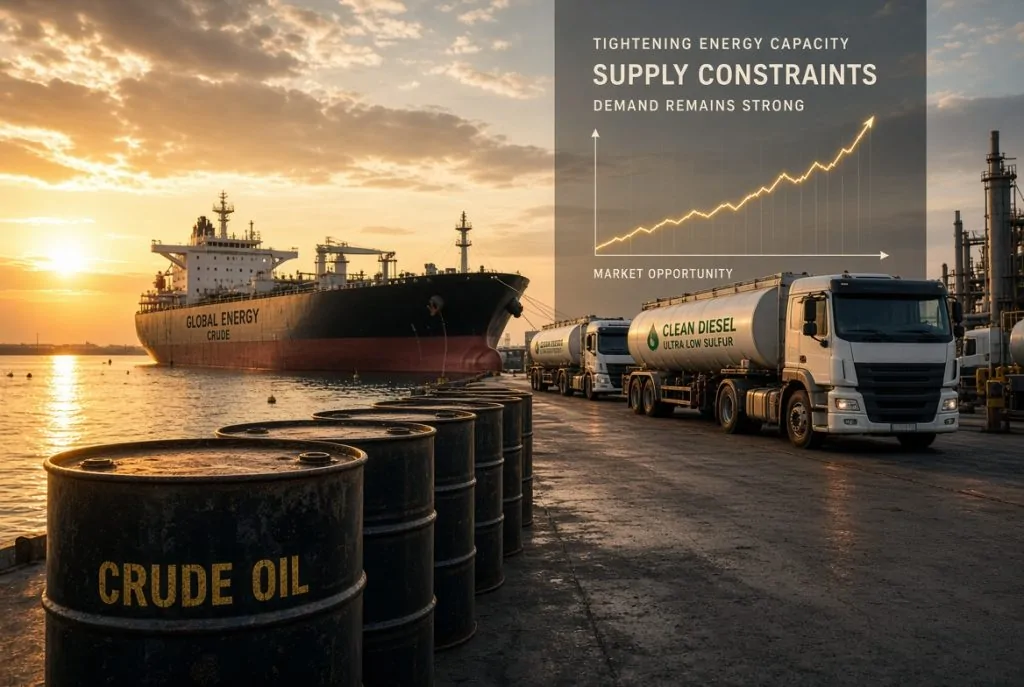
There’s a flip side to this story: when there is no spare capacity, every disruption gets settled by the market, i.e. higher prices.
This means that the companies that own the scarce assets collect the difference: the tanker owners, whose ships are tied up a LOT longer on every voyage around the war, and the companies that still have oil in the ground.
And owning a piece of those companies yourself is a great way to protect yourself from higher prices and inflation.
P.S. Schiff Sovereign’s investment research newsletter, Strategic Assets, exists to find exactly those companies: businesses that are already profitable, carry little or no debt, and trade cheap against the cash they’re generating.
Two oil tanker owners we featured in 2023 and 2024, when nobody wanted them, are up more than 180% and 130%, and one of them runs the ships that haul diesel. Right now we’re giving away a free sample issue so you can see what’s inside. Click here to download yours now.